
How to Install Pea Gravel: Complete DIY Guide 2026
The physical work of putting down pea gravel takes a weekend. The prep work, the right depth, the right fabric for your soil, the right base, determines whether the surface lasts two years or twenty. Most guides get the prep wrong. This one covers it correctly.
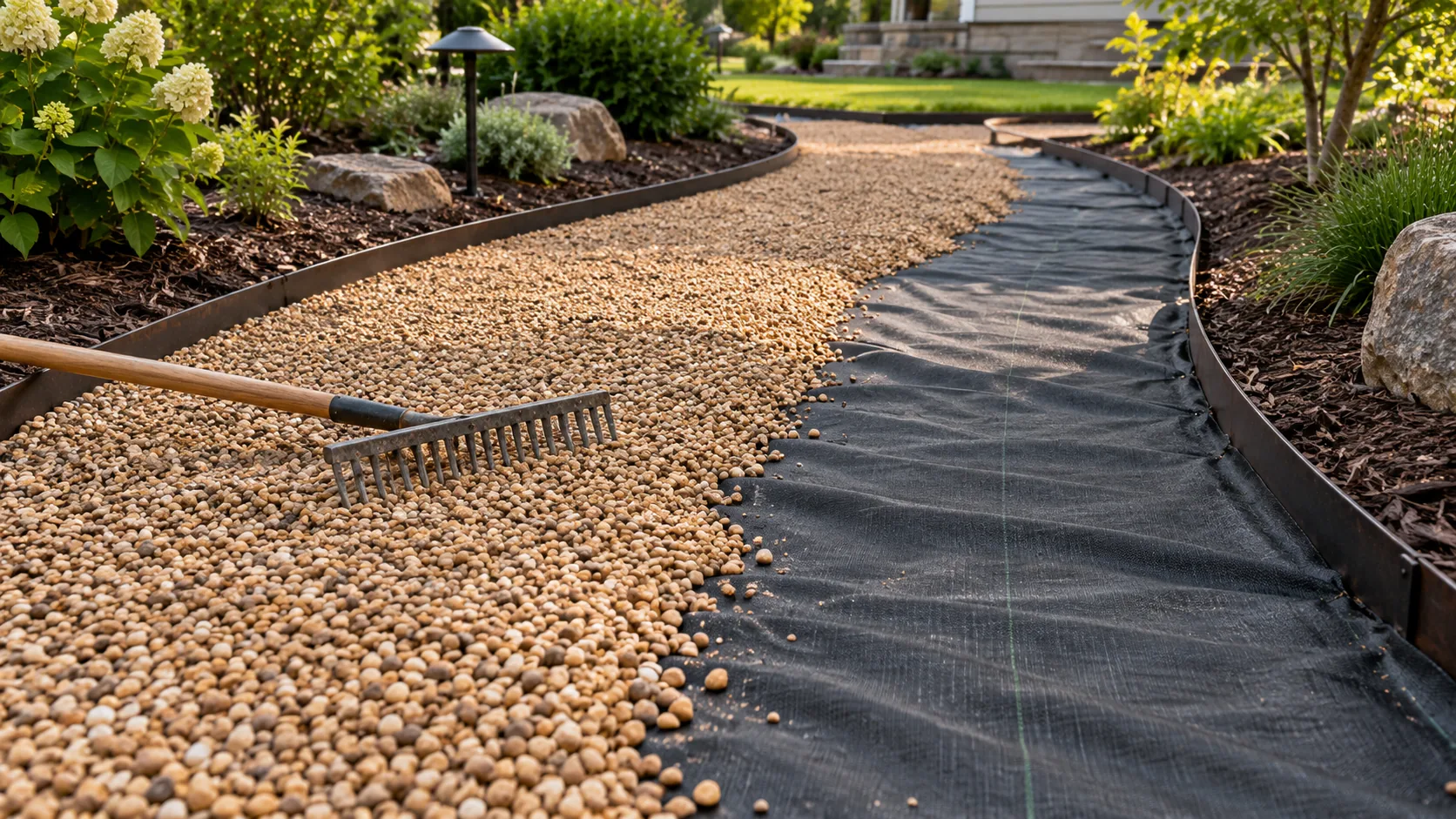
In This Guide
- Correct depth by project type
- Tools and materials checklist
- Step 1: Calculate quantities
- Step 2: Mark layout and plan drainage
- Step 3: Excavate and assess the ground
- Step 4: Landscape fabric (woven vs non-woven)
- Step 5: Spread and compact the base layer
- Step 6: Install edging
- Step 7: Spread pea gravel
- Special situations
- Time and cost by project size
- What people get wrong
- Frequently asked questions
Correct Depth by Project Type
The steps for every pea gravel installation, walkway, patio, path, or garden bed, are the same. The depths change by project type. Set your targets before buying a single bag or calling a supplier.
| Project type | Excavation depth | Base layer | Gravel layer | Total depth |
|---|---|---|---|---|
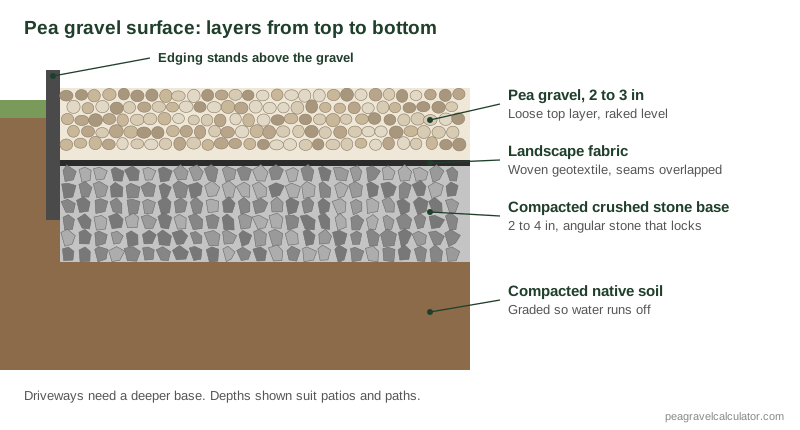
| Decorative bed or border | 2–3 in | None needed | 1–2 in | 2–3 in |
| Garden path (light use) | 4 in | 1–2 in crushed stone | 2 in | 4 in |
| Garden path (regular use) | 5 in | 2 in crushed stone | 3 in | 5 in |
| Patio or seating area | 5–6 in | 2 in crushed stone | 3 in | 5–6 in |
| Driveway (passenger cars) | 6–7 in | 4 in compacted base | 2–3 in | 6–7 in |
Add 1 inch to any excavation figure to account for settling in the first season. For driveway installation with heavy vehicles, see the driveway guide. Driveways need a more detailed treatment than this general guide covers.
Tools and Materials Checklist
| Item | Needed for | Notes |
|---|---|---|
| Tape measure and stakes | All projects | Mark area before ordering anything |
| String line | All projects | Straight-edge guidance for excavation |
| Spray paint or garden hose | All projects | Marking curves and shapes on ground |
| Flat-edge spade | All projects | Clean vertical excavation walls at edges |
| Round-point shovel | All projects | Loosening and moving soil |
| Wheelbarrow | All projects | Moving base stone and gravel |
| Metal landscape rake | All projects | Spreading and leveling both layers |
| Hand tamper | Paths and small patios | Compacting base layer, ~$30 to buy |
| Plate compactor | Large patios and driveways | Rent for $65–85/day, essential for large areas |
| 4oz landscape fabric | All projects | Woven for sandy/loam soil, non-woven for clay; see Step 4 |
| 6-inch landscape staples | All projects | One every 12–18 inches along seams and edges |
| Steel or composite edging | All except decorative beds | Install before gravel, not after |
| Edging stakes | All edged projects | One stake every 2 feet |
| Crusher run base (#3 or crusher run) | Paths, patios, driveways | Angular, compacts solid. Not rounded pea gravel |
| 3/8 inch washed pea gravel | All projects | Specify washed; unwashed contains clay fines |
| Garden hose with mist setting | All projects | Moistening base before compaction, settling gravel after spreading |
Step 1: Calculate Quantities Before Ordering
Order the wrong amount and you either run short on the last section or spend an afternoon moving surplus to the back of the property. Calculate before you call the supplier.
If you are ordering in bulk, the delivery guide covers truck sizes, minimum loads, and how to prepare the drop spot.
For the gravel layer, use the coverage calculator at your chosen depth. For the base layer, run the same calculator at base depth. The formula is identical. Add 10% to both figures before ordering.
Worked example: 12×14 ft patio with 3-inch gravel and 2-inch base
Gravel: 12 × 14 × (3 ÷ 12) = 42 ft³ = 1.56 yd³ × 1.10 = 1.71 yd³ to order
Base: 12 × 14 × (2 ÷ 12) = 28 ft³ = 1.04 yd³ × 1.10 = 1.14 yd³ to order
For the full material cost at your supplier's price, use the cost calculator. For the exact bag count if you're buying bagged rather than bulk, use the bags calculator.
Delivery timing matters. Order base stone and pea gravel for the same weekend. Base stone arrives and gets spread on day one. Pea gravel arrives on day two after the base is compacted. A 3-ton pile left in a driveway for several days becomes a hazard and a neighbor complaint. Book both deliveries from the same supplier if possible and ask for base stone first.
Step 2: Mark Layout and Plan Drainage
Spray paint or a garden hose both work for marking the area on the ground. For straight lines, use a taut string between stakes. For curves, a hose lets you test multiple shapes before committing. Once the excavation starts, adjustments cost time.
Standard path widths: 2 feet minimum for single-file walking, 3 to 4 feet for two people side by side, 5 feet for wheelchair accessibility. Patios need at least 10×10 feet for two chairs and 12×14 feet for a table with four chairs. Measure your actual outdoor furniture on the lawn before deciding. The size that looks right on paper always feels small when the furniture arrives.
Before you pick up a spade, identify the drainage slope. The finished pea gravel surface needs a 1/4-inch drop per foot of run, directing water away from any structure. On a 12-foot-wide patio, that means the far edge sits 3 inches lower than the house side. Measure and mark this now. Setting it later is much harder.
Step 3: Excavate and Assess the Ground
Excavation quality determines everything that follows. Three things matter:
Depth. Dig to the total required depth from the table above, plus 1 inch for settling. Use a flat-edge spade for the walls at the edges. Clean vertical walls support the edging properly and keep the surface boundary sharp.
Slope. Grade the bottom of the excavation to match the drainage pitch you planned in Step 2. Flat-bottomed excavations hold water under the gravel. After heavy rain, that trapped water undermines the base layer from below and causes settling. Even 1/4 inch per foot prevents this entirely.
Subgrade condition. Remove all sod, roots, and organic material down to native soil. Look for soft spots. Areas where the excavation floor gives when you step on it. Compact soft spots with a tamper, or fill with a thin layer of crusher run and compact before proceeding. A soft spot under a garden path becomes a depression within one season.
The excavated soil needs to go somewhere. A 12×14 patio at 5 inches deep removes roughly 8 to 9 cubic feet of material. A noticeable pile. Use it to fill low spots elsewhere in the yard, build raised bed walls, or arrange collection. Don't leave it next to the project where it will get accidentally walked back in.
Step 4: Landscape Fabric: Woven vs Non-Woven
The most common question at this stage is what to put under pea gravel. Most installation guides say "use woven landscape fabric" or "use non-woven landscape fabric" without explaining the difference. Both instructions are right in the right situation. Here is the actual distinction:
| Fabric type | Construction | Tensile strength | Water drainage | Best for |
|---|---|---|---|---|
| Woven polypropylene (4oz+) | Interlaced slit-film strands | High, resists tearing under load | Good initially, may slow on clay over time | Sandy and loam soils, high-traffic areas |
| Non-woven polypropylene (4oz+) | Heat-bonded random fibers | Lower tensile strength | Excellent, fibers maintain flow even on clay | Clay soils, drainage-critical areas |
On clay soil, non-woven fabric is the correct choice. Clay swells when wet and can push fine particles upward through woven fabric over several years. Non-woven fabric's randomly bonded fiber structure maintains drainage flow even as clay particles press against it.
On sandy and loam soil, woven fabric's higher tensile strength holds better under the repeated load of foot and vehicle traffic. The slightly lower drainage rate doesn't matter because sandy soil drains freely below the fabric anyway.
Fabric weight matters too. The 4oz minimum is non-negotiable for any project with foot traffic. Lighter fabrics tear under edging stakes, shift under base stone spreading, and degrade faster under UV exposure at edges. Cheap fabric costs more in the long run when it needs replacing.
Installing the fabric correctly
Lay fabric across the entire excavated area, running from edge to edge. Where two sheets meet, overlap by at least 12 inches. Not butted together. Secure with 6-inch landscape staples every 12 to 18 inches along all seams and edges. Fold excess fabric up against the excavation walls. The edging stakes will capture it in Step 6, preventing the edges from pulling up over time.
One thing all competitors miss: fabric over clay soil belongs directly on the clay, not on a sand layer. Sand placed over clay creates what soil engineers call a perched water table. Water passes through the gravel and fabric, hits the sand, but then cannot drain through the clay below fast enough, so it saturates the sand layer. The result is a soggy base that shifts and fails. Fabric directly on clay, then crushed stone base directly on fabric.
Step 5: Spread and Compact the Base Layer
The base layer carries structural load for paths and patios. Spread it wrong and it settles under traffic regardless of how carefully you laid the gravel on top.
The rule that no competitor explains clearly: compact in 2-inch lifts, never all at once. Spreading 4 inches of crusher run and running a plate compactor over it once produces a surface crust over a loose interior. Under foot and vehicle traffic, that loose interior settles and creates ruts within one season despite the surface initially feeling solid. Two 2-inch compacted lifts produce genuine density throughout.
Wet each lift lightly with a garden hose mist before compacting. Slightly moist material compacts 30 percent denser than bone-dry material. Too much water turns it to mud. A light surface mist is all you need.
When to use a plate compactor vs hand tamper: A hand tamper works for paths under 50 square feet and decorative areas with no vehicle traffic. For anything larger, or anything that will take regular foot traffic, rent a plate compactor. The difference in compaction density is significant. A hand tamper produces adequate results for light-use paths and that is roughly its limit.
After compacting the final lift, the base should feel completely solid underfoot with no give. Walk across it in different directions. Any soft spot means incomplete compaction. Go back over it before proceeding to edging.
Step 6: Install Edging
Edging is not decorative. It is structural. A pea gravel path without perimeter containment scatters into the adjacent lawn within weeks of the first use regardless of how carefully the gravel was spread.
Steel edging is the most durable option for straight runs and gentle curves. It resists frost heave better than composite, holds its position under edging stakes, and lasts decades. Composite and recycled plastic edging work well for tighter curves and areas where the industrial look of metal is unwelcome. Timber edging, railway sleepers, pressure-treated timber, provides the most visual weight and works for formal bordered paths and patios.
Staking interval is critical. One stake every 2 feet. Every 3 feet leaves the edging flexible enough to bow outward under gravel pressure over time. Every 2 feet keeps it rigid.
Height setting is the most important measurement in the whole installation. The top of the edging must sit at exactly the finished surface height. Base depth plus planned gravel depth. Edging set too low allows gravel to roll over it. Edging set too high creates a trip hazard and looks unfinished. Get this right before any gravel goes down.
Capture the folded fabric edges under the edging stakes as you install them. This prevents the fabric from pulling upward at the edges over time, which exposes it and allows gravel to work under it.
Step 7: Spread Pea Gravel
Whether you call it how to lay pea gravel, how to put down pea gravel, or how to spread pea gravel. This final step is the same. Always order washed 3/8-inch pea gravel. Unwashed material contains clay fines that reduce drainage, compact poorly, and eventually create a muddy layer on the surface after rain. The price difference between washed and unwashed is small. The performance difference is significant.
Dump the gravel in small piles across the area, then rake from pile to pile. Starting from one end and raking the entire surface tends to create an uneven finish. Small piles distributed across the area give you better control of the final depth.
Do not compact pea gravel. The rounded stones do not compact like angular stone. Compaction simply pushes them down into the base layer rather than locking them together. Raking pea gravel level is all the finishing required.
After raking pea gravel, use a straight-edge board across the edging to check that the surface sits 1/4 to 1/2 inch below the edging top. Gravel sitting at or above edging height scatters onto adjacent surfaces immediately. Gravel sitting more than 1/2 inch below edging height looks unfinished and creates a gap where debris accumulates.
Mist the surface lightly with a hose after spreading. This helps the stones settle into their final position and reveals any low spots that need a small additional spread. The surface will settle slightly further in the first season. Plan a small top-up application 6 to 12 months after installation.
Special Situations
These pea gravel scenarios come up on real projects: slopes, existing concrete, existing gravel, backyard trees, and fence posts. Each needs a slightly different approach.
How to install pea gravel on a slope
On slopes up to 5 percent grade (3 degrees), install pea gravel normally with a proper base and edging. On slopes of 5 to 10 percent, add plastic honeycomb stabilization grids, geocells, before spreading gravel. The grids hold individual stones in cells that prevent directional migration downhill. On slopes above 10 percent, pea gravel is unsuitable as a surface. Switch to angular crusher run throughout.
To measure your slope: place a 4-foot level horizontally from the high end. Measure the gap between the level and the ground at the low end. Divide that gap in inches by 48, then multiply by 100 to get the percent grade. A 2.5-inch gap over 48 inches = 5.2 percent grade, which puts you in stabilization grid territory.
How to install pea gravel over concrete
Check first that the concrete has adequate drainage. Either weep holes at the low end or a minimum 1 percent slope across the surface. Perfectly flat sealed concrete traps water under the gravel and creates a persistent damp layer.
Lay non-woven 4oz fabric over the concrete. Tape the edges to the concrete with exterior-grade tape to prevent lifting. Spread gravel directly on the fabric. No base layer needed since the concrete provides structural support. Minimum 2 inches of gravel depth to prevent fabric exposure at traffic points. Install edging around the perimeter as normal.
How to install pea gravel over existing gravel
Rake the existing gravel level and check the depth. If the existing layer is under 1.5 inches deep, add enough new gravel to bring the total to 2 to 3 inches. If the existing gravel has mixed with soil, the surface feels muddy when wet. This indicates the fabric has failed and the entire surface needs stripping, fabric replacement, and re-gravelling before any top-up.
How to install pea gravel around trees
Leave an 18-inch fabric-free zone around the base of any established tree. Landscape fabric under gravel reduces soil mycorrhizal fungi activity significantly over several years, limiting the tree's ability to absorb water and nutrients. Gravel can go up to the edge of this zone without fabric. The gravel layer alone suppresses most weeds adequately at that distance from the trunk.
How to install pea gravel around fence posts
Gravel against fence posts accelerates rot in wooden posts by trapping moisture against the wood. Keep pea gravel 4 to 6 inches away from wooden post bases. Use metal post bases or concrete collars where gravel contact is unavoidable. Steel and composite fence posts have no rot risk and can contact gravel without concern.
Time and Cost Estimates by Project Size
| Project | Area | DIY time | People needed | Material cost |
|---|---|---|---|---|
| Small garden path | 30 sq ft | 2–3 hours | 1 | $35–$65 |
| Standard path (3×20 ft) | 60 sq ft | 3–4 hours | 1 | $70–$130 |
| Small patio (10×10 ft) | 100 sq ft | 5–6 hours | 1–2 | $120–$220 |
| Standard patio (12×14 ft) | 168 sq ft | 6–8 hours | 2 | $200–$370 |
| Large patio (16×20 ft) | 320 sq ft | Full weekend | 2 | $380–$700 |
Renting a plate compactor adds $65 to $85 but cuts compaction time by more than half on any project over 100 square feet. For projects above 200 square feet, the rental pays for itself in saved time. For small paths under 50 square feet, a hand tamper is sufficient and the rental isn't worth it.
For a full breakdown of pea gravel material costs including base stone, fabric, and edging, see the 2026 cost guide.
What People Get Wrong
Six mistakes that account for most pea gravel installation failures in the first season.
Related Calculators
Coverage Calculator
Get exact cubic yards, tons, and bags for your project dimensions before calling the supplier.
CalculatorBags Calculator
Buying bagged? Get the exact 50-lb bag count for any area and depth with waste factor included.
CalculatorCost Calculator
Enter your supplier's price per ton or yard to get the total material cost for your project.
Related Guides
Pea Gravel Sizes
Which size to order for paths, patios, driveways, and play areas. And why 3/8-inch is usually right.
MaintenanceMaintenance Guide
Top-up schedule, weed control, edging repair, and when the whole surface needs replacing.
GuidePea Gravel Driveway
Driveway installation goes deeper than this guide. Traffic class, slope limits, climate zones, snow removal.
4 Most Common Pea Gravel Installation Mistakes
Mistake 1. Skipping the base layer to save money. The base layer, 2 inches of compacted #57 crushed stone, costs approximately $25 to $45 per cubic yard. On a 200 sq ft patio that is one cubic yard: $25 to $45 plus delivery. Homeowners who skip this to save cost install pea gravel directly onto native soil. The gravel sinks into the soil within one to two seasons, the surface becomes uneven, and the entire installation must be removed and rebuilt correctly. The base layer cost is always less than the cost of rebuilding.
Mistake 2. Installing on undisturbed grass without excavating. Covering grass with landscape fabric and pea gravel without excavating produces a raised surface that drains toward the lawn edge and a grass layer beneath the fabric that continues to grow. The grass pushes through fabric seams and edges within months. Always excavate to the correct depth. Remove all vegetation, roots, and organic material before any base or fabric goes down.
Mistake 3. Buying non-woven fabric for a gravel surface. Non-woven landscape fabric is designed for mulch beds where its water-permeable surface works adequately. Under pea gravel, the gravel weight and foot traffic tears non-woven fabric within two to three seasons. The torn fabric becomes entangled in the gravel and is difficult to remove. Woven geotextile at 3 oz per square yard costs slightly more and lasts 15 to 20 years. It is always the correct choice under pea gravel.
Mistake 4. Not setting a drainage slope before installation. A flat pea gravel surface retains water after rain. In clay-soil areas this creates puddles that persist for days. In freeze-thaw climates, standing water freezes beneath the gravel and heaves the surface by frost action over winter. The drainage slope, 1 to 2 percent away from structures, must be set during excavation. It cannot be corrected after the base and gravel are installed without starting over.
Frequently Asked Questions
How do you install pea gravel step by step?
What do you put under pea gravel?
Do you need landscape fabric under pea gravel?
How deep should pea gravel be?
What is the best base for pea gravel?
How do you install pea gravel on a slope?
How do you install pea gravel over concrete?
Do you need edging for pea gravel?
How long does it take to install pea gravel?
How do you install pea gravel on clay soil?
How do you stop pea gravel from spreading?
Can you install pea gravel without digging?
What size pea gravel is best for installation?
Sources & Methodology
- USDA NRCS: CPS Access Road (Code 560): gravel surface and aggregate installation standards
- ASTM C33/C33M: aggregate gradation and size specifications for construction materials
- USGS: Natural Aggregates Statistics: density reference data for construction aggregates
Last reviewed: October 2026 · Full methodology