
Pea Gravel Sizes: Which Size for Every Project
Most suppliers stock one size and call it pea gravel. That is fine for most projects. But choosing the wrong grade for a specific use costs you time and material. This guide covers every size, every project, and the few situations where the wrong choice causes a real problem.
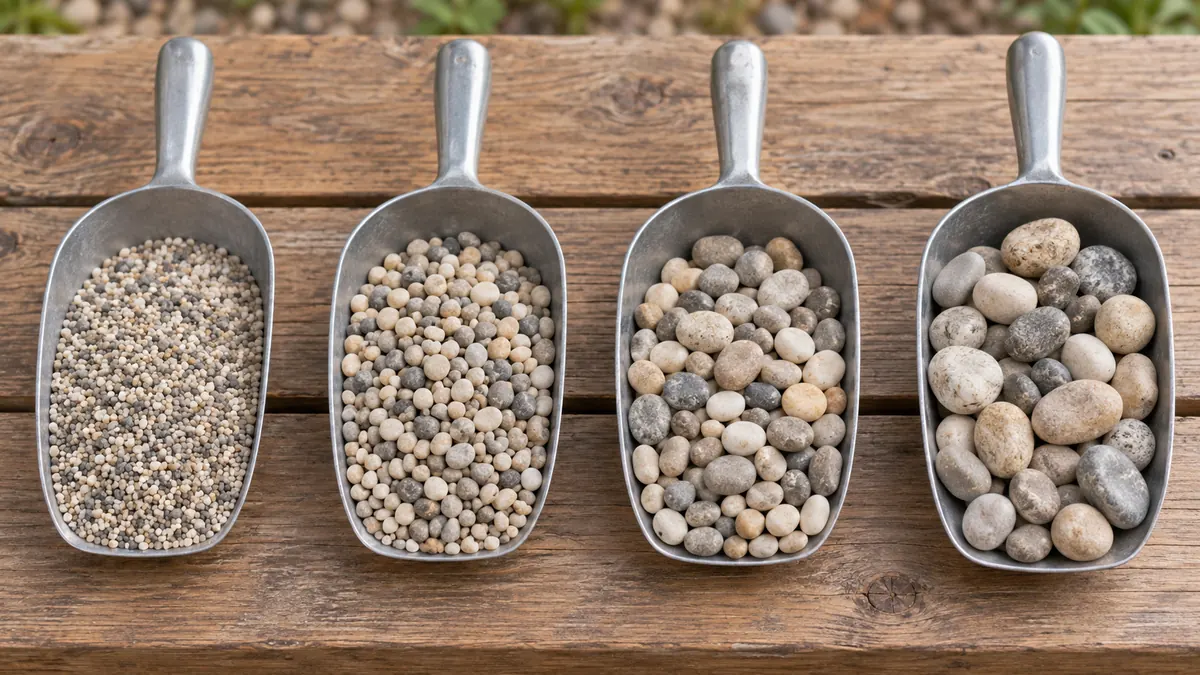
In This Guide
- All sizes at a glance
- 1/8 inch (3mm), fine grade
- 1/4 inch (6mm), medium grade
- 3/8 inch (9.5mm), standard grade
- 5/8 inch (16mm), coarse grade
- Right size by project, complete guide
- Depth and coverage by project
- Mixing sizes: 3 strategies that work
- How size affects drainage
- What to say when you order
- Frequently asked questions
All Sizes at a Glance
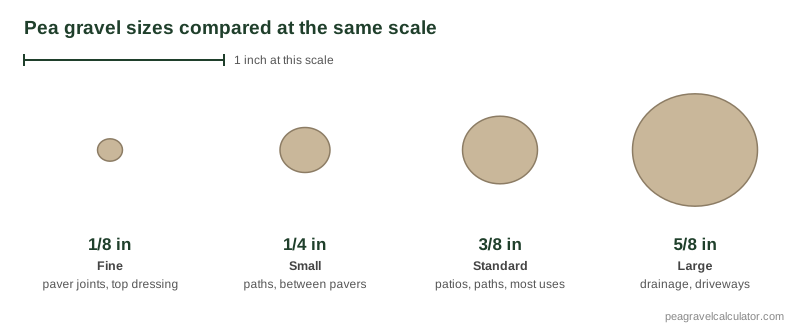
| Size | Inches | Metric | ASTM equiv. | Best for | Not suitable for |
|---|---|---|---|---|---|
| Fine | 1/8 in | 3mm | #10 / fine screen | Zen gardens, play surfaces, between pavers | Driveways, paths with regular traffic |
| Medium | 1/4 in | 6mm | #89 grade | Flower beds, barefoot paths, aquariums, pool surround | Driveways, heavy-traffic paths |
| Standard | 3/8 in | 9.5mm | #8 stone | Paths, patios, dog runs, driveways, garden beds | Aquariums (too large), septic fields (too small) |
| Coarse | 5/8 in | 16mm | #7 stone | French drains, pipe bedding, drainage swales, heavy driveways | Barefoot surfaces, play areas |
This pea gravel size chart covers all four standard grades. The ASTM D448 numbers come from the aggregate gradation standard used by contractors and suppliers. When a professional specifies "#8 stone" for a decorative path, they usually mean what a homeowner calls 3/8-inch pea gravel. Understanding this lets you communicate clearly at any supply yard.
1/8 Inch (3mm): Fine Grade
Fine-grade pea gravel has a soft, almost sand-like appearance in mass but the individual stones are clearly distinct. The texture is noticeably smoother underfoot than any larger grade.
Where it works well: Zen gardens and raked gravel features use the 1/8-inch grade specifically because it holds a raked line cleanly. Larger stones do not. Playground surfaces benefit from it because the fine texture creates a soft, cushioning layer that provides some fall protection. Between stepping stones and paver joints, it fills gaps without looking chunky.
Where it causes problems: Fine-grade scatters more easily than any other size. On slopes, it washes out in heavy rain. In high-traffic areas, foot traffic kicks it outward within days. Without rigid perimeter edging and landscape fabric underneath, a 1/8-inch installation requires constant raking and regrading. Do not use it for paths that handle regular traffic without a geocell stabilization grid.
Aquarium note: 1/8-inch grade is sometimes used in fish tanks but can cloud the water initially. The preferred aquarium size is 1/4 inch. See the aquarium section below for the full reasoning.
1/4 Inch (6mm): Medium Grade
This grade sits between the fineness of the 1/8-inch and the practicality of the standard 3/8-inch. It has a refined look that suits formal gardens, pool surrounds, and areas where aesthetics matter as much as function.
Where it works well: Flower beds and borders look better with 1/4-inch because smaller stones do not visually compete with low-growing plants. Pool surrounds benefit from it. The size is comfortable on bare feet, drains pool splash immediately, and does not scatter as readily as the 1/8-inch grade. Garden paths with moderate foot traffic hold up well with 1/4-inch if edging is installed correctly. For aquariums, this is the optimal size. See the project section below.
Where it causes problems: Under vehicle tires, 1/4-inch scatters badly. It works for very light driveway use, a car parking pad with a couple of vehicles per day, but fails under regular traffic. On slopes above 5 percent grade, it needs a stabilization grid.
The 1/4-inch grade is harder to find in bulk at standard landscape supply yards. Many yards stock only 3/8 inch as their standard "pea gravel." Call ahead and confirm availability before ordering.
3/8 Inch (9.5mm): Standard Grade
This is the default pea gravel size. And for most people the best pea gravel size for their project. When a supplier says "pea gravel" with no additional specification, this is what arrives. It suits the widest range of applications and is the most available size at landscape yards, home improvement stores, and online delivery services.
The 3/8-inch grade is the right choice because it balances three competing demands: stability under foot and vehicle traffic, comfort underfoot, and drainage performance. Smaller sizes drain just as well but scatter too easily. Larger sizes stay put but feel uncomfortable underfoot for barefoot use.
Where it works well: Garden paths, patios, driveways (passenger cars), dog runs, garden beds, fire pit surrounds, pool deck surrounds, and around-house foundation drainage. If you are unsure which size to use for a landscaping project, start here.
Where it does not work: Aquariums, too large, creates waste traps. Septic drain fields, too small, migrates into pipe perforations. Inside fire pits. Explosive hazard when heated.
When ordering the standard grade in bulk, specify: "washed 3/8-inch pea gravel." The word "washed" is not optional. Unwashed material carries clay fines that destroy drainage performance and create a muddy surface after rain. See the full explanation in the what is pea gravel guide.
5/8 Inch (16mm): Coarse Grade
The coarse grade sits at the upper boundary of what the industry calls pea gravel. Above 5/8 inch, stones are typically classified as small river rock rather than pea gravel.
Where it works well: French drains, drainage swales, foundation perimeter drainage, and pipe bedding applications. Coarse-grade stones create more void space, which means faster water movement through the aggregate layer. For any application where drainage rate is the primary concern, 5/8 inch outperforms the standard grade.
Heavy-use driveways serving delivery vehicles, equipment, or frequent traffic benefit from the coarser grade. It scatters less under heavier loads than 3/8 inch.
Where it does not work: Any surface where people walk barefoot. The 5/8-inch stones feel cobbly underfoot. Not sharp, but uneven enough to be uncomfortable for extended barefoot use around pools or in play areas.
Important French drain note: Pea gravel at 5/8 inch works for light decorative drainage channels and simple foundation drains. For heavy-load French drains that must handle large volumes of water, around a basement, beneath a driveway, or in a saturated yard, angular #57 crushed stone (3/4 inch) outperforms pea gravel. The angular edges of crushed stone interlock around the perforated pipe and resist migration into the pipe openings better than rounded stones. The pea gravel French drain guide covers when each material is appropriate.
Right Size by Project: Complete Guide
Driveway
Standard residential driveways serving passenger cars and light trucks: 3/8 inch. This size stays in place reasonably well under tire pressure and gives the driveway a clean, finished look.
High-traffic driveways or driveways used by vans, trucks, or regular delivery vehicles: 1/2 to 5/8 inch. The coarser grade displaces less under heavier loads and extends the time between raking and regrading.
Never use 1/8 or 1/4 inch for a driveway. Both scatter immediately under vehicle tires. Within a few weeks, all the material migrates to the edges and the center of the drive is bare base stone.
Pea gravel always needs a 4-inch compacted crushed stone base under it for driveways. The base carries the structural load. The pea gravel is a surface-only material. For the complete driveway build specification including base depth by vehicle class, see the pea gravel driveway guide.
Patio and seating area
Standard patio: 3/8 inch at 3 inches deep. Comfortable to walk on in shoes or sandals, stable enough for outdoor furniture, and the depth keeps weed suppression effective for several seasons before a top-up is needed.
Formal patio where appearance is the priority: 1/4 inch at 2.5 to 3 inches deep. The smaller stone gives a neater, more uniform surface that suits furniture legs better than the slightly bumpier 3/8-inch surface.
The patio calculator gives exact quantities at either depth for any patio dimensions.
Garden paths and walkways
Paths in shoes or light footwear: 3/8 inch at 2 to 3 inches deep. Stays in place best, handles regular foot traffic well, works with or without stepping stones.
Barefoot paths around pools, spa areas, or garden relaxation zones: 1/4 inch at 2 to 2.5 inches deep. Noticeably softer underfoot than the standard grade. Worth the slightly higher effort to source it.
Secondary garden paths with minimal traffic: 1/4 or 3/8 inch at 2 inches. Either size works. Choose based on what your supplier stocks in bulk.
Dog run and pet areas
Use 3/8 to 1/2 inch for dog runs. This size range is large enough that individual stones rarely lodge in paw pads or between toes, yet small enough that urine drains straight through rather than pooling.
Dog size matters. For toy breeds and puppies under three months, use 1/2 inch minimum. The standard 3/8-inch stones are small enough to swallow. For medium and large breeds, 3/8 inch is fine. Giant breeds have wide paw pads that distribute weight across multiple stones. The 3/8 inch size works well regardless of weight.
Install at 3 to 4 inches deep over a compacted crushed stone base with landscape fabric separating the two layers. The pea gravel dog run guide covers the full build including drainage slope and odor management.
Playground surfacing
Use 1/8 to 1/4 inch at 6 to 9 inches deep.
The CPSC Handbook for Public Playground Safety (2024 edition) sets these minimum depths for pea gravel as a loose-fill safety surface:
| Equipment fall height | Minimum depth | Notes |
|---|---|---|
| Up to 4 ft | 6 inches | Maintain during use; compaction reduces effective depth |
| 4 to 6 ft | 9 inches | Check depth monthly in high-traffic zones |
| 6 to 8 ft | 9 inches | Upper limit for pea gravel as safety surface |
| Above 8 ft | Not recommended | Use engineered wood fiber or rubber for these heights |
Two warnings that most guides miss:
Choking hazard. Pea gravel is not appropriate for children under 3 years old regardless of stone size or depth. All grades in the pea gravel range are small enough to be swallowed. Use engineered wood fiber or rubber mulch in any area accessible to toddlers.
ADA accessibility. Loose pea gravel does not meet ADA firmness and stability standards for accessible routes. If the playground requires accessible surfacing, consult a certified playground safety inspector before specifying pea gravel.
French drain and drainage systems
For light residential French drains alongside a path or garden bed: 3/8 to 5/8 inch washed. The rounded stones provide adequate drainage for decorative channels and simple foundation perimeter drains.
For load-bearing French drains managing basement seepage, yard flooding, or driveway drainage: angular #57 crushed stone (3/4 inch). Angular stone interlocks around the perforated pipe, resists migration into pipe openings, and maintains its void ratio under load better than rounded pea gravel. This is the honest answer that most guides skip.
Never use 1/8 or 1/4 inch in any French drain. Both sizes migrate through pipe perforations and clog the system within one to two seasons.
Aquarium and fish tank
Use 1/4 inch (6mm) for aquarium substrate. Here is why the size matters specifically:
Standard 3/8-inch pea gravel creates gaps between stones that are large enough for uneaten food and fish waste to fall into and decompose out of reach of a gravel vacuum. The waste accumulates, spikes ammonia, and creates a water quality problem that is hard to resolve without stripping and replacing the substrate.
Fine 1/8-inch grade can cloud the water when first installed because the small particles disturb easily. It also creates an almost solid surface that some bottom-dwelling fish, corydoras, loaches, cannot sift through naturally.
The 1/4-inch grade sits in the middle: clean enough to siphon, large enough to allow normal fish behavior, fine enough to look natural.
Whatever size you use: buy natural, uncoated stone and rinse three to four times before placing it in the tank. Check that it is not limestone-based if your fish need a neutral or acidic pH. Limestone raises water pH. Granite and quartzite grades are pH neutral.
Fire pit surround
Use 3/8 inch at 3 to 4 inches deep as the surface material around a fire pit. It is comfortable on bare feet during summer evening gatherings, drains rain quickly so the area is ready to use after wet weather, and the natural colors suit outdoor fire pit aesthetics.
Critical safety warning. Never place pea gravel, or any gravel, inside the fire pit bowl itself. Moisture becomes trapped inside porous and rounded stones. When the stones heat rapidly, the moisture expands and causes explosive spalling. The stones can crack or pop with enough force to cause injury. Only use fire-rated materials inside the fire pit: lava rock, fire glass, or clean washed sand. Pea gravel belongs on the surrounding ground area, not in the burn zone.
Garden beds: flower, herb, vegetable
For flower beds: 1/8 to 1/4 inch at 1.5 to 2 inches deep. Smaller stones create a neater backdrop for low-growing plants without visually competing with the flowers. The finer surface retains slight moisture longer than the coarser grade. Useful in dry climates.
For herb gardens: 1/4 inch at 2 inches. Most herbs prefer good drainage. The 1/4-inch grade provides it while keeping the surface tidy.
For raised vegetable bed drainage: a 2-inch layer of 1/4 to 3/8 inch at the very bottom of a raised bed before adding soil improves drainage in containers prone to waterlogging. This is not a mulch application. The gravel goes under the soil, not on top of it.
For paths between raised beds: 3/8 inch at 2 to 3 inches deep. Handles regular foot traffic, stays clean when muddy shoes walk through, and drains irrigation runoff between beds cleanly.
Around house foundations
A 6-inch-wide, 3-to-4-inch-deep gravel apron along a foundation wall improves surface drainage and reduces foundation moisture. Use 3/8 to 5/8 inch washed. The coarser grade drains faster, but 3/8 inch is adequate for most residential situations.
Keep pea gravel 6 inches away from wooden siding, door frames, and structural timber. Prolonged contact with moist gravel accelerates wood rot.
Pool surround
Use 3/8 inch around pool edges and in surrounding garden areas. The smooth texture is comfortable on bare feet, drains pool splash immediately, does not become slippery when wet the way sealed concrete does, and never needs resealing.
Shed base and under structures
For a gravel base under a small shed or outbuilding: 3/8 inch at 3 to 4 inches, leveled and compacted lightly. Gravel under a shed provides drainage and prevents the timber base from sitting in standing water.
Between pavers and stepping stones
Use 1/8 inch for filling joints between pavers or stepping stones. The fine grade sits in the joint without looking chunky and can be brushed in easily. Larger grades look wrong in narrow joints and do not stay put.
Erosion control
On gentle slopes under 5 percent grade: 3/8 inch with proper fabric and edging provides adequate surface protection against rain erosion. On steeper slopes, pea gravel alone is inadequate. The rounded stones roll downhill. Combine with a geocell stabilization grid on slopes above 5 percent, or switch to angular crusher run for serious erosion control requirements.
Depth and Coverage by Project
How deep should pea gravel be? The answer depends on the project. The table below gives the recommended depth and size for every application. Coverage figures use our verified density formula: 100 lb/ft³ · 1.35 tons/yd³. All figures include a 10% waste factor. Use the coverage calculator for exact quantities at your specific dimensions.
| Project | Recommended size | Depth | 1 ton covers (approx) |
|---|---|---|---|
| Flower bed / border | 1/8–1/4 in | 1.5–2 in | 130–160 sq ft |
| Herb garden bed | 1/4 in | 2 in | 115–130 sq ft |
| Vegetable garden path | 3/8 in | 2–3 in | 80–115 sq ft |
| Garden path (light use) | 1/4–3/8 in | 2 in | 100–115 sq ft |
| Garden path (regular use) | 3/8 in | 2–3 in | 80–115 sq ft |
| Patio / seating area | 3/8 in | 3 in | 80 sq ft |
| Fire pit surround | 3/8 in | 3–4 in | 60–80 sq ft |
| Dog run | 3/8–1/2 in | 3–4 in | 60–80 sq ft |
| Playground surface | 1/8–1/4 in | 6–9 in | 25–40 sq ft |
| Driveway surface layer | 3/8 in | 2–3 in | 80–115 sq ft |
| Pool surround | 3/8 in | 2–3 in | 80–115 sq ft |
| Around foundation | 3/8–5/8 in | 3–4 in | 60–80 sq ft |
| Under shed | 3/8 in | 3–4 in | 60–80 sq ft |
| French drain (light) | 3/8–5/8 in | Per trench depth | Varies by trench |
| Between pavers (joint) | 1/8 in | Fill joint | High coverage, small qty |
Mixing Pea Gravel Sizes: 3 Strategies That Work
Suppliers sometimes treat mixed-size requests as unusual, but the technique is practical and produces better results than a single size in certain situations.
Strategy 1: Base layer + surface layer. Spread 3/8-inch grade as a base layer at 2 inches, then top with 1/4-inch at 1 inch. The coarser base provides stability and drainage. The finer surface gives a refined, uniform appearance. Works well for formal patios and decorative paths where appearance matters most.
Strategy 2: Path + joint fill. Use 3/8 inch for the main path surface and 1/8 inch to fill the gaps between stepping stones or pavers set into the path. The two textures complement each other and the joint fill makes the stepping stones look intentional rather than floating.
Strategy 3: Zone differentiation. In a large garden area, use 1/4 inch close to planting beds and delicate groundcovers where visual refinement matters, and 3/8 inch on the main walking routes. Separate the zones with steel edging so the sizes stay distinct.
How Size Affects Drainage
The drainage difference between sizes is real but smaller than most people expect.
Pea gravel holds its void space because the rounded stones never fully interlock. They always leave gaps between them. At 3/8 inch, the void ratio is approximately 36%. At 1/4 inch, around 33%. At 1/8 inch, around 28 to 30%.
In practical terms: all three grades drain well for surface applications. The difference becomes meaningful only in French drain and pipe bedding applications, where water must move through the aggregate under sustained flow. For those uses, coarser is better. Which is why 3/8 to 5/8 inch is the minimum for drainage applications and angular #57 stone is the professional choice for heavy loads.
For surface landscaping, paths, patios, garden beds, the drainage difference between 1/8, 1/4, and 3/8 inch is not a deciding factor. Choose size based on project type and comfort requirements, not drainage performance.
What to Say When You Order
Most landscape suppliers carry the 3/8-inch grade as their standard product. Smaller grades are often special-order items. Call before visiting to confirm stock.
Use this phrasing at the yard or on the phone:
For most projects: "I need washed 3/8-inch pea gravel, delivered."
For flower beds or aquarium: "Do you carry washed 1/4-inch pea gravel? I need [quantity] delivered."
For Zen garden or between pavers: "Do you carry washed 1/8-inch pea gravel or pea gravel screenings?"
For heavy drainage: "I need washed 5/8-inch pea gravel, or do you have washed #57 crushed stone?"
Always specify washed. Without that word, some suppliers ship unwashed material that contains clay fines. The fines destroy drainage and create a muddy surface after the first rain.
To calculate how much to order before you call, use the coverage calculator. Enter your area dimensions and the depth from the table above. The calculator outputs cubic yards, tons, and 50-lb bag count. Add 10% before calling your supplier.
Related Calculators
Coverage Calculator
Enter your area dimensions and depth to get cubic yards, tons, and bag count. Works for any of the four pea gravel grades.
CalculatorBags Calculator
Buying bagged pea gravel from a home improvement store? Get the exact 50-lb bag count for your project with waste factor included.
CalculatorCost Calculator
Enter your supplier's price per ton or per yard to get a full project cost estimate at any size or depth.
Worked Size Selection Examples
Customer asking for "pea gravel for a patio". Correct response. The correct size is 3/8 inch washed. Not 1/4 inch (too fine, poor drainage, tracks more). Not 5/8 inch (uncomfortable underfoot for extended use). When a supplier asks "what size?" and you are unsure, 3/8 inch is the right answer for any surface application where people walk.
Customer building a French drain. Common size confusion. Many homeowners ask for pea gravel for a French drain because they have heard "gravel" is used. The correct material is #57 angular crushed stone at 3/4 inch. Not rounded pea gravel. Pea gravel in a French drain packs tighter than angular stone, reduces drainage capacity, and performs poorly compared to the correct material. The size and shape both matter for engineered drainage.
Customer with 3/8 inch gravel in a dog run and a small breed dog. The 3/8-inch size is safe for most breeds but small enough to be swallowed by toy breeds and puppies under 3 months. A customer with a Chihuahua or Yorkshire Terrier puppy should use 1/2-inch pea gravel. Most supplier bags do not label this clearly. Always ask for the size specification in millimetres or inches before purchase.
Aquarium substrate. Size confusion online. The most common online advice says "use pea gravel for aquariums" without specifying size. Standard 3/8-inch pea gravel is too large for most aquarium fish to interact with naturally and too heavy for planted tanks. The correct size for freshwater aquariums is 1/4-inch (6mm) washed smooth pea gravel. This size allows fish to move individual stones, is light enough for plant roots, and is too large to be accidentally swallowed by most fish species.
4 Pea Gravel Size Mistakes People Make
Mistake 1. Buying fine pea gravel for a driveway. The 1/8-inch and 1/4-inch grades scatter under vehicle tires immediately. A car moving at walking speed through a 1/4-inch gravel driveway throws stones onto adjacent lawn, into flower beds, and against the house. The minimum practical size for any driveway application is 3/8 inch, and 5/8 inch is better for high-traffic driveways.
Mistake 2. Using large 5/8-inch gravel for a children's play area. The 5/8-inch size is at the upper limit of what is comfortable to walk on barefoot. Children who fall on 5/8-inch gravel receive more impact per stone than they would on 3/8-inch material. For any playground or children's play area, 3/8 inch is the size that balances impact absorption with comfort.
Mistake 3. Mixing sizes from different suppliers without checking compatibility. Pea gravel from different quarries varies significantly in actual size even with the same nominal label. Mixing 3/8-inch material from two different suppliers can produce a surface with inconsistent drainage performance and visual patching. Where top-up is needed, always try to source from the same supplier to maintain visual and functional consistency.
Mistake 4. Ordering by color without specifying size. "White pea gravel" and "gray pea gravel" describe color only. Both are available in 1/4, 3/8, and 5/8-inch sizes. Many homeowners order by color and receive the wrong size for their application. Always specify both size and color when ordering: "3/8-inch white washed pea gravel" not just "white pea gravel".
Frequently Asked Questions
What sizes does pea gravel come in?
What is the standard pea gravel size?
What size pea gravel is best for a driveway?
What size pea gravel for a dog run?
What size pea gravel for a playground?
What size pea gravel for a French drain?
What size pea gravel for an aquarium?
Can you put pea gravel inside a fire pit?
Can you use pea gravel for a septic system?
What is pea gravel size in mm?
Does pea gravel size affect how much you need?
Can you mix pea gravel sizes?
What size pea gravel for raised garden beds and flower beds?
Related Guides
What Is Pea Gravel?
How it forms geologically, rock types by color, washed vs unwashed, and every use case including aquariums and dog safety.
How-ToHow to Install Pea Gravel
Once you have the right size, here is the full step-by-step: fabric by soil type, base compaction, edging height, and special situations.
GuidePea Gravel Driveway
Traffic class by vehicle weight, base depth table, slope limits, climate adjustments, and winter snow removal.
Sources & Methodology
- ASTM D448: Standard Classification for Sizes of Aggregate for Road and Bridge Construction; aggregate size designations including #8 and #89 stone grades
- CPSC Handbook for Public Playground Safety: loose-fill surfacing depth requirements by fall height (2024 edition)
- USGS: Natural Aggregates Statistics: density reference data for construction aggregates
Density formula used throughout: 100 lb/ft³ · 1.35 tons/yd³ · 0.5 ft³/bag. Locked and verified against USGS aggregate data. Full methodology
Last reviewed: October 2026