
Pea Gravel Coverage Calculator
Enter your project area and gravel depth. Get cubic yards, tons, and 50-lb bag count instantly. Results include a 10% waste factor. Use this calculator for patios, pathways, garden beds, dog runs, and any other flat area.
How the Pea Gravel Coverage Calculator Works
Most pea gravel projects start with a known area. A 12×14 ft patio, a 60 sq ft flower bed, a 90 sq ft front border. The problem is converting that area into a number your supplier understands. This calculator handles that conversion with one formula:
Then: ÷ 27 for cubic yards · × 100 lb for weight · ÷ 2,000 for tons · ÷ 0.5 for 50-lb bag count
The density figure, 100 lb per cubic foot, or approximately 1.35 tons per cubic yard, comes from USGS Construction Sand and Gravel data for loose, dry pea gravel. All conversion factors match what landscape suppliers and quarries use when they quote by the ton or cubic yard.
Sq ft per ton at this site's 1.35 t/yd³ (100 lb/ft³) density: 240 ÷ depth (inches)
Sq ft per cubic yard at the same density: 324 ÷ depth (inches)
Example at 3 inches: 240 ÷ 3 = 80 sq ft per ton, or 324 ÷ 3 = 108 sq ft per cubic yard.
If your supplier's density differs from 100 lb/ft³, replace 240 with (2,000 ÷ their lb/ft³ figure) × 12.
Worked Example: 10×12 ft Patio at 3 Inches Deep
- Area: 10 × 12 = 120 sq ft
- Depth in feet: 3 ÷ 12 = 0.25 ft
- Volume: 120 × 0.25 = 30 cubic feet
- Cubic yards: 30 ÷ 27 = 1.11 yd³
- Add 10% waste: 1.11 × 1.10 = 1.22 yd³ to order
- Weight: 1.22 × 1.35 = 1.65 tons
- 50-lb bags: 1.22 ÷ 0.0185 = 66 bags, bulk delivery is far cheaper at this volume
At bulk pricing of $45/yd³, this patio costs approximately $55 in material. At bagged pricing of $6 per 50-lb bag, the same project costs $396. More than 7 times the bulk price. The cost calculator compares these figures side by side once you enter your local prices.
Pea Gravel Coverage Reference Table
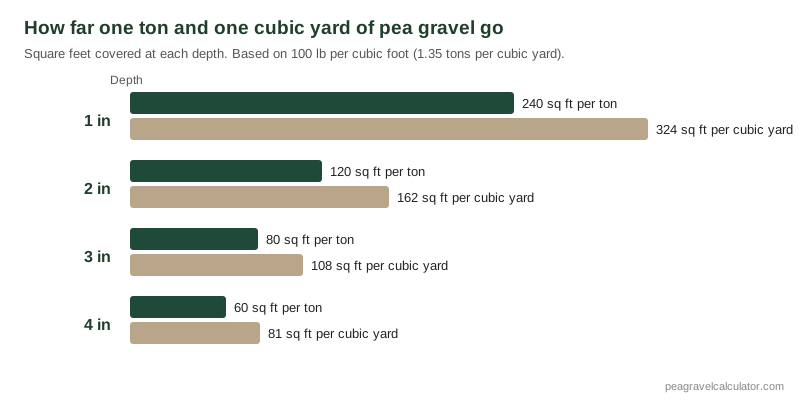
How much area does a fixed quantity of pea gravel cover at different depths? Use this table as a quick reference before opening the calculator.
| Quantity | 1 inch deep | 2 inches deep | 3 inches deep | 4 inches deep |
|---|---|---|---|---|
| 1 cubic yard | 324 sq ft | 162 sq ft | 108 sq ft | 81 sq ft |
| 1 short ton | 240 sq ft | 120 sq ft | 80 sq ft | 60 sq ft |
| 1 cubic foot | 12 sq ft | 6 sq ft | 4 sq ft | 3 sq ft |
| 1 bag (50 lb) | 6 sq ft | 3 sq ft | 2 sq ft | 1.5 sq ft |
| ½ ton mini-bag | 120 sq ft | 60 sq ft | 40 sq ft | 30 sq ft |
Depth drives coverage more than any other variable. A half-ton mini-bag stretched to 1-inch top-dressing covers 120 sq ft. Spread the same half-ton to 4 inches and it covers just 30 sq ft. Lock in your depth before you calculate. Wrong depth = wrong order quantity.
Recommended Pea Gravel Depth by Application
These are the depths used as defaults across all calculators on this site, verified against NRMCA standards and ASTM specifications where applicable.
| Application | Recommended Depth | Notes |
|---|---|---|
| Decorative mulch bed top-dressing | 1–2 inches | Weed suppression only, not structural |
| Garden pathway / walkway | 2–3 inches | Needs edging to contain stones |
| Patio or seating area | 3 inches | Over 2-in compacted #57 stone base |
| Dog run | 3–4 inches | Allows drainage; replace annually |
| Children's play area | 3–4 inches | Not a playground safety surface, see below |
| Residential driveway | 4–6 inches | Over 4-in crushed road base, mandatory |
| Playground safety surface | 9–12 inches | CPSC handbook: 9 in minimum maintained depth for equipment up to 5 ft, install at 12 in |
| French drain fill | Full trench depth | Use washed gravel meeting ASTM C33 |
How Much Pea Gravel for Common Project Sizes
These pre-calculated figures include the 10% waste factor. All assume 3-inch depth unless noted.
| Project | Area | Cubic Yards | Tons | 50-lb Bags |
|---|---|---|---|---|
| Small garden path (10×3 ft) | 30 sq ft | 0.31 yd³ | 0.42 tons | 17 bags |
| Standard patio (12×14 ft) | 168 sq ft | 1.71 yd³ | 2.31 tons | 93 bags |
| Large patio (16×20 ft) | 320 sq ft | 3.26 yd³ | 4.40 tons | 177 bags |
| Small driveway (10×20 ft, 4 in) | 200 sq ft | 2.71 yd³ | 3.66 tons | 147 bags |
| Two-car driveway (20×40 ft, 4 in) | 800 sq ft | 10.86 yd³ | 14.66 tons | 587 bags |
| Dog run (8×12 ft, 3 in) | 96 sq ft | 0.98 yd³ | 1.32 tons | 53 bags |
Bulk Pea Gravel vs Bagged: Which Should You Buy?
The bag count in the table above makes this decision obvious for large projects. For a two-car driveway you'd need 587 bags. That's 587 trips from your car to the driveway. Bulk delivery wins at any project above 1 cubic yard on both cost and practicality.
Below 1 cubic yard, roughly a 10×5 ft path at 3 inches deep, bagged gravel from a home improvement store is genuinely competitive. You avoid delivery minimums, you can buy exactly what you need, and you don't need to be home for a truck. The bags calculator shows the exact bag count for any project size.
For a full 2026 price comparison including regional bulk delivery rates, see the pea gravel cost guide.
Coverage for Irregular and Circular Areas
For rectangular areas, enter the total square footage directly into the Area field above. For irregular shapes:
- L-shaped areas: Divide into two rectangles, calculate each, add the totals, then enter the sum.
- Circular areas: Calculate area = π × radius² (radius = diameter ÷ 2). A 14 ft diameter circle has area = 3.14159 × 49 = 153.9 sq ft.
- Kidney or freeform shapes: Divide into overlapping rectangles and subtract the overlap, or break into a rectangle plus two semicircles.
- Triangular areas: Area = 0.5 × base × height.
Always measure at the largest point and add 10%. It's better to have a small surplus than to run short and pay a second delivery fee.
What People Get Wrong
Four mistakes that result in short orders, overspend, or project failures. And how to avoid each one.
Related Calculators
Pea Gravel Weight Calculator
Convert cubic yards to pounds, tons, kilograms, and metric tonnes.
CalculatorCost Calculator
Enter your local price per ton or yard to get a full project cost estimate.
CalculatorBags Calculator
See exactly how many 50-lb, 40-lb, or 80-lb bags your project needs.
CalculatorDriveway Calculator
Driveway-specific with compaction factor and base layer allowance.
Related Guides
- How to Install Pea Gravel: Step-by-Step DIY Guide
- Pea Gravel Sizes Guide: Which Grade for Which Application
- 2026 Pea Gravel Cost Guide: Bulk vs Bagged Pricing
- Pea Gravel vs Crushed Stone, River Rock, and Decomposed Granite
- 12 Pea Gravel Landscaping Ideas with Real Dimensions
Frequently Asked Questions
How many square feet does 1 ton of pea gravel cover?
Why do online sources give different coverage-per-ton figures?
How many square feet does 1 cubic yard of pea gravel cover?
What depth of pea gravel should I use?
Do I need to compact pea gravel?
How thick should the base layer be under pea gravel?
Can I put pea gravel directly on grass?
How do I calculate coverage for an irregular shape?
Does pea gravel coverage change in winter?
How much extra pea gravel should I order?
When does bulk pea gravel become cheaper than bags?
Is pea gravel sold by ton or cubic yard?
What do I do with leftover pea gravel?
Sources & Methodology
Formula used: Volume (ft³) = Area (ft²) × Depth (ft). Cubic yards = ft³ ÷ 27. Weight = cubic yards × 1.35 tons/yd³. Bags = cubic feet ÷ 0.5 ft³/bag, rounded up.
Density source: 100 lb/ft³ (1.35 tons/yd³) for loose, dry pea gravel. Verified against USGS Construction Sand and Gravel Statistics.
Verified against:
- USGS Mineral Commodity Summaries: Construction Aggregates: density and yield data for rounded aggregates
- NRMCA: National Ready Mixed Concrete Association: standards for aggregate base and sub-base calculations
Last reviewed: October 6, 2026 · Full methodology