
Pea Gravel Maintenance: Complete Care Guide 2026
Knowing how to maintain pea gravel correctly makes the difference between 5 years and 15 years from a single installation. Pea gravel care costs a fraction of lawn or mulch upkeep. But it is not zero maintenance. The homeowners who get 15 years from a single installation are the ones who understand which tasks matter and when. This guide covers every task, every project type, and every problem, with specific timing and methods for each.
In This Guide
- Is pea gravel really low maintenance?
- Seasonal maintenance calendar
- Raking, frequency and technique
- Weed control, all 7 methods
- Depth top-up, when and how
- Cleaning pea gravel
- Edging repair and maintenance
- Snow removal (winter climates)
- Project-specific maintenance
- When to replace completely
- 5-year maintenance cost
- Frequently asked questions
Is Pea Gravel Really Low Maintenance?
Yes. With an honest qualification. Pea gravel maintenance is low compared to the alternatives, not zero compared to nothing.
| Surface | Annual tasks | Annual material cost | Year 5 total cost |
|---|---|---|---|
| Pea gravel | Raking, weed control, occasional top-up | $15–$40 | $75–$200 |
| Organic mulch | Full annual replacement | $100–$200 | $500–$1,000 |
| Lawn / grass | Mowing, watering, fertilizing, reseeding | $300–$600 | $1,500–$3,000 |
| Concrete | Sealing every 3–5 years, crack repair | $0–$80 | $80–$400 |
| Asphalt | Seal coat every 3–4 years | $50–$150 | $250–$750 |
How long does pea gravel last? The stone itself never decomposes, never needs sealing, and never cracks. Granite and quartzite grades last indefinitely. What requires attention over time is the system around the stone. The depth that settles, the weeds that find the surface, the leaves that accumulate, and the edging that works loose. Manage those four things and a well-installed pea gravel surface stays in excellent condition for 10 to 15 years without full replacement.
Seasonal Maintenance Calendar
| Season | Tasks | Timing |
|---|---|---|
| Spring |
Rake full surface to redistribute winter-displaced stones Check and re-stake any edging that has lifted or shifted Apply granular pre-emergent herbicide (soil temp 50°F) Check depth; top up thin areas before growing season Inspect landscape fabric at edges for signs of degradation |
Late March – April |
| Summer |
Pull any weeds that break through (before they set seed) Hose down surface during hot dry periods to suppress dust Check high-traffic zones for ruts and redistribute stones Dog runs: weekly hose rinse throughout summer |
May – August |
| Autumn |
Leaf blower or rake to remove fallen leaves before they decompose Apply second pre-emergent application (late August – September) Check and repair edging before ground freezes Top up depth if needed before winter Rake to level surface before first frost |
September – November |
| Winter |
Snow removal with plastic shovel at angle above surface Apply rock salt or ice melt sparingly (not sand) Minimal activity; gravel maintenance largely pauses |
December – February |
Raking: Frequency and Technique
Raking pea gravel redistributes displaced stones back to thin areas, levels ruts from foot and vehicle traffic, and clears the surface of debris that has settled between stones. It is the one maintenance task that applies universally to every pea gravel installation, regardless of project type.
| Project type | Raking frequency | Notes |
|---|---|---|
| Decorative borders and beds | 4 times per year (seasonal) | Low traffic; mainly to redistribute and check depth |
| Garden paths (light use) | 3–4 times per year | Start of each season |
| Patios and seating areas | 4 times per year | More often if furniture legs create impression marks |
| Driveways | Monthly | Vehicle traffic displaces significantly more material |
| Dog runs | 2–3 times per week | Pet activity continuously redistributes stones |
| Playgrounds | Monthly (minimum) | Depth must be maintained; rake redistributes from edges to active zones |
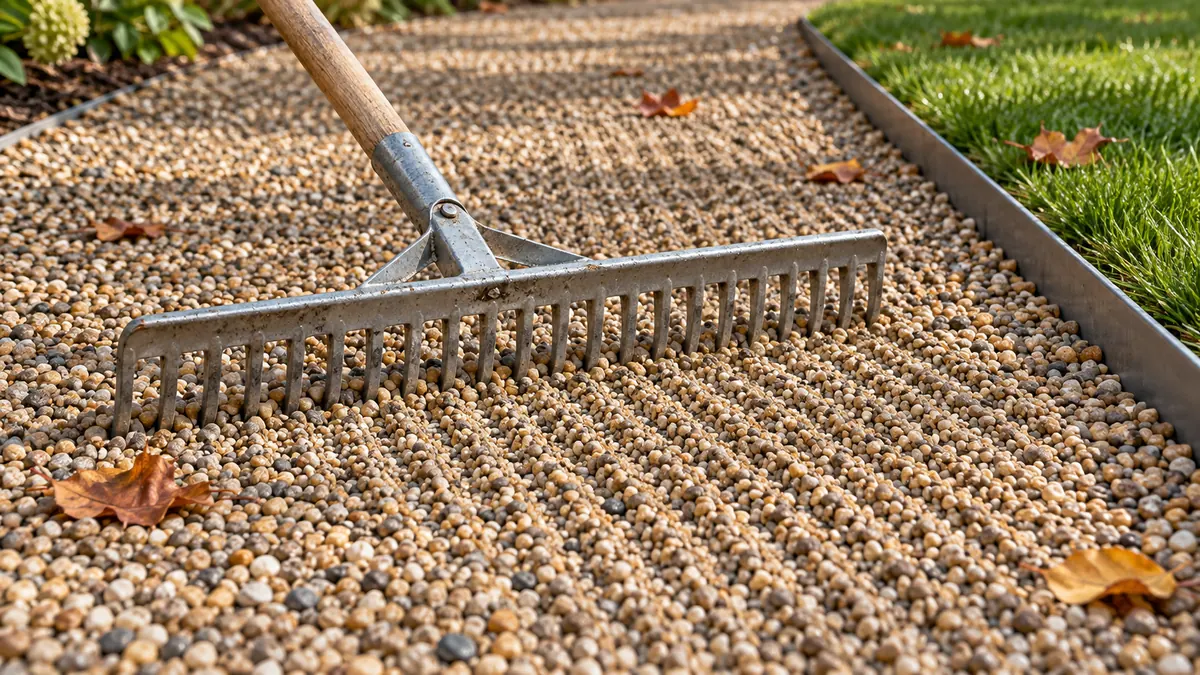
Use a standard garden rake on pea gravel rather than a leaf rake. The tines of a garden rake move stones effectively without catching and lifting them. Rake in one direction first to level major displacement, then perpendicular to catch cross-directional ruts. Aim for consistent depth across the surface. Use a depth gauge or simply press a ruler vertically into the surface at multiple points.
After raking, check the perimeter edging. Raking pulls stones toward edges, which puts lateral pressure on edging stakes. If any section has bowed or lifted, push it back into position and add a stake. See the installation guide for the correct stake spacing.
Weed Control: All 7 Methods
The best way to prevent weeds in pea gravel is a layered approach. Fabric below, maintained depth above, and pre-emergent applied twice per year. Landscape fabric stops weeds from below. Nothing stops weeds from above. Windborne seeds, bird droppings, and organic debris that settles between stones all provide germination material. Surface weed control is a year-round task for any pea gravel installation, not a one-time solution.
Understanding why weeds appear despite landscape fabric saves a lot of frustration. The fabric blocks soil-based seeds. It works for up to 80 to 95 percent of weed emergence. The weeds that break through fabric are either from seeds that germinated in the gravel layer above it (not through it), or from fabric that has degraded and torn over time.
| Method | Effectiveness | Cost | Safe near plants? | Best for |
|---|---|---|---|---|
| Pre-emergent herbicide (granular) | High; prevents germination | $10–$25/year | ✓ Yes (directed application) | Seasonal prevention; spring and late summer |
| Hand pulling | High if done before roots set | $0 | ✓ Yes | Isolated weeds, young seedlings |
| Horticultural vinegar (20%+) | High on young weeds | $15–$30/liter | ⚠ Avoid overspray | Areas where chemical herbicide is unsuitable |
| Boiling water | Medium; kills above-ground growth | $0 | ⚠ Keep clear of desirable plants | Small areas, young weeds with shallow roots |
| Flame weeding (propane torch) | High on young weeds | $30–$60 tool, $5/refill | ⚠ Fire hazard; check local rules | Larger areas, weed-dense gravel paths |
| Post-emergent herbicide (glyphosate) | Very high; kills roots | $8–$20/bottle | ✗ Keep well away from desirable plants | Last resort for established weed infestations |
| Salt | High but soil-destructive | $0–$2 | ✗ Permanently damages soil | Not recommended; irreversible soil damage |
Pre-emergent Herbicide: The Most Important Tool
Pre-emergent herbicide is the single most effective maintenance tool for pea gravel weed control. Apply a granular pre-emergent product containing pendimethalin or similar active ingredient twice per year:
Spring application: when soil temperature reaches 50°F. Typically late March to April in most of the US. This targets summer annual weeds including crabgrass, purslane, and spurge before they germinate.
Late summer application: late August to mid-September. This targets autumn and winter annual weeds that germinate in cooling temperatures.
Pre-emergent does not kill existing weeds. It only stops new seeds from germinating. Pull or treat any existing weeds before applying. After application, water lightly to activate the product. Always follow label directions and avoid application near water features, storm drains, or desirable annual plantings.
Horticultural vinegar
Standard household vinegar (5% acetic acid) is too weak for reliable weed control in gravel. Use horticultural vinegar at 20 to 30% acetic acid concentration. Available from garden centers and online suppliers. Mix with a tablespoon of dish soap as a surfactant to help it adhere to waxy weed leaves. Apply with a pump sprayer directly to weed foliage on a dry, windless day. Results appear within 24 to 48 hours.
Horticultural vinegar kills above-ground growth effectively but may not reach deep roots of perennial weeds. Repeat applications may be needed. Keep it off desirable plants and away from soil where you want to grow anything. High concentrations can temporarily acidify surface soil.
Flame weeding safety rules
A propane weed torch passes heat over weeds, rupturing plant cells without burning them to ash. Pass the flame for 1 to 2 seconds over each weed. You should see the leaves wilt. Do not try to char the plants. Clear dry leaves and debris from the gravel before using a torch. Never use during dry weather warnings or fire season restrictions. Keep a garden hose within reach. Do not use near structures, fences, or wooden edging without extreme caution.
Depth Top-Up: When and How Much
All pea gravel installations lose some depth over time through settling and traffic displacement. High-traffic areas settle at approximately 1/4 to 1/2 inch per year. Lower-traffic decorative areas may settle only 1/4 inch over 2 to 3 years. When depth drops below 2 inches on a path or patio, the installation loses both weed suppression effectiveness and visual quality.
How to measure pea gravel depth: push a pencil or ruler vertically through the gravel until it contacts the landscape fabric or compacted base beneath. Mark the gravel surface level on the tool. Measure the insertion depth. Check at multiple points across the surface. Thin spots are usually in the highest-traffic zones at the center of paths and directly under furniture.
| Project type | Top-up trigger depth | Target depth after top-up | Typical interval |
|---|---|---|---|
| Decorative beds and borders | Below 1.5 in | 2 in | 3–5 years |
| Garden paths and patios | Below 2 in | 3 in | 2–3 years |
| Driveway surface layer | Below 1.5 in surface | 2–3 in surface | Annually in high-traffic zones |
| Dog run | Below 2.5 in | 3–4 in | Annually for top 1 in; full review every 3–5 yrs |
| Playground | Below CPSC minimum for fall height | CPSC minimum + 1 in buffer | As needed; check monthly |
To calculate how much material to order for a top-up, measure the area in square feet and the depth deficit in inches. Use the coverage calculator to get cubic yards, tons, and bag count. For small thin spots, the bags calculator is easier. It shows the exact 50-lb bag count for the affected area at your chosen top-up depth.
When matching color for a top-up, order from the same supplier and ask for material from the same quarry source. Gravel color varies between quarries. Slight color variation between new and old pea gravel is normal and blends in after one to two seasons as the new material weathers.
Cleaning Pea Gravel
Knowing how to clean pea gravel properly keeps the surface sharp-looking and prevents organic matter from creating weed habitat. Regular cleaning and prevents organic matter from accumulating and creating weed habitat between stones.
Leaf blower vs rake
For dry leaves, a leaf blower is far faster and better than a rake. Hold the nozzle at a low angle, pointing parallel to the gravel surface, and blow leaves toward an edge or corner. Do not point the nozzle directly into the gravel at high power. You will scatter stones along with leaves. A rake handles wet, embedded, or decomposing leaves that the blower cannot shift. Rake in firm, short strokes rather than long sweeping motions that pull stones out of position.
Hosing down
A standard garden hose on jet setting rinses fine particles, dust, and light organic matter through the void spaces between stones. Work systematically across the surface. This is the most effective routine cleaning method. Takes 5 minutes for most patios and produces a noticeably fresher surface. Hose down after dusty periods, after any construction or landscaping work nearby, and any time the surface looks grimy.
Power washing
A pressure washer on a low-to-medium setting (1,000 to 1,500 PSI) washes embedded dirt and algae effectively. Move the wand continuously. Do not hold the spray in one place, as direct high-pressure impact displaces stones and compacts the surface unevenly. Work in sections and rake the surface level after washing while it is still wet. Power washing more than once per year is not necessary for most installations and eventually degrades the landscape fabric beneath if the jet is too powerful.
White or cream gravel that has turned green
Algae and moss growth on the stone surface is the most common maintenance issue with light-colored gravel, particularly in damp or shaded areas. Clean with a diluted bleach solution. One part household bleach to ten parts water. Apply with a watering can or garden sprayer, leave for 10 to 15 minutes, then rinse thoroughly with a hose. Keep the bleach solution away from plant foliage and rinse any splashed plants immediately. Repeat annually or whenever discoloration reappears. If the same area keeps greening repeatedly, improve drainage, trim overhead shade, or switch to gray pea gravel in that section. Gray hides algae discoloration far better. See the colors and types guide for guidance on color choices by condition.
Edging Repair and Maintenance
Edging failure is the most common reason a pea gravel installation starts looking neglected. Without it, even well-installed gravel migrates within weeks. Without a functioning perimeter, gravel migrates into lawn within weeks of installation. Check and maintain edging at least twice per year. Spring and autumn.
Steel edging that has lifted or bowed: Push the edging back to its original position. Drive a new stake into the ground at the lifted point, angling the stake slightly outward so the top hooks over the edging cap. Stakes should be no more than 18 inches apart in sections prone to movement. Tighter than the standard 2-foot spacing.
Composite or plastic edging that has cracked or brittle: Replace in sections. Most plastic edging connects end-to-end and individual sections can be swapped without disturbing the whole perimeter. Exposed plastic edging degrades in UV faster than steel. Expect to replace plastic sections every 5 to 8 years in direct sun.
Timber edging that has bowed: Add a sister piece of pressure-treated timber flat against the inside face of the bowed section. Spike both pieces together with galvanized nails or screws. Timber edging that has rotted through needs full replacement. Rotten timber no longer holds stakes reliably.
Snow Removal: Winter Climates
Snow removal from a pea gravel surface requires different technique than snow removal from hard surfaces. The loose stone means any aggressive removal disturbs the gravel along with the snow.
The right tool: A plastic-bladed snow shovel held at a slight angle above the gravel surface. Not pressing into it. Work in broad, gentle strokes that skim the snow off the surface rather than scooping into the gravel. Accept that some gravel will mix with the snow and be removed. Rake it back in spring.
Light, powdery snow before it freezes: A leaf blower on maximum setting moves powdery snow efficiently before it bonds to the gravel surface. Work quickly. Once snow starts to melt and refreeze it becomes much harder to remove without disturbing the stones.
Ice melt and rock salt: Apply sparingly to icy patches. Rock salt and calcium chloride ice melt products work without mixing permanently into the gravel. Avoid sand entirely. It mixes into pea gravel and is nearly impossible to separate out. A gravelled surface covered in sand looks wrong and is unpleasant underfoot.
Never use a metal-bladed snowblower: The metal impeller throws gravel as readily as snow. This damages the machine, creates dangerous projectiles, and scatters your gravel across the garden, driveway, and any vehicles or people nearby.
Spring recovery: After the last frost, rake the entire surface to redistribute stones displaced by snow removal. Check edging. Frost heave often lifts stakes slightly during winter. Check depth and order a top-up if winter displaced significantly more than normal settling.
Project-Specific Maintenance
Driveway maintenance
Maintaining pea gravel driveways takes more effort than other projects. Knowing how to keep pea gravel clean and level on a driveway is the most demanding ongoing task in any pea gravel installation. Vehicle tires displace stones laterally. Over time, ruts develop in the tire tracks and stones build up in ridges between them and along the edges.
Monthly raking prevents ruts from deepening into the base layer. Focus on pushing stones from the ridges at the edges back into the tire tracks. Keep a depth check quarterly. Driveway gravel settles fastest in the areas directly under tire contact. Top up annually in the high-traffic zones rather than waiting until the whole surface is thin.
Check edging stakes monthly. Vehicle vibration and the lateral pressure of displaced stones works stakes loose faster than any other installation type. Add extra stakes wherever you notice the edging creeping outward. The full driveway maintenance schedule including seasonal snow removal is in the driveway guide.
Patio and seating area maintenance
Set pavers under furniture legs if not already done. This distributes leg weight and prevents impression marks. Impression marks in pea gravel are not permanent; they rake out, but they keep forming if the furniture sits directly on loose gravel.
After outdoor gatherings with high foot traffic, rake the surface the following morning before any displaced stones work into surrounding lawn. This is far easier when stones are still at the surface edge than after they have been mown over or walked into the grass.
Dog run maintenance
Dog run pea gravel requires the most intensive maintenance schedule of any application.
Weekly: Rinse the entire surface with a garden hose on jet setting. This flushes urine through the gravel and out through the drainage slope beneath. Without weekly rinsing, urine salts crystallize between stones and generate persistent odor regardless of other treatments.
Monthly: Apply an enzymatic pet odor neutralizer diluted according to label directions over the entire surface. Do not use bleach for odor. It damages the stone surface and the residual chlorine smell is unpleasant for dogs. Enzymatic products break down the organic compounds in urine and faeces at a molecular level.
2–3 times per week: Rake to redistribute displaced stones. Dogs create wear patterns. Favorite paths and zones get worn thin quickly while less-used edges stay deep.
Annually: Remove and dispose of the top 1 inch of gravel and replace with fresh washed material. This removes the accumulated salt and organic residue that builds up in the top layer regardless of regular rinsing.
Every 3 to 5 years: Full review. If odor persists despite the weekly rinsing and enzymatic treatment regime, and the annual partial replacement is not resolving it, a full removal and reinstallation with new fabric and fresh gravel is needed.
Playground surface maintenance
Playground maintenance is non-negotiable where fall protection is involved. Check depth in the active play zones monthly using a measuring stick at multiple points directly beneath and around equipment.
CPSC minimum depths: 6 inches for equipment with fall heights up to 4 feet; 9 to 12 inches for fall heights of 4 to 7 feet. Pea gravel is not recommended above 8 feet regardless of depth; use engineered wood fiber or tested rubber surfacing instead. Do not wait for the depth to reach minimum. Top up when depth drops to within 1 inch of the minimum to maintain a safety buffer.
Rake displaced pea gravel from low-use edges back into the active zones under equipment each month. Annual full-surface depth audit: measure at a grid of points across the entire play area, at least one point per every 50 square feet, and record the lowest reading. Order top-up material based on the lowest reading, not the average.
Garden path and border pea gravel maintenance
Seasonal raking is the primary task. After leaf fall in autumn, clear the path surface before leaves decompose and add organic matter that weed seeds can use. In spring, check for winter weed emergence and pull any seedlings before they flower and set seed.
Paths alongside planting borders accumulate organic debris from adjacent beds. Fallen flowers, spent seedheads, soil disturbed by planting and digging. Rake this debris toward the beds rather than deeper into the path gravel. A clean pea gravel path edge is the visual element that makes the difference between a maintained and an unmaintained garden.
When to Replace Completely
Full replacement is rarely needed for a properly installed pea gravel surface. Most upkeep is ongoing top-up. Most maintenance is ongoing top-up and management, not replacement. The following signs indicate that full pea gravel replacement is warranted.
If raking reveals that gravel and soil have mixed through the full depth and the stones cannot be separated, the landscape fabric has completely failed or was never installed. The only fix is full removal, fabric replacement, and reinstallation.
Woven fabric typically lasts 10 to 15 years before UV degradation and root penetration make it ineffective. When fabric failure is widespread and weeds emerge continuously across the full surface despite surface treatment, replacement is the only long-term solution. Budget fabric fails faster. Some grades degrade within 5 to 7 years in direct sun.
If the surface depth is consistently below 1 inch across most of the area despite regular topping up, the installation has deteriorated beyond economic maintenance. This situation usually accompanies landscape fabric failure. The gravel is sinking into the soil beneath.
When weekly rinsing, monthly enzymatic treatment, and annual partial replacement no longer resolve the odor, the organic contamination has penetrated through the full gravel layer and into the soil beneath. Full removal and reinstallation with fresh fabric and gravel is the only effective resolution.
If the surface looks permanently dark, stained, or heavily discolored despite cleaning, the gravel may have absorbed enough organic matter that cleaning can no longer restore its appearance. Fresh gravel ordered from the same source revives the surface immediately.
5-Year Maintenance Cost
| Task | Year 1 | Year 2 | Year 3 | Year 4 | Year 5 |
|---|---|---|---|---|---|
| Raking (DIY) | $0 | $0 | $0 | $0 | $0 |
| Pre-emergent herbicide | $15–$25 | $15–$25 | $15–$25 | $15–$25 | $15–$25 |
| Depth top-up (200 sq ft) | $0 | $0 | $30–$60 | $0 | $0 |
| Edging repair | $0 | $5–$15 | $0 | $5–$15 | $0 |
| Annual total | $15–$25 | $20–$40 | $45–$85 | $20–$40 | $15–$25 |
| 5-year total | $115–$215 for a 200 sq ft patio | ||||
Compare to organic mulch: $100 to $200 per year for a similar area, totalling $500 to $1,000 over 5 years. The 5-year cost of pea gravel maintenance is 50 to 80 percent less than mulch, despite higher initial installation cost. The longer the time horizon, the stronger the economic case for pea gravel over mulch.
For full project cost including installation, use the cost calculator. For top-up quantities before calling your supplier, use the coverage calculator. For small top-up areas where bags are more practical than bulk delivery, the bags calculator gives exact 50-lb bag count.
Worked Maintenance Examples: Time and Cost
200 sq ft patio, annual maintenance, average use. Spring: rake edge build-ups back to center (30 minutes). Apply pre-emergent granules to surface (15 minutes). Pull any winter-surviving weeds (10 minutes). Check edging stakes and reset any heaved by frost (20 minutes). Autumn: leaf blower over surface to remove leaves (20 minutes). Total annual time: approximately 95 minutes. Annual material cost: pre-emergent granules for 200 sq ft approximately $8 to $12. Top-up every 2 to 3 years (0.5 inch, 0.34 yd³) approximately $25 to $40. Annual cost averaged: $20 to $30.
Dog run, 10 x 20 ft, daily heavy use. Weekly: enzyme cleaner spray and hose rinse (20 minutes). Monthly: full rake to redistribute stone, check depth under digging spots (30 minutes). Quarterly: pre-emergent application at perimeter (15 minutes). Annual: full depth check, top-up thin areas (1 hour). Total annual maintenance time: approximately 18 to 20 hours. Annual material and product cost: $60 to $90. A dog run requires significantly more maintenance than a decorative patio. Factor this into the decision between pea gravel and alternative surfaces.
4 Maintenance Mistakes That Shorten Pea Gravel Life
Mistake 1. Raking uniformly instead of targeting edge build-ups. Many homeowners rake the entire gravel surface in random directions, which moves gravel around but does not correct the specific accumulation pattern that develops over time. The correct technique: identify the edge build-up ridge inside the perimeter, pull it specifically toward the centerline. This targeted approach takes half the time and produces twice the result compared to uniform raking.
Mistake 2. Applying pre-emergent after weeds have germinated. Pre-emergent herbicide prevents seed germination. It has no effect on weeds that have already sprouted. Homeowners who see weeds appearing in spring and apply pre-emergent in response are doing nothing useful. Pre-emergent must be applied before soil temperature reaches 55°F. In most states this means applying in March or early April, before any weeds are visible. The forsythia bloom is the reliable timing indicator.
Mistake 3. Leaving leaves on the surface over winter. Decomposing leaves on a pea gravel surface build up a thin layer of organic matter that is the primary germination medium for surface weeds the following spring. A 20-minute leaf blower pass in November prevents months of spring weeding. This is the highest return-per-minute maintenance task in pea gravel care and is consistently skipped by homeowners who do not understand the connection between autumn leaves and spring weed pressure.
Mistake 4. Topping up with a different gravel type or size. Topping up a 3/8-inch tan pea gravel installation with a different grade or color from a different supplier creates visible patches and changes the surface drainage behavior. Always keep a note of the original supplier, gravel size, and color description. When ordering top-up material, take a sample of the existing gravel to the supplier for comparison. Color consistency matters particularly for decorative applications visible from the street.
Frequently Asked Questions
Is pea gravel low maintenance?
How often should I rake pea gravel?
How do I stop weeds in pea gravel?
How often should I top up pea gravel?
How do I remove leaves from pea gravel?
How do I maintain a pea gravel dog run?
How do I remove snow from pea gravel?
Why do weeds appear despite landscape fabric?
When should I completely replace pea gravel?
How do I clean dirty pea gravel?
How much does pea gravel maintenance cost per year?
How do I maintain a pea gravel playground?
Related Calculators
Coverage Calculator
Calculate exact quantities for a depth top-up. Enter your area dimensions and the deficit depth to get cubic yards, tons, and bags.
CalculatorBags Calculator
For small top-up areas where buying bags is more practical than bulk delivery. Get the exact 50-lb bag count.
CalculatorCost Calculator
Enter your supplier's price per ton to calculate the total material cost for a top-up or full replacement at any size.
Related Guides
Installation Guide
Correct installation, fabric type by soil, base depth, edging height, is what determines how much maintenance the surface needs long-term.
GuideColors and Types
Color affects maintenance. Dark gray hides debris and algae; white requires more cleaning. Match color to conditions before ordering.
ComparisonPea Gravel vs Others
Full 5-year maintenance cost comparison between pea gravel, mulch, river rock, decomposed granite, and rubber mulch.
Cost Guide 2026
Full cost breakdown for top-ups, partial replacements, and complete reinstallations with 2026 material pricing.
IdeasLandscaping Ideas
20 project ideas. Each includes the expected maintenance frequency for that specific application type.
GuideDriveway Guide
Driveway-specific maintenance including vehicle rut repair, seasonal snow removal protocol, and edging for high-traffic edges.
Sources & Methodology
- CPSC Handbook for Public Playground Safety: loose-fill depth requirements by fall height (2024 edition)
- EPA: Registered Pesticides: pre-emergent and post-emergent herbicide registration and label guidance
- USGS: Natural Aggregates Statistics: material density reference used in coverage calculations
Last reviewed: October 2026 · Full methodology