
Pea Gravel vs Other Gravel: Complete Comparison Guide 2026
Most comparison guides pit pea gravel against one other material. Real projects involve a choice between six or eight options. This guide covers all of them. With specific data on drainage, stability, cost, heat, safety, and which material wins for each project type.
In This Guide
- All materials at a glance
- Pea gravel vs crushed stone
- Pea gravel vs river rock
- Pea gravel vs decomposed granite
- Pea gravel vs mulch
- Pea gravel vs lava rock
- Pea gravel vs marble chips
- Pea gravel vs rubber mulch
- Washed gravel, naming confusion
- Jersey Shore gravel explained
- Pea gravel vs crushed concrete
- Project decision matrix
- Drainage science, void ratio
- Summer heat comparison
- Freeze-thaw and climate
- pH and plant safety
- Which gravel is best for dogs
- ADA accessibility
- Cost comparison table
- Frequently asked questions
All Materials at a Glance
| Material | Shape | Drainage | Stability | Comfort | Cost/ton | Best for |
|---|---|---|---|---|---|---|
| Pea gravel | Rounded | Excellent (36% void) | Low; stays loose | High; smooth | $30–$55 | Paths, patios, dog runs, drainage |
| Crushed stone | Angular | Good (28% void) | High; compacts solid | Low; sharp edges | $28–$45 | Driveways, bases, structural fill |
| River rock | Rounded, large | Excellent (40% void) | Low; too large to lock | Poor; too large underfoot | $45–$80 | Water features, dry creek beds |
| Decomposed granite | Fine, angular | Fair (15% void compacted) | Medium; semi-solid | Medium; firm surface | $22–$40 | Firm paths, patios, ADA routes |
| Lava rock | Irregular, porous | Excellent | Medium | Low; abrasive | $80–$160 | Desert gardens, heat-loving plants |
| Marble chips | Angular, bright | Good | Medium | Medium | $60–$120 | Formal decorative beds, brightening shade |
| Rubber mulch | Irregular | Good | Medium | High; soft | $80–$160/yd³ | Playgrounds, high-fall-height areas |
| Crushed concrete | Angular, recycled | Good | High; compacts well | Low; sharp edges | $15–$30 | Budget driveways, base layers |
| Mulch (organic) | Irregular | Good | Low | High; soft | $25–$50/yd³ | Plant beds needing soil improvement |
Pea Gravel vs Crushed Stone
This is the most-searched comparison and the most misunderstood one. Most guides treat it as an either/or choice. Professional landscapers almost always use both.
The Shape Difference: Why Everything Else Follows From It
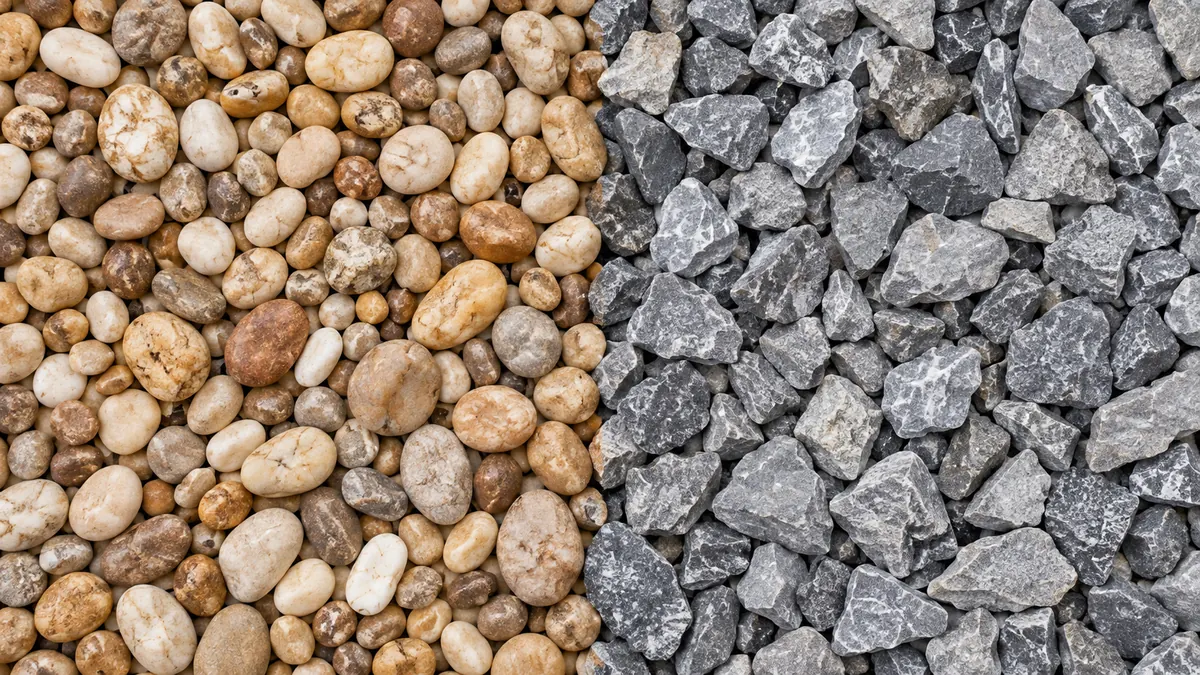
Pea gravel is rounded. Water tumbled the stones for thousands of years until the edges wore smooth. Crushed stone is angular. A machine broke larger rocks into pieces, leaving sharp edges. That shape difference determines every performance characteristic that matters.
Rounded stones cannot interlock. Place it under tire pressure and the stones roll sideways rather than supporting the load. Rake the surface flat and it will stay flat. Until someone walks on it or it rains. The surface is permanently loose.
Angular stones interlock. Compact crushed stone with a plate compactor and the pieces lock together like a puzzle. The surface becomes nearly solid. It handles vehicle loads, resists displacement, and does not rut.
Which drains better
The void space is approximately 36%. Compacted crushed stone has approximately 28% void space. Water moves through it faster under light conditions. Under heavy load, crushed stone compacts further and reduces void space over time. For pure drainage, French drains, foundation perimeter channels, light garden drainage, rounded stone drains faster. For drainage under a structural load, the honest answer is that angular #57 crushed stone (3/4 inch) outperforms pea gravel because it maintains its void structure under pressure. See the sizes guide for the full French drain size guidance.
Which is more stable
Crushed stone is more stable than pea gravel in every load-bearing application. Angular particles lock together under compaction and resist displacement under vehicle and foot traffic. The rounded material stays loose permanently. It offers no structural stability and cannot be compacted into a solid surface regardless of effort or depth. For any project where the surface must not shift under load, crushed stone or crushed concrete is the correct base material.
Which is more comfortable underfoot
Rounded stone wins clearly. The smooth surface is comfortable in bare feet, comfortable for dog paws, and comfortable for children. Crushed stone has sharp edges that bite into the sole underfoot. It is fine in work boots. It is poor for a patio, a pool surround, or any barefoot surface.
For Driveways, the Correct Answer Is Both
Rounded gravel alone fails as a driveway surface. The rounded stones have no interlocking resistance under tire pressure. Within weeks, vehicle tracks create ruts and the gravel migrates to the edges. Using crushed stone alone is structurally sound but visually harsh and uncomfortable to walk on from the car.
The standard professional specification combines them: 4 inches of compacted crusher run as the base, 2 to 3 inches of pea gravel as the surface layer. The base provides load-bearing capacity. The surface layer provides the visual finish, foot comfort, and drainage at the surface. Together they outperform either material alone. The driveway guide covers traffic class by vehicle weight and base depth specifications in full.
For garden paths and patios
The 3/8-inch grade over a 2-inch compacted base layer works well for garden paths with regular foot traffic. The base provides firmness. The surface layer provides comfort. Crushed stone alone on a garden path is uncomfortable underfoot and looks industrial next to planting beds.
For patios with outdoor furniture, set 12-inch square concrete pavers under each furniture leg. This prevents the legs from sinking into the loose gravel surface. Full installation guidance including fabric type by soil type is in the installation guide.
Which is cheaper
Crushed stone typically costs $28 to $45 per ton. The standard grade runs $30 to $55 per ton. Crushed stone is marginally cheaper for equivalent coverage. For a full cost breakdown by project type including both materials together, see the 2026 cost guide or use the cost calculator.
Pea Gravel vs River Rock
Both are rounded, water-worn stones. The difference is size. Rounded pea stone is 1/8 to 5/8 inch. River rock is typically 1 to 5 inches. They come from the same geological process and the same river and glacial sources. Once river rock stones become smaller than 1/2 inch, they become pea gravel. The classification is purely about size.
River rock suits decorative features, dry creek beds, water feature surrounds, and large-scale borders where the visual weight of bigger stones is appropriate. It suits any surface where people or animals will walk, any drainage application involving pipe, and any project where stone must fill compact spaces.
River rock costs more per ton. Expect $45 to $80 versus $30 to $55 for the rounded grade. It also covers less area per ton because the large stones leave bigger gaps. Use river rock for the visual drama it creates at water features and creek beds. Use the smaller rounded material for everything functional.
For mixing the two: a dry creek bed works well with fine rounded gravel filling the channel and river rock placed as larger accent boulders at bends and transitions. The size variation looks natural and mimics how real streambeds deposit different-sized stones. See the dry creek bed idea in the landscaping ideas guide.
Pea Gravel vs Decomposed Granite
Decomposed granite (DG) is granite that has weathered into fine particles mixed with small stone fragments. Wet it down and compact it, and it sets into a firm, stable surface. Let it dry completely and it loosens and scatters. It behaves partly like gravel and partly like packed earth.
The compaction difference
This is the defining distinction. DG compacts into something approaching a solid. Pea gravel never compacts regardless of effort. The rounded stones simply roll under load and settle back to loose. If you want a firm, walkable surface that feels more like a path than a gravel pit, DG achieves that. If you want free drainage and a natural loose feel, pea gravel is right.
The DG tracking problem
DG has one practical problem that most guides skip. The fine particles stick to shoes and pet paws when damp. Track them inside on hardwood floors and you get scratching. DG particles act like fine sandpaper. Near entryways, garage doors, and anywhere that connects to indoor floors, pea gravel is the better choice because the rounded stones shake off cleanly.
Freeze-thaw climate warning for DG
DG performs poorly in climates with hard freeze-thaw cycles. The fine particles absorb moisture, freeze, and expand. The compacted surface breaks apart within one or two winters. What was a firm path in autumn becomes a crumbled, loose, uneven surface by spring. In USDA zones 1 through 5, avoid DG for any surface application. It handles freeze-thaw cycles well because the drainage keeps moisture from pooling beneath the surface.
ADA accessibility
Stabilized DG, DG mixed with a polymer stabilizer during installation, meets ADA firmness and stability standards when properly installed and maintained. Loose pea gravel does not meet ADA requirements. For public paths, accessible routes, or any project with disability access requirements, stabilized DG is the gravel-family option that complies. Plain DG without stabilizer also fails ADA standards when dry and loose. See the full ADA section below.
Pea Gravel vs Mulch
This comparison comes up most often for garden beds. The question is whether you want to improve the soil underneath or simply cover it permanently.
Organic mulch, wood chips, bark, shredded leaves, decomposes over time into the soil. The decomposition adds organic matter, improves soil biology, and feeds the microbial ecosystem that plant roots depend on. But it disappears. A fresh 3-inch mulch layer reduces to 1 inch within a year. Annual replenishment costs $100 to $200 per year for a typical garden bed.
The gravel does not decompose. It does nothing to improve soil fertility. The soil beneath pea gravel stays exactly as it is, which is why it works well over landscape fabric in low-maintenance decorative areas but is the wrong choice for vegetable gardens or beds where soil improvement matters. One top-up every 2 to 3 years restores depth lost to settling. At $30 to $60 per application. The 5-year cost comparison favors pea gravel by $400 to $800 in most garden bed applications.
For weed suppression, both work. Neither eliminates weeds completely. Gravel at 3 inches over 4oz landscape fabric gives better long-term weed control than mulch, because organic mulch eventually decomposes and the fabric beneath it degrades. The full weed suppression and maintenance comparison is in the maintenance guide.
pH caution: Avoid limestone-based pea gravel next to acid-loving plants. Calcium leaches slowly from limestone gravel into adjacent soil, raising pH over time. Azalea, blueberry, camellia, and rhododendron are sensitive to this and decline slowly. Not immediately obviously. Use granite or quartzite grades near these plants. Mulch adds slight acidity as it decomposes. Better for acid-preferring species.
Pea Gravel vs Lava Rock
Lava rock is solidified volcanic material. It is lightweight, porous, rust-red to dark brown in color, and typically used in desert-style landscaping and around heat-loving or drought-tolerant plants.
The lightweight advantage: lava rock covers more area per ton than pea gravel because it is far less dense. A ton of lava rock goes further. It also retains heat from the day and releases it overnight. Beneficial for frost-sensitive plants in marginal climates.
The problems: lava rock gets significantly hotter in direct summer sun than pea gravel. Dark lava rock reaches 30 to 40°F above ambient air temperature. That makes it unsuitable for barefoot areas, dog runs, and children's play areas. It is also abrasive. The sharp, porous surface is rough on bare feet and dog paws. In extreme weather conditions, lightweight lava rock can be displaced by strong wind. Some lawn mower blades have been damaged by lava rocks blown from adjacent beds onto grass areas.
Use lava rock for: desert and Mediterranean garden beds, around cacti and succulents, in fire pit surrounds designed for heat retention, and any ornamental application where you want dramatic dark color and warmth retention for plants. Use the rounded grade where people or animals will walk on it.
Pea Gravel vs Marble Chips
Marble chips are bright white to off-white angular stone chips. They brighten shaded garden areas, create formal visual contrast, and are popular in contemporary and Mediterranean-style landscapes.
The significant advantage over all other materials: marble chips reflect sunlight rather than absorbing it. They reach just 5 to 8°F above ambient air temperature in direct sun. The coolest of all gravel options in summer. In USDA zones 8 through 10 where summer heat stress is the primary challenge, white marble mulch provides genuine soil protection for shallow-rooted plants.
Two important cautions. First, marble is calcium carbonate. It raises soil pH over time just as limestone does. The same rule applies: keep marble chips away from acid-loving plants. Use granite or quartzite pea gravel next to rhododendron, azalea, camellia, blueberry, and other calcifuge species. Second, white marble shows debris. Fallen leaves, windblown soil, and any organic material stands out visibly against the white surface. It requires more frequent cleaning than natural-toned pea gravel.
Cost is the main barrier: marble chips run $60 to $120 per ton, significantly more than pea gravel. For small feature areas where the visual drama is worth the premium, marble chips are effective. For large installations, the cost and maintenance commitment make pea gravel a better value.
Pea Gravel vs Rubber Mulch
Rubber mulch is manufactured from recycled tires. It is used primarily for playground safety surfacing and is CPSC-approved as a loose-fill impact attenuation material alongside pea gravel.
For playground surfaces specifically, both materials work within limits. Pea gravel meets CPSC requirements at tiered depths depending on fall height, from 6 inches up to 4 feet to 9-12 inches for 4 to 7 feet, and it is not recommended at all above 8 feet regardless of depth. Rubber mulch performs across a wider range of fall heights with slightly better impact attenuation at greater heights. Rubber mulch requires no topping up. It does not compress or migrate the way pea gravel does. Over a 10-year period, rubber mulch costs less to maintain despite the higher upfront cost.
The chemical leaching question is real but not conclusive. Research published in 2024 identified trace leaching of zinc and other compounds from recycled-tire rubber mulch under high-heat conditions. The concentrations found were low, but the research is ongoing. Natural stone is chemically inert. It contains no synthetic materials and releases nothing into surrounding soil or water. For playgrounds in hot climates where rubber mulch sits in direct sun, this distinction may influence the decision.
Neither material is appropriate for children under 3 years old. Both are choking hazards. Use sand or poured rubber tiles for toddler areas.
Washed Gravel: The Naming Confusion
This confusion appears in supplier conversations regularly and causes homeowners to receive the wrong material.
Washed pea gravel = rounded pea gravel that has been cleaned to remove clay fines and dust. The word "washed" describes the cleaning process. The stones are still smooth and rounded.
Washed gravel (without "pea") = angular crushed stone that has been washed to remove dust. It is not rounded. It compacts and interloads like standard crushed stone. The word "washed" again describes cleaning, not shape.
Can you mix pea gravel and crushed stone? Yes. And in fact most professional driveway and patio installations do exactly this. Crushed stone goes down first as a compacted base. Pea gravel goes on top as the surface layer. The two materials complement each other perfectly: base stability from angular stone, surface comfort from rounded gravel. These are opposite materials that behave completely differently. When ordering, always specify both the shape and the washing separately. Say: "Washed 3/8-inch pea gravel" if you want rounded, clean, smooth stones. Say: "Washed #57 crushed stone" if you want angular, clean, compactable aggregate. Never say just "washed gravel". The supplier will send whatever they stock.
Jersey Shore Gravel Explained
Jersey Shore gravel is a regional US name used primarily in New England and Mid-Atlantic states. It refers to small, smooth, rounded gravel in tan, gold, and warm brown tones. Named for its resemblance to beach sand coloring.
Structurally and functionally, Jersey Shore gravel is pea gravel. Same rounded shape. Same size range. Same drainage performance. Same installation requirements. The name refers to the color palette and regional sourcing, tan and gold tones from particular quarry deposits, rather than any structural difference. It performs identically in all applications and can replace standard pea gravel in any project. If your supplier stocks Jersey Shore gravel and standard pea gravel at similar prices, choose based on color preference for your house exterior.
Pea Gravel vs Crushed Concrete
Crushed concrete is recycled demolition material. Concrete from demolished buildings and roads processed into aggregate. It behaves similarly to crushed stone: angular, compactable, structurally strong. It costs significantly less than pea gravel, $15 to $30 per ton versus $30 to $55, because it is a recycled material rather than quarried stone.
For driveways, base layers, and utility paths, crushed concrete is a legitimate budget alternative to virgin crushed stone. It compacts well, handles vehicle loads, and provides good drainage. For decorative or visible applications, the gray recycled appearance suits some projects and looks wrong in others.
Two cautions. Crushed concrete can raise soil pH. Like limestone, it contains calcium from the cement matrix. Keep it away from acid-loving plants and out of garden bed applications where pH sensitivity matters. Residual rebar fragments occasionally appear in lower-grade crushed concrete. Check with your supplier that the material has been properly screened before using it in areas where children or pets will be present.
Project Decision Matrix
| Project | Best choice | Why | Avoid |
|---|---|---|---|
| Driveway; passenger cars | Crushed stone base + pea gravel surface | Base provides load-bearing; surface provides finish and comfort | Pea gravel alone; shifts under tires |
| Driveway; heavy vehicles | Crushed stone throughout (3/4 in #57) | Load-bearing requirement exceeds pea gravel capability | Pea gravel, DG, lava rock |
| Garden path; shoes | Pea gravel 3/8 in over compacted base | Comfortable, good drainage, natural appearance | Lava rock, marble chips (cost) |
| Garden path; barefoot | Pea gravel 1/4 in | Smallest comfortable grade; smoothest underfoot | Crushed stone, lava rock, DG |
| Patio / seating area | Pea gravel 3/8 in at 3 in depth | Comfortable, drains well, low cost vs pavers | DG (tracks indoors), lava rock |
| Formal path needing firm surface | Stabilized decomposed granite | Firm feel; ADA-compliant with stabilizer | Loose pea gravel (too unstable for ADA) |
| French drain; decorative | Pea gravel 3/8–5/8 in | Drainage + appearance | DG, lava rock, mulch |
| French drain; heavy load | #57 crushed stone 3/4 in angular | Resists pipe migration; maintains void under load | Pea gravel (rounded stones migrate into pipe) |
| Dog run | Pea gravel 3/8–1/2 in | Rounded; no paw cuts; urine drains; comfortable | Crushed stone, lava rock, DG |
| Playground; under 8 ft equipment | Pea gravel 1/4 in at 9 in depth | CPSC-approved; natural; low cost | Lava rock, crushed stone, DG |
| Playground; above 8 ft equipment | Rubber mulch or engineered wood fiber | Better impact attenuation at higher fall heights | Pea gravel (insufficient above 8 ft per CPSC) |
| Garden beds; decorative | Pea gravel 1/4–3/8 in | Permanent, low maintenance, drainage | Marble chips near acid plants; DG (tracks) |
| Garden beds; soil improvement | Organic mulch | Decomposes to feed soil biology | Any stone; no soil benefit |
| Desert / xeriscape | Pea gravel or DG | Both suit dry climates; DG firmer, PG cooler | Organic mulch (decomposes too fast in heat) |
| Water feature surround | Pea gravel 3/8 in | Natural look, good drainage, comfortable barefoot | Lava rock (too hot barefoot), DG (tracks) |
| Brightening shaded area | White marble chips or white quartzite PG | Reflects light; coolest surface temperature | Dark lava rock, dark DG |
Drainage Science: Why Void Ratio Matters
Void ratio is the percentage of open space between stones. The higher the void ratio, the faster water moves through the material. This is why different gravels perform differently in drainage applications. And why the numbers matter more than vague claims about "excellent drainage."
| Material | Void ratio | Drainage rate | Notes |
|---|---|---|---|
| River rock (1–3 in) | ~40% | Very fast | Too large for most drainage pipe |
| Pea gravel 3/8 in | ~36% | Fast | Standard drainage aggregate for residential |
| Pea gravel 1/4 in | ~33% | Fast | Slightly lower than 3/8 in |
| Pea gravel 1/8 in | ~28–30% | Moderate | Settles more compactly |
| Crushed stone #57 (3/4 in) | ~28–30% | Moderate-fast | Under load, holds void better than pea gravel |
| Crushed stone compacted | ~22–25% | Moderate | Compaction reduces void significantly |
| Decomposed granite loose | ~25–30% | Moderate | Drops rapidly when compacted |
| Decomposed granite compacted | ~12–15% | Slow | Near-solid when wet-compacted |
| Organic mulch | ~40–60% | Fast initially | Decomposes, reducing void over time |
The practical implication: for light residential drainage applications where water volume is low and pressure is minimal, pea gravel and crushed stone perform similarly. For heavy-load French drains managing significant water volume under load, angular #57 stone outperforms pea gravel because angular stones maintain their interlocked void structure under sustained pressure where rounded stones gradually compress and reduce void space.
To calculate how much gravel you need for a drainage application, use the coverage calculator at the appropriate depth for your trench dimensions.
Summer Heat Comparison
Surface temperature matters for barefoot areas, dog runs, children's play areas, and any space where direct contact with the gravel is likely. This data comes from Lawrence Berkeley National Laboratory (LBNL) research on surface materials and urban heat.
| Material | Surface temp above ambient | Barefoot safety |
|---|---|---|
| White marble chips | +5–8°F | ✓ Coolest option |
| White / cream pea gravel (quartzite) | +8–12°F | ✓ Good in most climates |
| Gray pea gravel | +15–18°F | ⚠ Hose before use on hot days |
| Tan / buff pea gravel | +12–16°F | ⚠ Moderate heat |
| Dark pea gravel / basalt | +22–28°F | ✗ Too hot for barefoot in summer |
| Decomposed granite (tan) | +20–25°F | ⚠ Warm; check before use |
| Crushed stone (gray) | +18–22°F | ⚠ Warm |
| Dark lava rock | +30–40°F | ✗ Hottest; avoid barefoot areas |
| Asphalt (reference) | +35–50°F | ✗ Hottest hard surface |
For dog runs and children's play areas in climates where summer afternoon temperatures exceed 85°F, choose the lightest colored material available. White quartzite pea gravel reaches the lowest surface temperature of any rounded stone product. Hose any gravel surface down before barefoot or paw contact on hot afternoons. This drops the surface temperature by 15 to 25°F within minutes.
Freeze-Thaw and Climate Performance
| Material | Freeze-thaw performance | Notes |
|---|---|---|
| Pea gravel | Excellent | Drainage prevents ice accumulation; stones themselves unaffected |
| Crushed stone | Excellent | Interlocking structure resists frost heave; standard in cold-climate construction |
| Decomposed granite | Poor | Fine particles absorb moisture; heaves severely in USDA zones 1–5 |
| Lava rock | Fair | Porous structure can crack in hard freezes; not recommended in zones 1–4 |
| Marble chips | Good | Angular; handles freeze-thaw reasonably; confirm with supplier |
| River rock | Good | Large stones unaffected by freeze; drainage can be limited by size |
| Rubber mulch | Good | Flexible material; not damaged by freezing |
| Organic mulch | Good | Insulates soil; decomposes faster in warm spring after freeze |
In USDA hardiness zones 1 through 5, avoid decomposed granite for any surface path or patio application. The surface you install in autumn will be a broken, heaved, loose mess by spring. Both pea gravel and crushed stone are the correct choices for cold-climate installations. The installation guide covers base depth adjustments by climate zone.
pH and Plant Safety
| Material | pH effect on adjacent soil | Safe near acid plants? |
|---|---|---|
| Pea gravel (granite / quartzite source) | Neutral; no change | ✓ Yes |
| Pea gravel (limestone source) | Raises pH gradually | ✗ No; avoid near azalea, blueberry, rhododendron |
| Crushed stone (granite / basalt) | Neutral | ✓ Yes |
| Crushed stone (limestone) | Raises pH | ✗ No |
| Decomposed granite | Slightly acidic to neutral | ✓ Generally safe |
| Marble chips | Raises pH; calcium carbonate | ✗ No; same risk as limestone |
| Lava rock | Neutral to slightly alkaline | ⚠ Check source; basalt is neutral |
| Crushed concrete | Raises pH; cement matrix | ✗ No |
| Organic mulch | Slightly acidic as it decomposes | ✓ Yes; beneficial for acid plants |
| River rock (granite / quartzite) | Neutral | ✓ Yes |
When a supplier says "pea gravel," ask what the source rock is. Buff and tan colors often indicate limestone origin. White and cream often indicate quartzite origin, pH neutral. Gray typically indicates granite, pH neutral. The color gives a rough guide but confirming the source rock takes the guesswork out. See the colors and types guide for the full rock type by color breakdown.
Which Gravel Is Best for Dogs
Dog run and pet area surface selection matters more than most guides acknowledge. The wrong material causes paw injuries, respiratory irritation, and ongoing odor problems.
| Material | Paw safety | Urine drainage | Heat risk | Verdict |
|---|---|---|---|---|
| Pea gravel 3/8–1/2 in | ✓ Smooth, no cuts | ✓ Drains freely | ⚠ Warm in sun; hose down | Best overall choice |
| Crushed stone | ✗ Sharp edges; paw cuts | ✓ Good | ⚠ Moderate heat | Avoid for dog surfaces |
| Decomposed granite | ✗ Fine particles on wet paws | ✓ When loose | ⚠ Moderate heat | Avoid; tracks indoors on paws |
| Lava rock | ✗ Abrasive, rough surface | ✓ Good | ✗ Very hot in sun | Avoid entirely for dog areas |
| River rock | ✓ Smooth but too large | ✓ Good | ⚠ Moderate | Too large for most dog runs |
| Rubber mulch | ✓ Soft, no cuts | ✓ Good | ✓ Insulates | Good alternative; leaching caveat |
The 3/8 to 1/2-inch pea gravel range is the standard recommendation among dog run builders. Large enough that stones do not lodge between toe pads. Small enough that urine drains through immediately rather than pooling. Smooth enough that daily paw contact causes no abrasion. Install at 3 to 4 inches depth over woven landscape fabric on a 1/4-inch drainage slope. The full dog run build is covered in the pea gravel dog run guide (coming soon).
In summer, hose the surface before afternoon use. Light-colored pea gravel (white or cream quartzite) stays coolest. The better choice in regions where afternoon temperatures exceed 85°F regularly.
ADA Accessibility
Loose gravel surfaces, pea gravel, river rock, loose DG, do not meet ADA firmness and stability standards for accessible routes. The US Access Board defines a firm, stable surface as one that resists deformation under load and allows wheelchair users to roll without excessive effort. Loose rounded stones fail this test.
| Material | ADA compliance | Notes |
|---|---|---|
| Loose pea gravel | ✗ Does not comply | Shifts under wheelchair load; fails firmness test |
| Compacted crushed stone path | ✓ Complies if properly compacted | Must be maintained; regraded when displaced |
| Stabilized decomposed granite | ✓ Complies when stabilized | Polymer stabilizer required; regular maintenance needed |
| Loose decomposed granite | ✗ Does not comply | Unstable when dry |
| Concrete or asphalt | ✓ Complies | Hard surface standard |
| Poured rubber tiles | ✓ Complies | Best for playground accessible routes |
For any public project, commercial property, or residential project requiring accessible routes under the Fair Housing Act, consult a certified accessibility specializt before specifying any gravel surface. Standards vary by jurisdiction and application type. Stabilized DG is the most commonly specified accessible gravel surface in parks and public gardens.
Cost Comparison Table
| Material | Cost per ton | 200 sq ft at 3 in (materials only) | 5-year maintenance |
|---|---|---|---|
| Crushed concrete | $15–$30 | $20–$40 | Low; compacts and stays |
| Decomposed granite | $22–$40 | $30–$55 | Medium; replenish after frost heave |
| Crushed stone | $28–$45 | $40–$65 | Low; stable once compacted |
| Pea gravel | $30–$55 | $45–$80 | Low; rake + top-up every 2–3 yrs |
| River rock | $45–$80 | $65–$115 | Very low; stays put, large stones |
| Marble chips | $60–$120 | $85–$170 | Medium; shows debris, needs cleaning |
| Lava rock | $80–$160 | $115–$230 | Low; doesn't migrate much |
| Organic mulch | $25–$50/yd³ | $50–$100 | High; annual replacement $100–$200 |
| Rubber mulch | $80–$160/yd³ | $160–$320 | Very low; no replacement for 10+ yrs |
For exact project costs based on your local supplier price, use the cost calculator. For quantity calculations before calling any supplier, use the coverage calculator. It works for any material at any depth.
Worked Decision Scenarios: Which Gravel for Which Project
Homeowner building a French drain in a wet backyard. The correct material is #57 angular crushed stone at 3/4 inch. Not pea gravel. Angular stone creates larger and more consistent void spaces than rounded pea gravel, producing better hydraulic conductivity in a drainage application. The homeowner who uses pea gravel because it is cheaper and more comfortable underfoot installs a French drain with 30 to 40 percent less drainage capacity than the same drain filled with #57 stone. For any engineered drainage application, angular crushed stone is always the correct choice.
Homeowner choosing pool surround material. Pea gravel beats all alternatives on the key criterion: barefoot comfort at pool temperatures. Dark pavers reach 150 to 175°F in summer afternoon sun. Concrete reaches 130 to 160°F. Pea gravel reaches 95 to 115°F. The pool surround is the one application where barefoot comfort is the primary functional requirement. This makes pea gravel the objectively correct choice for anyone who wants to use the pool area without shoes during summer afternoons.
Homeowner choosing material for a front garden border visible from the street. This is where aesthetics, budget, and maintenance all interact. River rock provides the longest maintenance interval and most natural appearance for a border that is primarily seen, not walked on. Pea gravel is cheaper and easier to work around plants. Lava rock provides unique color if the garden design supports it. The decision matrix: if the border is primarily decorative and budget allows, river rock or larger decorative stone. If budget is the priority and the border receives regular planting activity, pea gravel.
4 Gravel Selection Mistakes and the Cost of Getting It Wrong
Mistake 1. Using pea gravel in a French drain. This mistake costs the equivalent of rebuilding the drain. A French drain installed with pea gravel instead of #57 angular stone has significantly reduced drainage capacity. In a severe rain event the drain cannot move water fast enough, the yard floods, and the expensive drain installation appears to have failed. The fix is excavating the drain, removing the pea gravel, and replacing it with the correct material. Total rework cost on a 50-foot drain: $400 to $800 in labor and materials.
Mistake 2. Using crusher run as a surface material. Crusher run, a mix of crushed stone and stone dust, is a base layer material. As a surface material it produces a fine dust in dry conditions and a sticky mud surface in wet conditions. Homeowners who use crusher run as a visible driveway surface because it is cheaper than clean gravel create a surface that tracks brown dust into the house in summer and muddy footprints in spring. Crusher run belongs under the surface layer, not on top of it.
Mistake 3. Choosing lava rock for a high-foot-traffic path. Lava rock's porous, angular surface is uncomfortable for extended barefoot walking and provides poor traction in wet conditions due to its uneven texture. It is an excellent decorative material for low-traffic borders, around plants, or as a visual feature. As a primary foot-traffic surface it is the wrong choice. The material aesthetics are appealing but the practical performance does not suit the application.
Mistake 4. Using fine decorative stone as a base layer substitute. Marble chips, colored glass stone, and other fine decorative materials are not base layers. They are surface materials. Installing decorative stone directly on native soil without a compacted crushed stone base produces a surface that sinks, becomes uneven, and mixes with soil within one to two seasons. No decorative stone substitutes for the structural function of a compacted angular crushed stone base.
Frequently Asked Questions
What is the difference between pea gravel and crushed stone?
Which is better: pea gravel or crushed stone?
What is the difference between pea gravel and river rock?
What is the difference between pea gravel and decomposed granite?
Is pea gravel the same as washed gravel?
Which gravel is best for a driveway?
Which gravel is best for dogs?
Which gravel is ADA accessible?
Which gravel is cheapest?
Which gravel handles freeze-thaw cycles best?
Which gravel gets hottest in summer?
Should I use pea gravel or mulch for garden beds?
What is Jersey Shore gravel?
Is pea gravel or rubber mulch better for playgrounds?
Related Calculators
Coverage Calculator
Calculate cubic yards, tons, and bags for any material at any depth. Works for pea gravel, crushed stone, river rock, or DG.
CalculatorCost Calculator
Enter your supplier's price per ton or per yard to compare total material costs between options before deciding.
CalculatorDriveway Calculator
Calculate base stone and surface gravel quantities separately for a correctly specified driveway build.
Related Guides
What Is Pea Gravel?
How it forms, rock types by color, washed vs unwashed, void ratio, uses for aquariums, dogs, drainage, and more.
GuidePea Gravel Sizes
1/8, 1/4, 3/8, and 5/8 inch with ASTM equivalents and the right size for every project including playgrounds and French drains.
CostsCost Guide 2026
Full material cost breakdown. Per ton, per yard, per bag, by project type, by region, and 5-year ownership comparison.
Installation Guide
Step-by-step: fabric by soil type, base compaction, edging, drainage slope, clay soil, slopes, and over-concrete installs.
IdeasLandscaping Ideas
20 project ideas with size, depth, cost, and plant pairings. Including the 60/40 design rule and color-by-house-exterior guide.
GuideDriveway Guide
Traffic class by vehicle weight, base depth, slope limits, climate adjustments, and contractor quote checklist.
Sources & Methodology
- USGS: Natural Aggregates Statistics: density and void ratio reference data
- CPSC Handbook for Public Playground Safety: loose-fill depth requirements by fall height (2024 edition)
- US Access Board: ADA Accessibility Guidelines: firmness and stability standards for accessible routes
- ASTM D448: Standard Classification for Sizes of Aggregate for Road and Bridge Construction
Heat data source: Lawrence Berkeley National Laboratory surface temperature research on urban materials. Void ratio data: USGS aggregate research cross-referenced with civil engineering literature. Full methodology
Last reviewed: October 2026