
Pea Gravel Colors and Types: Complete Guide 2026
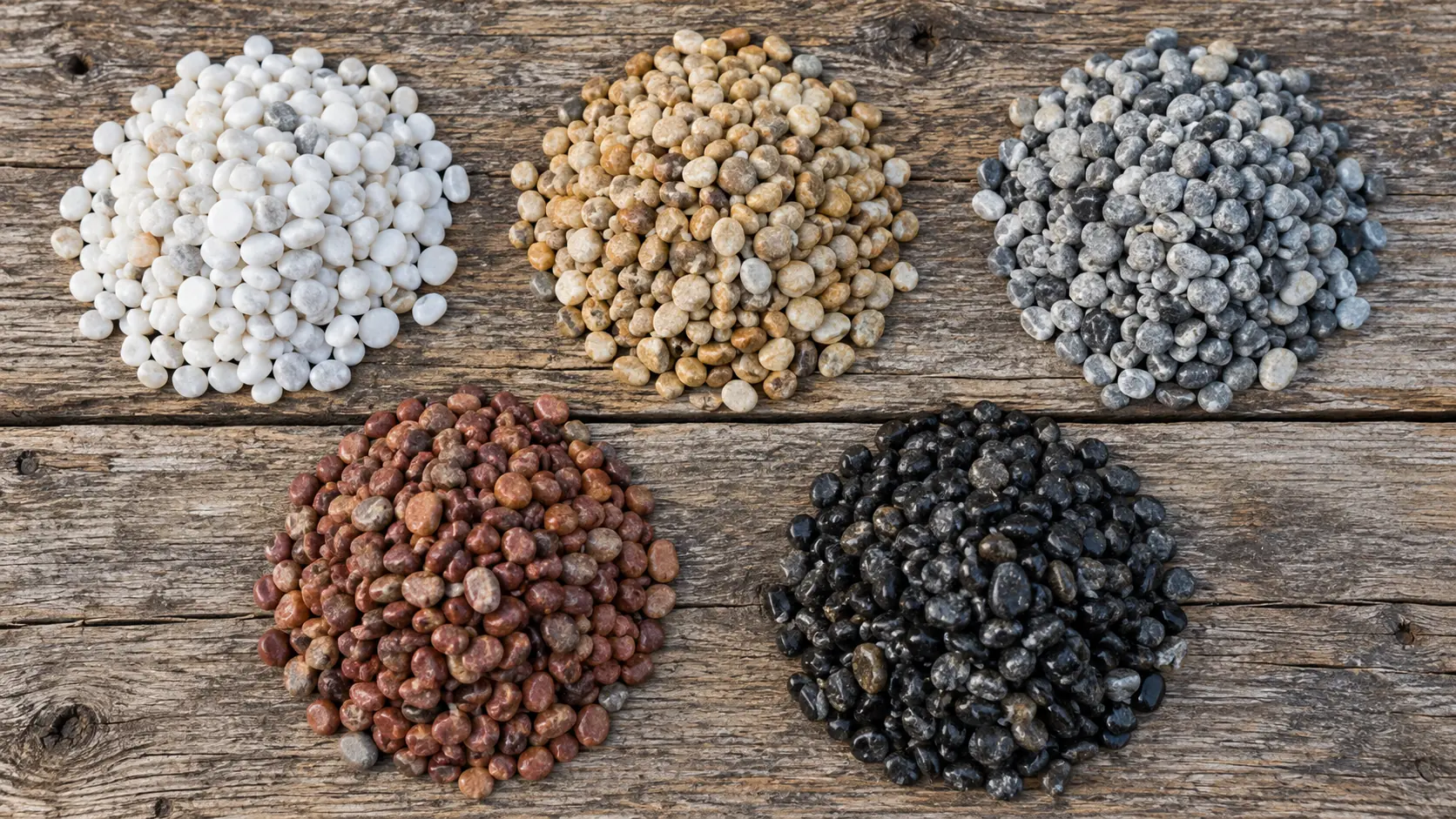
Two bags labelled "white pea gravel" from different suppliers can come from completely different source rocks. One pH neutral, one that raises soil pH over time. This guide explains what each color actually means, what source rock it comes from, how it behaves in different conditions, and which color suits your specific project and climate.
In This Guide
- All colors at a glance
- Why color comes from the mineral
- White and cream
- Gray and charcoal
- Tan, buff, and brown
- Black
- Pink and rose
- Natural mixed blends
- Dyed and colored grades
- How color changes when wet
- Color in sun vs shade
- Choosing your color, decision guide
- Heat by color
- pH safety by color
- Regional color availability
- Pea gravel types
- Color maintenance
- Frequently asked questions
All Colors at a Glance
| Color | Source rock | pH effect | Heat (above ambient) | Best for |
|---|---|---|---|---|
| White / bright white | Quartzite | Neutral ✓ | +8–12°F (coolest) | Modern design, barefoot areas, shaded spaces |
| Cream / off-white | Limestone or quartzite | Ask supplier | +8–14°F | Formal gardens, contemporary landscaping |
| Light gray / silver | Granite | Neutral ✓ | +13–16°F | Driveways, paths, modern designs |
| Standard gray | Granite | Neutral ✓ | +15–18°F | Most versatile; suits nearly all styles |
| Charcoal / dark gray | Granite or basalt | Neutral ✓ | +20–25°F | Contemporary, high contrast with plants |
| Black | Basalt | Neutral ✓ | +22–28°F | Modern drama, contrast borders; not barefoot |
| Tan / buff / golden | Sandstone / mixed | Varies; ask | +12–16°F | Cottage garden, rustic, Mediterranean |
| Brown / reddish-brown | Iron-rich sandstone / mixed | Neutral ✓ | +14–18°F | Rustic, farmhouse, natural styles |
| Pink / rose | Feldspar-rich granite | Neutral ✓ | +12–16°F | Feature areas, flower bed highlights |
| Natural mixed | Mixed river deposit | Usually neutral | +12–18°F | General landscaping; most common retail product |
| Dyed (red/blue/green/yellow) | Any base + pigment | Neutral ✓ | Varies by base color | Small accent areas only; fades in 2–3 seasons |
Why Color Comes From the Mineral
Every natural pea gravel color traces back to the mineral composition of the parent rock. The original rock before erosion wore it into small rounded stones. This is why two bags labelled "pea gravel" from different quarries look nothing alike, and why the color name alone tells you less than you might think.
Use this pea gravel color chart as your decision reference. The full mineral origin explanation follows below.
The mineral agents that create color in pea gravel:
Iron oxide produces the warm tones in brown pea gravel. Rust, reddish-brown, tan, golden. Rocks rich in iron that were exposed to oxygen developed these warm colors as the iron oxidized. Most brown and tan pea gravel carries iron oxide as the primary color agent.
Quartz contributes white and translucent tones. Quartzite. The metamorphic rock formed when sandstone is subjected to extreme heat and pressure. Is the purest source of white pea gravel. Its crystalline quartz structure gives the stones a bright, sometimes sparkling white appearance.
Feldspar and mica create the gray and speckled tones characteristic of granite. Feldspar ranges from white to pink depending on its chemical composition. High-feldspar granite produces pink and rose tones. Mica creates the shimmering silver flecks visible in many gray pea gravel stones in direct sunlight.
Basalt minerals. Pyroxene, olivine. Create the deep dark gray and black tones. Basalt is dense volcanic rock; its dark color comes from iron-magnesium silicate minerals.
Calcium carbonate (limestone and dolomite) creates buff, cream, and off-white tones. This is functionally important: limestone-sourced gravel raises soil pH over time through calcium leaching. See the pH safety section below.
White and Cream
White pea gravel is the most searched individual color. And the most misunderstood, because "white" covers two completely different source rocks with very different properties.
Quartzite white. Bright, clean white from quartz-rich metamorphic rock. pH neutral. The color is permanent mineral color. It never yellows, never fades, and never leaches anything into adjacent soil. The best white pea gravel for any application near plants comes from a quartzite source.
Limestone and dolomite white / cream. Off-white to cream color from calcium carbonate rock. Also completely natural color that does not fade. The critical difference: limestone is calcium carbonate. It leaches calcium ions into adjacent soil over time, raising pH. This process is slow, years rather than months, but cumulative. Acid-loving plants placed next to limestone-based pea gravel begin to show stress in years two through four as the pH shifts. By year five, azalea, blueberry, camellia, and rhododendron planted adjacent to limestone gravel can fail entirely.
The rule: if you need white or cream pea gravel near acid-preferring plants, ask your supplier specifically whether the product is quartzite or limestone. Do not rely on color alone.
White gravel in shaded or damp areas is prone to algae growth. A green or gray-green film develops on the stone surface. See the maintenance section for the cleaning method. Gray pea gravel in the same conditions hides algae discoloration far better.
White and cream grades are the coolest color option for summer surface temperature. Light-colored stones reflect rather than absorb solar radiation. Reaching only 8 to 12°F above ambient air temperature in direct sun. This makes them the right choice for barefoot areas and dog runs in hot climates.
Gray and Charcoal
Gray is the most widely stocked pea gravel color nationally. Most landscape supply yards, Home Depot, and Lowe's carry gray as their standard grade. It suits the widest range of house styles, does not show tire marks on driveways, hides debris well, and is available at standard price with no color premium.
Gray pea gravel comes from granite. One of the most common building and landscaping stones in North America. Granite is pH neutral, chemically inert, and extremely durable. The gray color comes from a mix of quartz, feldspar, and dark mica minerals in the stone structure.
The shade range within "gray" is wide. Light silvery gray is almost white. Deep charcoal gray is almost black. Suppliers vary significantly in their gray grades. Always request a sample before ordering in bulk, as "gray pea gravel" from one yard can look dramatically different from another's.
Darker charcoal and near-black gray comes from basalt-dominant or high-mica granite sources. These darker grades absorb more heat than lighter gray. Reaching 20 to 25°F above ambient compared to 15 to 18°F for standard gray. For barefoot or dog-run applications in hot climates, choose lighter gray rather than charcoal.
Tan, Buff, and Brown
These warm earth tones are the most common natural color in many regions, particularly the Southeast and Midwest where river deposits carry high iron-oxide content. The color range spans pale golden tan through warm buff to deep reddish-brown.
Brown and tan pea gravel suits cottage gardens, rustic landscapes, farmhouse styles, and any design where warm earthy tones complement timber, stone, and brick. It blends naturally with soil and works well as a backdrop for flowering perennials. The warm neutral does not compete visually with colored blooms.
One design rule competitors all note: avoid pairing brown or tan gravel with gray house exteriors. Brown is a warm neutral. Gray is a cool neutral. The two tones create visual tension that reads as an accident rather than a design decision. Warm gravel requires a warm backdrop. See the decision guide below for the full warm-cool pairing logic.
The pH status of tan and buff grades depends on source rock. River deposits with sandstone and granite content are pH neutral. Buff grades from limestone sources raise pH. Tan and buff colors are the ambiguous zone. Always ask suppliers to confirm the rock type for these shades.
Black
Black pea gravel comes from basalt. Dense volcanic rock that contains no light-reflecting minerals. The color ranges from deep midnight black to softer charcoal, depending on whether the batch is pure basalt or a basalt-granite blend.
Black gravel creates maximum visual contrast. Against light-colored walls, bright green foliage, or pale stone pavers, black gravel reads as dramatic and intentional. It suits contemporary, minimalist, and Japanese-inspired garden styles. It is easier to keep clean visually than white. Debris, leaves, and soil are less visible on a dark surface.
The significant limitation: surface temperature. Black basalt gravel reaches 22 to 28°F above ambient air temperature in direct summer sun. On a 90°F day, the surface can reach 112 to 118°F. Hot enough to burn bare feet and dog paws. Use black gravel only in areas where barefoot or paw contact is unlikely, or ensure shade cover during afternoon peak heat.
Black gravel is pH neutral. Basalt contains no calcium carbonate and does not affect soil pH. Safe near all plant types.
Pink and Rose
Pink pea gravel comes from feldspar-rich granite. When granite contains high concentrations of potassium feldspar, which is naturally pink to salmon in color, the resulting stone carries pink, rose, or peachy tones. The intensity ranges from subtle blush pink through to strong rose-salmon depending on the feldspar concentration in the specific quarry deposit.
Pink gravel suits cottage gardens, formal English-style borders, and feature areas where a warmer, softer tone is wanted without the full warmth of tan or brown. It works particularly well as an accent material in small quantities. A pink gravel path leading to a garden seat, or a pink-gravel filled flower bed surrounded by standard gray paths.
Pink granite grades are pH neutral. Feldspar and quartz, the minerals that produce the color, are both chemically inert in soil applications.
Natural Mixed Blends
Natural mixed pea gravel comes from river deposits that collected stones from multiple parent rock types. The result is a varied blend of tan, gray, brown, white, and buff stones in a single batch. Every stone slightly different, the overall effect a warm, natural multi-tone palette.
Natural mixed is the most common retail product. Most 50-lb bags at home improvement stores contain a natural mixed blend rather than a single color. It is also the most forgiving color selection for large areas. The variation prevents the uniform flatness that can make a single-color large installation look monotonous.
For large landscaping projects where a single consistent color is wanted, natural mixed is not the right choice. Batches from different deliveries will vary noticeably. Order all material for a large project from the same batch delivery if color consistency matters.
The pH status of natural mixed depends on what river source rocks are in the blend. Most are neutral, but confirm with suppliers for grades with significant buff or cream content.
Dyed and Colored Grades
Dyed pea gravel and rainbow pea gravel both have pigment applied to the stone surface after production. Typically through a tumbler or mixer process that coats each stone. This creates vivid colors unavailable in natural stone: bright red, cobalt blue, emerald green, sunshine yellow, and purple.
How dyed pea gravel is made
Manufacturers take standard natural pea gravel, usually gray or buff, and coat it with acrylic or mineral-based dyes in industrial mixers. Some grades use paint, others use chemical mineral dyes. The coating sits on the stone surface, not within its mineral structure.
Fade timeline
UV radiation begins breaking down the surface pigment almost immediately on installation. The visible fade sequence:
Months 3–6: Slight loss of vibrancy in direct sun areas.
Season 1–2: Noticeable color shift. Bright red becomes muted rust, blue becomes gray-blue.
Season 2–3: Significant fade. The color is a washed-out shadow of the original.
Year 3: Most dyed grades need replacement to restore the original appearance.
True 5-year cost
Dyed grades cost $20 to $50 per ton more than standard natural grades. Combined with full replacement at year 2 or 3, the 5-year cost of dyed pea gravel runs two to three times higher than natural mineral color over the same installation area. Use the cost calculator to compare both options at your supplier's prices before deciding.
When dyed is acceptable
Small accent areas, a 20-square-foot feature border, a pot-sized decorative circle, where replacement every 2 to 3 years is manageable. Container gardens where the gravel can be replaced easily. Seasonal or temporary installations. Any permanent, large-scale installation is wrong for dyed grades.
How Color Changes When Wet
Every pea gravel color looks significantly different dry versus wet. And the difference surprises most homeowners who selected a color from a dry sample in a garden center.
| Color (dry) | Color (wet) | Change description |
|---|---|---|
| White / bright white | Cream / light gray | Loses the crisp brightness; looks softer and warmer |
| Cream / off-white | Warm tan / beige | Develops noticeable warmth and depth |
| Light gray | Medium gray | One to two shades darker |
| Standard gray | Dark gray / charcoal | Looks almost black in heavy rain |
| Tan / buff | Rich reddish-brown | Significant warm shift; the most dramatic change |
| Brown | Deep rich brown | Darker and more saturated |
| Black | Matte deep black | Darker and richer; less variance than lighter colors |
| Natural mixed | Deeper version of itself | All tones deepen; warm tones shift most noticeably |
The dry appearance returns within 30 to 60 minutes of sun exposure after light rain, and within a few hours after heavy rain. In permanently damp or shaded areas, the wet appearance can be the persistent reality rather than the exception.
Always request wet and dry samples from your supplier before placing a bulk order. Hold the dry sample in one hand and pour a little water on it to see the wet state immediately. Do not make a final color decision from a dry sample alone.
Color in Sun vs Shade
The same gravel color behaves differently depending on how much light reaches it. Three variables matter: direct sun, shade, and artificial evening light.
In direct sun: Light colors (white, cream) appear brighter and more reflective. Almost glowing in bright midday sun. Dark colors (black, charcoal) appear richer and more saturated. Mid-tones (standard gray, buff) show their full mineral variation. The sparkle of mica, the variation between stones.
In shade: All colors shift darker and more muted. White in deep shade appears gray. Buff appears brown. Standard gray can look almost charcoal. Light-colored gravel in a heavily shaded area helps reflect ambient light and visually brightens the space. This is the main reason garden designers specify white or light gray in north-facing beds and shaded courtyards. Dark gravel in shade creates a very dark visual that can make a shaded space feel oppressive.
In the evening with artificial light: White and cream gravel reflects artificial light upward, making outdoor spaces appear larger and warmer after dark. Dark gravel absorbs light, creating a more intimate, enclosed feel. String lights over tan or cream gravel produce the warmest evening atmosphere. If evening use matters to you, factor this into the color selection alongside the daytime appearance.
Test samples in your actual project location at different times of day before ordering. A sample that looks perfect in a sunny garden center may look very different in your north-facing side yard or under a pergola.
Choosing Your Color: Decision Guide
By house exterior tone
The best pea gravel color for landscaping depends first on your house exterior tone. The single most reliable color selection rule: match the temperature of the gravel to the temperature of the house exterior.
| House exterior | Tone | Best gravel colors | Avoid |
|---|---|---|---|
| Red or orange brick | Warm | Buff, tan, brown, natural mixed | Cool gray, stark white, black |
| Tan / cream render | Warm | Buff, warm tan, brown, natural mixed | Cold gray, blue-gray |
| Gray render / stone | Cool | Light gray, white, charcoal | Brown, warm tan, rust |
| White painted / render | Neutral / cool | White, light gray, black (high contrast) | Busy multi-color mixes |
| Dark gray / charcoal cladding | Cool | White or light gray; high contrast | Brown, buff, warm tan |
| Timber / cedar cladding | Warm | Natural mixed, buff, brown | Cold white, blue-gray |
| Blue-gray stone or slate | Cool | Gray, white, charcoal | Brown, warm tan |
By garden style
| Garden style | Best color | Why |
|---|---|---|
| Modern / contemporary | Gray or white | Clean neutrals suit angular architecture and architectural plants |
| Cottage garden | Buff, light tan, natural mixed | Warm neutrals complement soft planting and brick paths |
| Mediterranean | Warm buff / terracotta tones | Matches terracotta pots and warm stone walls |
| Japanese / Zen | White or light gray | Raking patterns show best in fine, light-toned grades |
| Rustic / farmhouse | Brown, tan, natural mixed | Earthy warmth suits timber and stone structures |
| Desert / xeriscape | Warm tan, buff, terracotta | Complements desert plants and clay-colored soil |
| Formal / parterre | Gray or buff | Neutral tone keeps focus on formal plant structure |
By climate and use
In hot climates where afternoon temperatures regularly exceed 85°F: choose white or cream quartzite. It is the coolest natural option and the safest for barefoot use and dog runs. See the full heat table below.
In permanently damp or heavily shaded areas: choose gray or dark gray over white. White gravel develops algae discoloration in damp shade. Gray hides it far better and requires less maintenance to stay presentable.
For driveways: gray is the practical choice. It hides tire marks, does not show road dust, suits most house styles, and is available at standard price everywhere. Natural mixed is the next best option for hiding dirt and settling patterns on driveways.
For large areas where pattern or monotony could be a problem: natural mixed blends. The stone-to-stone variation creates visual interest that single-color grades lack at scale.
Heat by Color
| Color | Surface temp above ambient | Barefoot / dog run suitability |
|---|---|---|
| White / cream quartzite | +8–12°F | ✓ Best choice in hot climates |
| Cream / off-white (limestone) | +8–14°F | ✓ Good; but check pH for plants |
| Light gray / silver | +13–16°F | ✓ Good |
| Tan / buff | +12–16°F | ✓ Good |
| Standard gray | +15–18°F | ⚠ Hose down before afternoon use on hot days |
| Brown | +14–18°F | ⚠ Moderate heat |
| Natural mixed | +12–18°F | ⚠ Depends on blend; hose down in summer |
| Dark gray / charcoal | +20–25°F | ✗ Too hot barefoot on summer afternoons |
| Black / basalt | +22–28°F | ✗ Avoid for barefoot areas or dog runs |
Heat data sourced from Lawrence Berkeley National Laboratory surface temperature research. On a 90°F summer afternoon, black basalt gravel can reach 112 to 118°F. Hot enough to cause burns on bare feet or dog paws within seconds. Hosing any gravel surface drops the surface temperature by 15 to 25°F within minutes, which helps for brief barefoot use even with darker grades. But for any area with regular barefoot or paw contact, start with the lightest color available from your supplier. See the full analysis in what is pea gravel.
pH Safety by Color
| Color | Likely source | pH effect | Safe near acid plants? |
|---|---|---|---|
| Bright white / true white | Quartzite | Neutral | ✓ Yes |
| Cream / off-white | Limestone or quartzite; ask | Raises pH if limestone | ⚠ Confirm source |
| Buff / pale tan | Limestone or sandstone; ask | Raises pH if limestone | ⚠ Confirm source |
| Standard gray | Granite | Neutral | ✓ Yes |
| Charcoal / black | Basalt or dark granite | Neutral | ✓ Yes |
| Brown / tan | Sandstone / iron-rich mixed | Usually neutral | ✓ Usually yes |
| Pink / rose | Feldspar-rich granite | Neutral | ✓ Yes |
| Natural mixed | Mixed river deposit | Usually neutral | ✓ Usually; confirm if cream-heavy |
| Dyed grades | Any base + pigment | Neutral (dye does not affect pH) | ✓ Yes |
Acid-loving plants that suffer near limestone-based gravel: azalea, blueberry, camellia, rhododendron, pieris, heather, and most conifers. The pH shift is gradual. The plants may look fine in year one and decline noticeably in years two through four as calcium accumulates in the adjacent soil. By the time the cause is obvious, replacing the gravel is the only real fix.
The test: if you care about this distinction, buy a cheap pH testing kit from any garden center. Add a sample of your proposed gravel to a jar of distilled water, leave for 24 hours, then test the water's pH. Quartzite and granite grades should show no change. Limestone-based grades will raise the pH of the test water measurably.
Regional Color Availability
The color most available locally and cheapest reflects the local geology. Quarries extract what is present in their region. They do not import rock for color variety.
| Region | Most available / cheapest | Notes |
|---|---|---|
| Southeast (GA, AL, SC, TN) | Tan, buff, brown, natural mixed | Iron-rich river deposits dominate local geology |
| Midwest (OH, IN, IL, MO) | Gray-white, natural mixed | Glaciofluvial deposits; Indiana pea gravel prominent |
| Northeast (NY, MA, CT, PA) | Gray | Granite-dominated local quarries |
| Mid-Atlantic (NJ, MD, VA) | Jersey Shore tan/gold, gray | Both coastal deposits and quarry stone available |
| Pacific Coast (CA, OR, WA) | Natural mixed, gray | Mixed river sources; premium for specialty colors |
| Mountain West (CO, UT, AZ) | Buff, tan, natural mixed | Desert geology; warm tones dominate |
| National (all regions) | White quartzite, black basalt | Available everywhere; slight premium over local grades |
Ordering a color that is not local to your region costs more. Transport distance adds to the per-ton price. White quartzite and black basalt are available nationally but may carry a $5 to $20 per ton premium over local standard grades in regions where they are not quarried. Call local landscape supply yards and ask what they stock before designing around a specific color.
Pea Gravel Types
River pea gravel
Sourced directly from riverbeds and floodplains. The longest natural tumbling process, thousands of years of water erosion, produces the smoothest, most uniformly rounded stones with the most polished surface appearance. River pea gravel shows the greatest color variation within a batch, reflecting the diverse rock types that entered the river system at different points upstream. Often described as the premium option for visible landscaping applications. The extra smoothness and color variation create a richer, more natural appearance than quarry-processed grades.
Quarry pea gravel
Produced at quarries by mechanically crushing larger stone and then running it through tumblers or graders to achieve a rounded finish. Less expensive than river-sourced material in most regions, and more color-consistent within a batch because it comes from a single rock source. The rounding is less perfect than water-worn river gravel. Quarry grades often include some slightly angular pieces. For most practical applications the difference is not significant, but for high-visibility decorative work, request river-sourced material.
Indiana pea gravel
A specific regional type sourced from the White River basin in Indiana. Glaciofluvial deposits, stones transported and rounded by glacial meltwater during the last Ice Age, produce a consistently gray-white, very smooth stone that has been rounded by both ice and water action. Indiana pea gravel is well known in Indiana, Illinois, and Ohio for its clean appearance and reliable supply. The gray-white color makes it pH-neutral quartzite-dominated material suitable for all plant types. Functionally it performs identically to any rounded pea gravel of equivalent size.
Jersey Shore gravel
A regional name used in New England and Mid-Atlantic states for tan, gold, and warm-brown rounded gravel with a beach-sand quality. Named for the color, not the structure. Functionally identical to standard pea gravel. Available at most landscape supply yards in the New England/Mid-Atlantic region at standard pricing. The warm golden color suits warm-toned house exteriors and Mediterranean-style landscaping. See the full explanation in the comparison guide.
Washed pea gravel
Any of the above types that has been cleaned to remove clay fines, silt, and dust. Washed material drains better, looks cleaner, and performs better in all applications. Always specify washed when ordering. Unwashed pea gravel of any color will turn muddy after rain as the fine particles migrate to the surface. The full explanation of washed vs unwashed is in the what is pea gravel guide.
Color Maintenance
Different colors require different maintenance effort to stay presentable over time.
Dark gray and black: The lowest maintenance colors for appearance. Debris, leaves, soil, and organic matter are all less visible. Algae and moss growth blends in rather than standing out. Occasional raking and leaf blowing is all that is needed. Dark colors do not show discoloration from rain splash or run-off.
Standard gray and tan: Moderate maintenance. Raking 2 to 4 times per year maintains the surface appearance. Occasional hosing after dusty periods or construction work nearby. These colors suit high-traffic areas where the gravel gets disturbed regularly. The moderate tone hides imperfection better than white without requiring the full attention white demands.
White and cream: The highest maintenance colors for appearance. Leaves, soil splash, and debris are all highly visible against a white surface. In damp or shaded conditions, algae and moss grow on the stone surface, turning white gravel green or gray-green.
Cleaning white or cream gravel that has turned green: prepare a solution of one part household bleach to ten parts water. Apply with a watering can or garden sprayer over the affected area. Leave for 10 to 15 minutes, then rinse thoroughly with a hose. Avoid applying bleach solution near plants. Rinse any affected foliage immediately after cleaning the gravel.
To reduce the recurrence of algae on white gravel: improve drainage so the surface dries faster after rain, trim any overhead plants or structures that create permanent shade, and consider applying a commercial algae preventer (available at garden centers) once per season in areas prone to damp conditions. The full maintenance schedule for pea gravel of all colors is covered in the maintenance guide.
Worked Color Decision Examples
Mediterranean front garden in a hot climate. A homeowner in Arizona installing a drought-tolerant front garden with lavender, rosemary, and ornamental grasses. The correct color choice is light gold or buff pea gravel. The dominant color of southern European gravel terrain where these plants originate. White quartz gravel is cooler but creates high visual contrast that can look stark in hot sunlight. Gray or mixed gravel suits the color palette of the plants. The choice is largely aesthetic, but matching the native terrain of the plants creates a coherent design.
Modern minimalist garden with dark planting beds. Black edging, architectural grasses, and dark-stemmed plants need a light gravel surface to create contrast. White or light gray quartz pea gravel is the correct choice. It reads as a deliberate design element against dark stems and edging. Tan or buff gravel in the same setting blends too softly. The white surface also reflects more light into shadowed areas of the garden.
Naturalistic woodland garden. Color mismatch warning. White pea gravel in a woodland or naturalistic garden setting looks artificial and out of place. The clean white surface conflicts with the soft, organic character of the planting. Natural brown, mixed, or gray-brown pea gravel reads as organic and suits the setting. The color choice is one of the most consequential design decisions in pea gravel landscaping.
4 Pea Gravel Color and Type Mistakes
Mistake 1. Buying dyed pea gravel expecting permanent color. Dyed black or red pea gravel fades significantly within 2 to 3 seasons of UV exposure. The color that looks intense in the supplier's yard or online photo becomes washed-out gray-brown within two summers. Natural mineral color, the inherent color of the stone, never fades. If color longevity matters, always buy naturally colored stone and confirm the color comes from the mineral, not from a dye or coating.
Mistake 2. Using white pea gravel in a shaded location. In shade with limited sunlight, white pea gravel develops algae and moss within one to two seasons, turning the surface gray-green. The maintenance required to keep white gravel clean in shade, annual bleach treatment, regular hosing, is significantly higher than in full sun. Reserve white pea gravel for south-facing or full-sun locations. Use gray or tan for shaded areas.
Mistake 3. Mixing different color batches from different deliveries. Pea gravel color varies by quarry and by batch. Topping up a tan pea gravel installation with a new delivery from the same supplier can produce visible color variation if the new batch came from a different part of the quarry. Always keep a sample of the original material and compare it to any top-up delivery before spreading. Color inconsistency in a top-up is difficult to correct without removing and replacing the entire surface.
Mistake 4. Choosing color without seeing it wet. Pea gravel looks very different wet than dry. Most natural stones deepen and saturate in color when wet. A light tan pea gravel that looks neutral when dry becomes a warm amber when wet. White gravel stays relatively light when wet. Always ask the supplier to wet a sample before committing to a color for a large order. Particularly for pool surrounds and garden paths where the surface will frequently be wet.
Frequently Asked Questions
What colors does pea gravel come in?
What is white pea gravel made of?
Does pea gravel color fade?
Does pea gravel change color when wet?
What color pea gravel is best for landscaping?
Which pea gravel color is coolest in summer?
Is pea gravel color safe for plants?
What is the difference between natural and dyed pea gravel?
What is Indiana pea gravel?
What is Jersey Shore gravel?
Why is my white pea gravel turning green?
Can you mix pea gravel colors?
Related Calculators
Coverage Calculator
Once you have chosen your color and confirmed availability, calculate exact quantities before calling your supplier.
CalculatorCost Calculator
Enter your supplier's price per ton to compare the true 5-year cost of natural vs dyed grades at your specific project size.
CalculatorBags Calculator
Buying bagged pea gravel to test a color before committing to bulk? Get the exact bag count for your sample area.
Related Guides
What Is Pea Gravel?
Geological formation, rock types, void ratio, washed vs unwashed, and all uses including dogs, aquariums, and drainage.
IdeasLandscaping Ideas
20 project ideas with color recommendations for each, plant pairings, and the warm-cool design rule in action.
MaintenanceMaintenance Guide
Raking schedule, weed control, depth top-up timing, and color-specific cleaning including white gravel algae treatment.
Cost Guide 2026
Per-ton pricing by color and grade including the dyed grade premium and 5-year total cost comparison.
ComparisonPea Gravel vs Others
How pea gravel color performance compares with marble chips, lava rock, decomposed granite, and other materials.
GuideSizes Guide
Color and size work together. The right size for each application type alongside the color decision.
Sources & Methodology
- USGS: Natural Aggregates Statistics: mineral composition reference and density data for construction aggregates
- ASTM C33/C33M-24A: aggregate gradation and quality specifications
Heat data: Lawrence Berkeley National Laboratory surface temperature research on urban and landscape materials. pH data: USDA soil science references and standard horticultural practice. Full methodology
Last reviewed: October 2026