
20 Pea Gravel Landscaping Ideas: Designs, Costs and Plant Pairings
Pea gravel costs $30 to $55 per ton. Concrete costs $90 per cubic yard. Pavers run $10 to $20 per square foot installed. The price gap is real. And pea gravel delivers a better result in most landscape applications when installed correctly. Whether you are looking for pea gravel garden ideas for a quiet retreat, backyard landscaping ideas on a budget, or a full pea gravel landscape design for a drought-tolerant front yard. Each idea below gives you the size, depth, approximate material cost, plant pairings, and a link to calculate exact quantities.
In This Guide
- Before you start: 5 planning decisions
- All 20 ideas at a glance
- Paths and walkways (Ideas 1–4)
- Patios and seating areas (Ideas 5–7)
- Front yard and curb appeal (Ideas 8–9)
- Water and drainage (Idea 10)
- Specialty areas (Ideas 11–16)
- Sloped yard solutions (Idea 17)
- Small backyard ideas (Ideas 18–19)
- Creative approaches (Idea 20)
- Plant pairings by design style
- Color by house exterior
- How to keep pea gravel in place
- 10 design mistakes to avoid
- Frequently asked questions
Before You Start: 5 Planning Decisions
Make these five decisions before ordering a single ton. They determine whether the finished result looks designed or dumped.
1. Gravel color. Match the gravel tone to your house exterior. Warm exteriors (brick, tan render, cream) need warm gravel. Cool exteriors (gray render, white walls) need cool gravel. Full guidance in the color section below.
2. The 60/40 rule. Gravel occupies 60 percent of any area at most. Plant mass covers the remaining 40 percent minimum. Pure gravel with a few isolated plants reads as a parking lot. Design planting islands first, then fill the rest with gravel.
3. Edging type. Every pea gravel installation needs perimeter containment. Steel edging staked every 2 feet is the most durable. Composite suits curved beds. Timber works for formal paths and patios. Without edging, gravel migrates into adjacent lawn within weeks. The installation guide covers edging installation in detail.
4. Calculate before ordering. Measure your area, choose a depth from the table below, and use the coverage calculator before calling a supplier. Add 10 percent for waste. One ton goes further than most people expect. Running short halfway through a project is a common and avoidable problem.
5. Washed only. Always specify washed pea gravel. Unwashed material carries clay fines that destroy drainage and create a muddy surface after the first rain. See what is pea gravel for a full explanation of the difference.
All 20 Ideas at a Glance
| Idea | Best size | Depth | Approx. material cost |
|---|---|---|---|
| 1. Casual garden path | 3/8 in | 2–3 in | $0.50–$1.20/sq ft |
| 2. Formal entry path | 3/8 in | 2–3 in | $0.80–$1.50/sq ft |
| 3. Stepping stone hybrid path | 3/8 in | 2 in between stones | $1.00–$2.50/sq ft incl. stones |
| 4. Barefoot pool path | 1/4 in | 2 in | $0.60–$1.20/sq ft |
| 5. Outdoor dining patio | 3/8 in | 3 in | $1.00–$2.00/sq ft |
| 6. Fire pit surround | 3/8 in | 3–4 in | $1.00–$1.80/sq ft |
| 7. Modern paver courtyard | 3/8 in gray | 2–3 in | $2.50–$5.00/sq ft incl. pavers |
| 8. Xeriscape front yard | 3/8 in | 2 in | $1.00–$2.00/sq ft |
| 9. Formal entry with symmetry | 3/8 in | 2–3 in | $0.80–$1.50/sq ft |
| 10. Dry creek bed | 3/8 in + 1/2 in mix | 4–6 in | $1.50–$3.00/sq ft |
| 11. Dog run | 3/8 in | 3–4 in | $0.80–$1.50/sq ft |
| 12. Children's play area | 1/4 in | 9–12 in | $3.00–$5.00/sq ft |
| 13. Zen and meditation garden | 1/8 in | 2–3 in | $1.20–$2.50/sq ft |
| 14. Side yard utility path | 3/8 in | 2–3 in | $0.60–$1.20/sq ft |
| 15. Raised bed surround | 3/8 in | 2–3 in | $0.50–$1.00/sq ft |
| 16. Water feature surround | 3/8 in | 3 in | $0.80–$1.50/sq ft |
| 17. Terraced sloped yard | 3/8 in | 3 in per terrace | $1.50–$3.50/sq ft incl. walls |
| 18. Small backyard micro-patio | 3/8 in | 3 in | $1.00–$2.00/sq ft |
| 19. City courtyard base | 3/8 in gray | 3 in | $1.00–$2.00/sq ft |
| 20. Epoxy-bound outdoor floor | 3/8 in | 1 in (epoxy-set) | $4.00–$8.00/sq ft |
Paths and Walkways
Idea 1; The Casual Garden Path
A meandering gravel path through planted beds is the most common pea gravel landscaping project. And one of the most successful. It fills irregular shapes that would cost a fortune in pavers, handles curves naturally, and looks better as plants spill over the edges over time.
What makes it work: Steel edging on both sides. 4-oz woven landscape fabric underneath on sandy or loam soil, non-woven on clay. Keep the path width at least 30 inches. Narrower feels cramped. Allow the path to follow the line people actually walk, not the designer's ideal route.
Near entry doors, stay with 3/8-inch grade. It tracks indoors less than finer stone. For paths used mainly in bare feet or sandals, step down to 1/4 inch. The difference underfoot is noticeable.
Plant pairings: Lavender, catmint, and creeping thyme all spill naturally over path edges and soften the hard line between gravel and bed. Salvia and nepeta add height without blocking the path.
Size and depth: 3/8 inch at 2 to 3 inches deep over a 1-to-2-inch compacted base.
Approx. material cost: A 30-inch by 20-foot path runs $40 to $80 in gravel and base stone. Use the coverage calculator for exact quantities.
Idea 2; Formal Entry Path
A straight gravel path from the gate or street to the front door adds instant structure. Boxwood topiary or symmetrical plantings flanking both sides transforms a basic gravel strip into a formal arrival sequence.
The key distinction between a formal path and a casual one is the edging. Formal paths use clean metal edging or a double row of cast concrete edging blocks that create a visible linear boundary. The gravel sits crisp inside that boundary. Mess with the line and the formality collapses.
Plant pairings: Matched plantings in pairs. Boxwood spheres, standard roses, or lavender columns on each side at regular intervals. The symmetry is the design; the gravel is the floor.
Size and depth: 3/8 inch at 2 to 3 inches. Gray or buff color suits most house styles.
Approx. material cost: A 36-inch by 30-foot path runs $60 to $120. Calculate with coverage calculator.
Idea 3; Stepping Stone and Gravel Hybrid Path
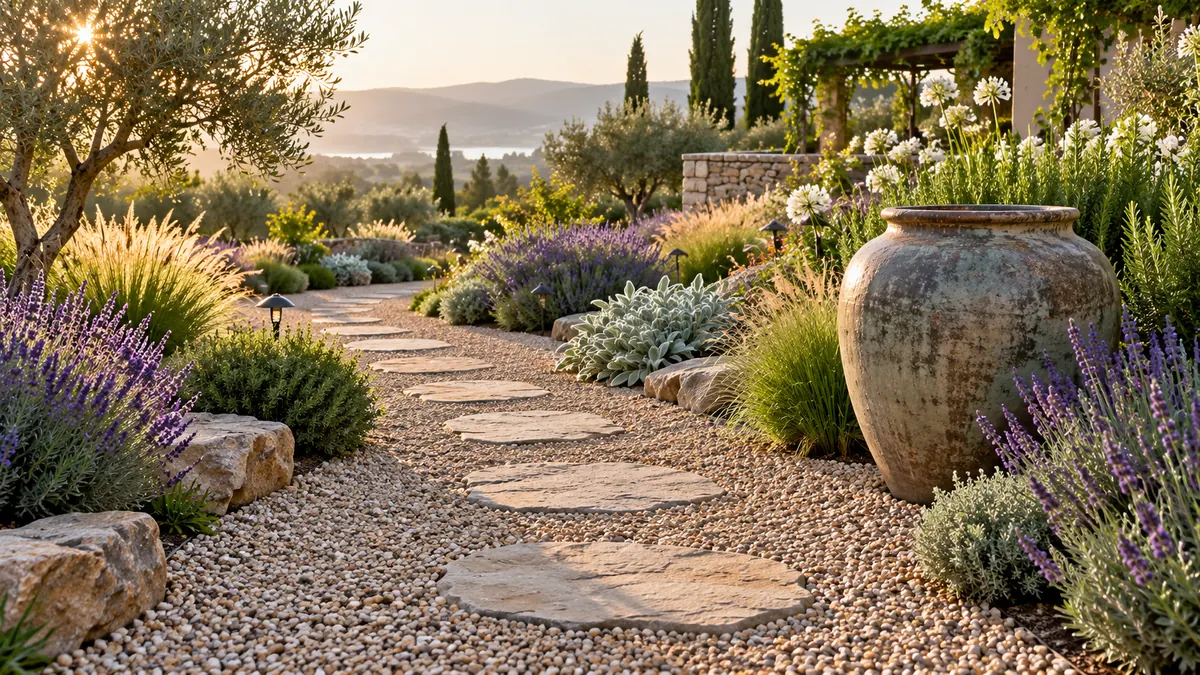
Large flat stones, 24-inch square concrete, limestone, or bluestone, set in a grid or offset pattern with 3/8-inch pea gravel filling the surrounding area and the gaps between them. The stepping stones give confident footing. The gravel handles drainage and visual texture.
The critical detail: set each stone so its top surface sits 1/4 to 1/2 inch above the finished gravel level. Flush stones collect gravel and feel unstable underfoot. Proud stones give a clear footfall target and feel solid.
Color note: Pair cream or buff limestone stones with gray gravel for contrast. Pair concrete pavers with tan gravel for a warmer, unified look. Same-tone stone and gravel loses the visual separation that makes this design work.
Size and depth: 3/8 inch at 2 inches in the gravel areas, with stones set at proper height above finished surface.
Approx. material cost: Stones add $3 to $6 per square foot above the gravel cost. Budget both together.
Idea 4; Barefoot Path Around Pool
The path from the house to the pool and around the pool surround gets used barefoot. That changes the size specification immediately. Use 1/4-inch grade. Noticeably softer underfoot than the standard 3/8-inch, and the stones are less likely to stick between toes after a swim.
Pool splash drains straight through pea gravel. Concrete pool surrounds stay wet for an hour after swimming; gravel is dry in minutes. Hot in direct afternoon sun. Hose the surface before afternoon use in summer. See the note on pea gravel surface temperatures in the what is pea gravel guide.
Plant pairings: Agapanthus, ornamental grasses, and tropical plants suit pool surrounds. They look right near water and handle wet-dry cycles well.
Size and depth: 1/4 inch at 2 to 3 inches. White or cream grade reflects heat and light well in this application.
Approx. material cost: Around a 12x24-foot pool: approximately 1.5 yd³ for a 4-foot border. Use coverage calculator.
Patios and Seating Areas
Idea 5; Outdoor Dining Patio
A 12x14-foot patio handles a 6-person dining set with pull-out clearance on all sides. The minimum for comfortable outdoor dining. Material cost runs $300 to $500 for a full DIY install. Compare that to $1,300 to $2,500 for concrete over the same footprint, and the budget case makes itself.
The single addition that transforms a gravel patio from frustrating to functional: set 12-inch concrete or natural stone pavers under every furniture leg. Chairs and tables stop sinking. The table sits level. Guests stop adjusting their chair angle every time they move.
Leave at least 18 inches of gravel beyond the furniture footprint on all sides. Less than that and the patio feels cramped once the chairs are pulled back from the table.
Plant pairings: Potted citrus, rosemary standards, or olive trees in large terracotta containers placed at the patio corners give visual definition without requiring bed planting. They can be moved when needed.
Size and depth: 3/8 inch at 3 inches over a 2-inch compacted base.
Calculate your patio: The patio calculator handles rectangular and circular layouts. For cost per square foot at your supplier's price, use the cost calculator.
Idea 6; Fire Pit Surround Zone
A defined circular zone of pea gravel around a fire pit creates a non-combustible outdoor room. Comfortable for bare feet on a summer evening, easy to sweep clean with a leaf blower, and it separates the fire area from the rest of the lawn without a wall or fence.
Minimum diameter for comfortable seating: 12 feet. A 14-foot diameter gives generous spacing for 4 to 6 chairs with room to move. Use 3/8-inch grade at this size. Fine enough to be comfortable barefoot, coarse enough to stay in place.
Critical safety warning: Never put pea gravel inside the fire pit bowl. Moisture trapped inside the stones expands when heated rapidly, causing explosive spalling. The stones can crack or pop hard enough to cause injury. Set the fire pit itself on a concrete pad or fire-rated ceramic base. Pea gravel belongs on the surrounding ground area only. The sizes guide covers this in more detail.
Plant pairings: Low ornamental grasses at the outer edge of the gravel zone. Keep taller plants and any flammable planting well clear of the fire pit itself.
Size and depth: 3/8 inch at 3 to 4 inches over base.
Approx. material cost: A 14-foot diameter circle needs approximately 0.85 yd³. Use the circular patio calculator.
Idea 7; Modern Paver Courtyard
Set large concrete or limestone pavers, 24x24 inches or 24x36 inches, in a grid or random pattern with 3 to 4-inch joints between them. Fill the joints and the surrounding field with light gray or white pea gravel. The result reads as contemporary European courtyard design.
The pea gravel fill tolerates the slight level variation between individual pavers that would look wrong with a solid surface. Color contrast is essential: cream limestone pavers with dark gray gravel. Concrete pavers with light tan gravel. Matching stone and gravel tones kills the design effect entirely.
In 2026, this mixed-material hardscape approach is what professional landscapers recommend over all-gravel yards. The pavers give visual weight and stable footing at key points. The gravel provides permeability, drainage, and texture in between.
Plant pairings: Karl Foerster feather reed grass or blue fescue at the courtyard edges. Architectural plants with clean vertical lines suit the geometric paver grid.
Size and depth: 3/8 inch gray at 2 to 3 inches in the field areas.
Cost note: Pavers add $3 to $6 per square foot above the gravel cost. Budget both together when estimating. Use the cost calculator for the gravel portion.
Front Yard and Curb Appeal
Idea 8; Drought-Tolerant Xeriscape Front Yard
Replacing a high-water lawn with pea gravel and drought-tolerant plants saves a typical household 5,000 to 15,000 gallons of water per year. It also eliminates weekly mowing, seasonal reseeding, and fertilizer costs. This has shifted from fringe to mainstream in California, Texas, Arizona, Colorado, and across the UK.
The mistake most homeowners make: covering the entire front yard in gravel and adding a few isolated plants. That reads as a commercial forecourt. Design planting islands that occupy 40 percent or more of the total area. Allow the gravel to fill the remaining 60 percent. Edge the planting islands with steel to keep gravel and mulch separate.
Permitting note: Some municipalities require permits for lawn removal above certain square footage, or mandate minimum plant coverage percentages. Check local codes before excavating. This varies significantly by county and municipality.
Plant pairings: Agave, Russian sage, sedum, blue oat grass, lavender, and native ornamental grasses. Avoid acid-loving plants (azalea, blueberry, rhododendron) next to limestone-based pea gravel. Calcium leaching from limestone raises soil pH and stresses these plants over time. Use granite or quartzite grades near acid-preferring species.
Size and depth: 3/8 inch tan or buff at 2 inches over fabric.
Approx. material cost: 500 sq ft at 2 inches needs approximately 3.1 yd³. Use the coverage calculator. For the full budget including plants and edging, see the cost guide.
Idea 9; Formal Entry with Symmetrical Beds
Stone paths flanking symmetrical planted beds are a classic feature of parterre-style gardens. Scaled down for a residential front yard, the result suits Georgian, Victorian, French, and English-style homes particularly well. Pea gravel fills the path areas between the planted beds, keeping the design readable without the cost of cut stone throughout.
Symmetry does the design work here. Matched plantings in identical positions on each side of the front door. The gravel is just the floor connecting them. Keep the gravel color neutral: gray or buff. Dramatic or unusual colors fight the formal planting scheme.
Plant pairings: Matched boxwood spheres, lavender columns, standard roses, or clipped yew cones. Whatever plant you choose, use identical specimens in identical positions on both sides. Formal symmetry broken by unmatched plants reads as error rather than design.
Size and depth: 3/8 inch at 2 to 3 inches. Gray or buff.
Approx. material cost: Calculate at coverage calculator. Measure only the gravel areas, not the planted beds.
Water and Drainage
Idea 10; Dry Creek Bed for Drainage
A dry creek bed solves a real drainage problem while becoming a landscape feature. Designed well, it looks like a natural watercourse whether it is carrying runoff or bone dry in summer. This is one of the few landscaping ideas that fixes an actual yard problem rather than just adding decoration.
What makes it work: Excavate a meandering channel 12 to 18 inches deep and 18 to 36 inches wide. Line with non-woven geotextile. The drainage rate through non-woven is faster than woven for water management applications. Fill the center with a mix of 3/8-inch pea gravel as the base material, 1/2-inch stones mid-fill, and occasional larger river rock boulders at bends and transitions. The size variation creates the natural appearance of a real streambed. Grade the channel to fall toward a drain outlet or daylight exit. A flat dry creek bed is decorative but not functional as drainage.
This application calls for the full installation treatment. See the installation guide for fabric selection by soil type and slope guidance.
Plant pairings: Blue oat grass, Louisiana iris, and ornamental grasses planted along the bank edges look natural and soften the stone edges. These plants also tolerate the wet-dry cycle a drainage channel experiences.
Size and depth: Mixed 3/8 inch and 1/2 inch at 4 to 6 inches in the channel.
Approx. material cost: A 3-foot wide, 20-foot long creek bed needs approximately 1 yd³. Calculate with coverage calculator. For comparison with other drainage options, see pea gravel vs other materials.
Specialty Areas
Idea 11; Dog Run
Pea gravel is the preferred dog run surface among owners who have tried multiple options. It drains urine immediately with no pooling, holds no odor the way compacted soil does, won't stick to paw pads or coat unlike mud or bark, and stays cooler than concrete or dark pavers in afternoon sun.
Use 3/8-inch grade. The finer 1/8-inch grade packs into paw pads. Woven landscape fabric underneath is non-negotiable. Urine that pools below gravel without fabric creates a permanent odor reservoir in the soil underneath. Set the gravel at 3 inches and plan to rinse the surface weekly and replace the top inch annually.
In summer, hose down the surface before the dog uses it on hot afternoons. Light-colored pea gravel reaches 8 to 12°F above ambient air temperature in direct sun. Hot enough to be uncomfortable on paw pads.
The full build including drainage slope and odor management is covered in the pea gravel dog run guide (coming soon).
Size and depth: 3/8 inch at 3 to 4 inches over landscape fabric.
Approx. material cost: An 8x12 ft run needs approximately 0.9 yd³. Calculate at coverage calculator.
Idea 12; Children's Play Area
Pea gravel appears on the CPSC approved list for playground impact attenuation surfacing. At the right depth, it cushions falls and reduces injury risk measurably. The CPSC Handbook (2024 edition) sets these minimum depths:
| Equipment fall height | Minimum depth |
|---|---|
| Up to 4 ft | 6 inches |
| 4 to 5 ft | 9 inches minimum, 12 inches as-installed |
| 5 to 7 ft | 12 inches as-installed |
| Above 8 ft | Not recommended, regardless of depth |
Use 1/4-inch grade. Never use angular crushed stone on play surfaces. The edges cause abrasions on knees and hands from falls. Surround with timber edging that doubles as seating for supervising adults. Top up whenever depth falls below minimum. A play area that started at 12 inches needs annual checking.
Age warning: Pea gravel is not appropriate for children under 3 years old. All grades in the pea gravel size range are small enough to be swallowed. Use sand or rubber tiles for toddler areas. The full playground guidance including ADA accessibility notes is in the sizes guide.
The complete playground installation with fall zone specification is covered in the pea gravel playground guide (coming soon).
Size and depth: 1/4 inch at 9 to 12 inches.
Approx. material cost: A 20x20 ft area at 10 inches deep needs approximately 12 yd³. Bulk delivery only at this quantity. Use the cubic yards calculator.
Idea 13; Zen and Meditation Garden
Japanese-style raked gravel gardens use fine-grade pea gravel specifically because it holds a raked line. The 1/8-inch grade takes a clean pattern impression and holds it until deliberately disturbed. Standard 3/8-inch grade does not hold raking patterns. The stones are too coarse to show the line clearly.
The design restraint that makes Zen gardens work: less is more. A few carefully placed stepping stones, one bonsai or specimen plant, a stone lantern, and a bench facing the raked gravel. Every additional element reduces the meditative quality. The raking itself is part of the practice for many people. It becomes a daily ritual.
For a dedicated raked Zen garden, separate the space from the rest of the yard with a low bamboo fence, stone wall, or clipped hedge. Visual separation from the wider garden creates the enclosed quality that makes the space feel intentional rather than just a corner with gravel in it.
Plant pairings: Japanese maple, bonsai, bamboo (in a container to contain spread), and low-growing moss between stepping stones. Keep plant count to three or fewer species. Complexity kills the effect.
Size and depth: 1/8 inch at 2 to 3 inches over landscape fabric.
Approx. material cost: A 10x12 ft Zen garden needs approximately 0.37 yd³. Calculate at coverage calculator.
Idea 14; Side Yard Utility Path
The gap between house and fence, typically 3 to 5 feet wide, is rarely attractive and always functional. Two inches of pea gravel turns it from muddy transit corridor into a clean-looking, all-weather surface that handles dog traffic, bin-wheeling, HVAC access, and general use.
For narrow side yards under 3 feet wide, skip the base layer. Preparation time outweighs the benefit in a space that rarely sees standing water. For wider side yards with regular traffic, a 2-inch compacted base plus 2 inches of gravel lasts significantly longer. Woven landscape fabric is mandatory here. Foot and wheel traffic is heavy and without it the gravel sinks within one season.
Size and depth: 3/8 inch at 2 to 3 inches.
Approx. material cost: A 4x30 ft side yard needs approximately 0.75 yd³. Use the coverage calculator.
Idea 15; Raised Bed Surround
Pea gravel around the base and between raised vegetable or flower beds keeps mud off hands and boots when working, suppresses weeds in the growing zones around beds, and looks intentional rather than patchy. HGTV's Arentz Landscape Architects used exactly this approach to unify a group of raised beds. Leaf litter in autumn blows off cleanly.
Keep pea gravel at 2 to 3 inches between beds. Deeper than that and it becomes awkward to kneel beside the beds. Run the gravel right up to the bed wall edges. The color contrast between the timber or Corten steel beds and the gravel reads well visually.
For the paths between raised vegetable beds, 3/8-inch grade gives stable footing in all weather without the mud problem bare soil creates after irrigation or rain.
Plant pairings: The raised beds handle the planting. The gravel is the floor. Keep the gravel color neutral so it does not compete with foliage and flowers in the beds.
Size and depth: 3/8 inch at 2 to 3 inches. Use the coverage calculator for the path and surround areas only. Exclude the bed areas from the calculation.
Idea 16; Water Feature Surround
Pea gravel around a garden pond or fountain base creates a natural transition between the water and the rest of the landscape. It hides the pond liner edge, improves drainage around the liner perimeter, and prevents the muddy border that develops around water features set directly in soil.
Use 3/8-inch grade and set it slightly below the pond edge so water splash drains away from the liner rather than pooling against it. Layer in a few larger river rocks or boulders at the water edge for visual variation. The size contrast between the fine gravel and the large stones looks natural and prevents the feature from reading as a uniform pebble ring.
Water-loving plants planted at the gravel-water edge, iris, lobelia, moisture-tolerant grasses, complete the naturalistic effect and attract beneficial insects to the garden.
Size and depth: 3/8 inch at 3 inches around the pond perimeter.
Approx. material cost: Around a small 6x8 ft pond (3-foot border): approximately 0.5 yd³. Calculate at coverage calculator.
Sloped Yard Solutions
Idea 17; Terraced Sloped Yard
Pea gravel on a slope needs containment. The rounded stones have no interlocking resistance. On grades above 5 percent, they roll downhill in heavy rain regardless of how carefully they were spread.
The solution is terracing. Install timber retaining walls (railway sleepers or pressure-treated timber) or stone walls to create level platforms, then fill each platform with pea gravel at 3 inches deep. The flat terraces hold the gravel securely, the walls take the grade change, and the result looks designed rather than compromised.
| Slope grade | Approach |
|---|---|
| 0–5% | Standard installation; base, fabric, edging |
| 5–10% | Geocell stabilization grid required before spreading gravel |
| 10–15% | Terracing with retaining walls recommended |
| Above 15% | Pea gravel not suitable; use angular crusher run or paving |
To measure your slope: place a 4-foot level horizontally from the high end. Measure the gap between the level and the ground at the low end. Divide the gap in inches by 48, then multiply by 100 to get the percent grade. Full slope guidance is in the installation guide.
Size and depth: 3/8 inch at 3 inches per terrace.
Approx. material cost: Calculate each terrace separately at coverage calculator. Wall materials are additional. Treated timber runs $15 to $25 per linear foot installed.
Small Backyard Ideas
Idea 18; Small Backyard Micro-Patio
A small backyard does not need a large patio. An 8x10-foot gravel area, 80 square feet, gives enough space for two chairs and a side table with room to move around them. Floating 24-inch square pavers set in the gravel create firm footing for the seating area without requiring a full concrete pad.
In a small space, keep to a single gravel color and a single paver material. Two materials creates variety; three creates clutter. The 60/40 rule applies at small scale too. One or two planted containers or a narrow bed along one edge provides the plant mass that prevents the space from looking like a gravel pit.
String lights overhead transform the space at night. Light-colored gravel, gray or cream, bounces artificial light upward and makes the space appear larger and warmer after dark.
Size and depth: 3/8 inch at 3 inches.
Approx. material cost: An 8x10 ft micro-patio needs approximately 0.4 yd³. Achievable with bagged pea gravel from a home improvement store. Use the bags calculator for the exact bag count.
Idea 19; City Courtyard Gravel Base
A walled courtyard or enclosed urban garden often has drainage problems. Surrounded by walls and paving, water has nowhere to go. A pea gravel base throughout the courtyard solves this completely. Water drains through, the surface dries quickly after rain, and the maintenance burden drops to occasional raking.
Contemporary courtyard design pairs well with gray pea gravel: clean stone walls, potted architectural plants, and a simple bench against one wall. The gravel acts as a neutral canvas. Ivy-covered walls and modern outdoor furniture against a gray gravel base is a classic urban garden combination that photographs well and lives well.
Plant pairings: Potted bamboo, pleached hornbeam or pleached lime trees in containers, topiary balls, and large specimen succulents in contemporary pots. Courtyard planting should be bold. Single large specimens rather than many small ones.
Size and depth: 3/8 inch gray at 3 inches over base and fabric.
Approx. material cost: A 12x12 ft courtyard at 3 inches needs approximately 0.67 yd³. Calculate at coverage calculator.
Creative Approaches
Idea 20; Epoxy-Bound Pea Gravel Floor
Resin-bound pea gravel locks individual stones in a clear polyurethane resin, creating a permanently bonded surface that looks like loose gravel but performs like a paved floor. It is permeable, handles vehicle traffic, and never needs raking or regrading.
The trade-off is cost. Epoxy-bound pea gravel runs $4 to $8 per square foot installed. Significantly more than loose gravel but cheaper than most pavers. It is the right choice where durability matters more than cost: a driveway that needs to look attractive, an entrance courtyard with high foot traffic, or a patio where furniture stability is a priority.
The resin is UV-stabilized to prevent yellowing, non-toxic after curing, and fully permeable. It meets sustainable drainage (SuDS) requirements in jurisdictions that mandate permeable surfaces for driveways. Professional installation only. DIY epoxy-bound systems rarely achieve the correct aggregate-to-resin ratio and fail within one to two seasons.
Size and depth: 3/8 inch at 1 inch resin-set depth over a solid base.
Approx. material cost: $4 to $8 per square foot installed. Material cost alone is approximately $1 to $2 per square foot. The resin is the main cost driver.
Worked Project Examples With Costs
Drought-tolerant front garden replacement, 400 sq ft. Removing 400 sq ft of lawn and replacing with pea gravel, drought-tolerant plants, and a decomposed granite path. Pea gravel (4.07 yd³) at $40/yd³ = $163. Landscape fabric = $72. Steel edging (80 lin ft) = $120. Plants (5 lavender, 3 ornamental grasses, 2 santolina) = $150. Mulch for plant base zones = $40. Delivery = $80. Total = $625. Equivalent lawn maintenance cost avoided annually: $200 to $400 in water, mowing, and fertilizer. Payback period: 18 to 36 months.
Zen garden installation, 12 x 16 ft. White quartz pea gravel at premium price ($65/yd³): 1.96 yd³ = $127. Woven fabric = $35. Timber border frame (cedar, 4 sides) = $160. Two large specimen rocks = $80. Raking tools = $25. Total = $427. This compares to a professionally installed Zen garden at $1,800 to $3,500 for the same dimensions.
4 Pea Gravel Landscaping Mistakes That Ruin the Design
Mistake 1. Using pea gravel in a naturalistic garden. White or uniform-colored pea gravel in a naturalistic planting scheme looks artificial and conflicts with the organic, random character of the design. Natural mixed-color gravel, decomposed granite, or bark chip mulch suits naturalistic planting. If the garden has soft informal plantings, cottage-style flowers, or woodland character. Pea gravel is the wrong material. It reads as manufactured in a context that should feel organic.
Mistake 2. Not defining the boundary with edging before planting. Installing plants into a pea gravel area without steel edging to define the boundary between gravel and lawn or beds produces a ragged edge that degrades within one season. The gravel creeps into the lawn and the lawn grows into the gravel zone. Installing edging after plants are in the ground is difficult without disturbing roots. Always install edging first, fabric second, gravel third, plants last.
Mistake 3. Planting moisture-loving plants in a pea gravel garden. Hostas, ferns, astilbe, and other woodland plants placed in pea gravel mulched beds suffer from heat stress and moisture deficit. The gravel absorbs and retains heat, reduces moisture retention, and provides no soil enrichment as it does not decompose. Mediterranean and drought-tolerant plants thrive in pea gravel. Moisture-lovers require bark mulch over enriched soil. Mixing the two in the same garden zone is the most common planting error in pea gravel landscaping.
Mistake 4. Installing pea gravel on a slope without level containment. A sloped pea gravel garden area without horizontal containment features, cross-risers, level terraces, or retaining elements, loses its gravel downhill progressively. The aesthetic effect degrades quickly and the maintenance cost of constantly redistributing stone uphill is significant. Any pea gravel landscaping on ground with more than 5 percent gradient needs terracing or risers to retain the material in position.
Plant Pairings by Design Style
The plants you choose beside pea gravel determine whether the result looks designed or accidental. This table gives specific plant names by design style. Not vague categories.
| Design style | Plants that work | Gravel color |
|---|---|---|
| Cottage garden | Lavender, catmint, foxglove, salvia, David Austin roses, nepeta, allium | Buff, tan, natural mixed |
| Modern / contemporary | Karl Foerster grass, blue fescue, architectural succulents, phormium, agave | Gray, white, black |
| Mediterranean | Rosemary, lavender, cistus, olive tree, pomegranate, terracotta herbs | Buff, warm tan |
| Japanese / Zen | Japanese maple, bonsai, bamboo (container), black pine, moss, ferns | Gray, white |
| Xeriscape / desert | Agave, sedum, Russian sage, ornamental grasses, yucca, penstemon | Tan, buff, mixed natural |
| Woodland / shade | Hostas, ferns, astilbe, hellebores, epimedium | Natural mixed, gray |
| Coastal / tropical | Agapanthus, phormium, cordyline, ornamental grasses, palms | White, cream, gray |
Limestone pH warning. If your pea gravel comes from a limestone source (buff, tan, cream colors are often limestone-based), calcium leaches slowly into the adjacent soil and raises pH over time. Acid-loving plants, azalea, blueberry, camellia, rhododendron, grow poorly next to limestone pea gravel. Check the source rock with your supplier, or use granite or quartzite grades near acid-preferring plants. See colors and types guide for rock type by color.
Color by House Exterior
Choosing the wrong gravel color for your house exterior is one of the most common pea gravel design mistakes. The fix is simple: match the temperature of the gravel to the temperature of the exterior.
| House exterior | Exterior tone | Recommended gravel | Avoid |
|---|---|---|---|
| Red brick | Warm | Buff, tan, brown, natural mixed | Stark white, blue-gray |
| Tan / cream render | Warm | Buff, brown, warm tan | Cold gray, black |
| Gray render / stone | Cool | Gray, white, charcoal | Warm tan, brown |
| White painted / white render | Cool/neutral | White, cream, light gray, black | Mixed colors |
| Dark gray / charcoal cladding | Cool | White, light gray; high contrast | Brown, buff |
| Timber cladding / cedar | Warm | Natural mixed, buff, brown | Cold white, blue-gray |
| Modern flat roof / zinc cladding | Cool/neutral | Gray, white, black | Any warm tone |
For the full color guide including rock source by color, dyed vs natural grades, and what fades in UV, see the pea gravel colors and types guide.
Lighting note. Gravel color changes at night. White and cream gravel bounces artificial light upward. Outdoor spaces appear larger and warmer in the evening. Dark gravel absorbs light, creating a more intimate, enclosed feel. String lights over tan or cream gravel produce the warmest evening atmosphere. Consider your evening use of each space when choosing color.
How to Keep Pea Gravel in Place
"How to keep pea gravel in place" is one of the most-searched questions about pea gravel landscaping. Three approaches work, and which one you use depends on the project.
Approach 1. Perimeter edging (all projects, mandatory). Steel, composite, or timber edging staked every 2 feet on all sides. Without edging, gravel migrates into adjacent lawn within weeks regardless of everything else you do. This is not optional on any pea gravel installation.
Approach 2. Gravel binder / mulch glue (decorative paths and beds). Resin-based binders spray onto the surface and lock individual stones in place for 1 to 3 years. They are permeable, non-toxic, and pet-safe. Available at Home Depot (DOMINATOR brand), Walmart, and online. Best for paths, flower beds, fire pit surrounds, and decorative areas with foot traffic only. Not suitable for driveways. The resin breaks down under repeated vehicle loads. Reapply every 1 to 2 years.
Approach 3. Geocell stabilization grids (high-traffic paths, slopes, driveways). HDPE honeycomb panels installed before spreading gravel. Each cell holds individual stones in place. Load capacity up to 1,880 lb per square foot. Suitable for vehicles and heavily used paths. Works on slopes up to 10 percent grade. The panels cut to shape, fold for transport, and last decades. This is the correct solution for driveways, sloped installations, and any path that takes regular traffic and needs to stay level.
10 Design Mistakes to Avoid
Pure gravel with a few isolated plants reads as commercial hardscape. Apply the 60/40 rule: gravel occupies 60 percent maximum, plant mass covers 40 percent minimum. Design the planting islands first, then fill the rest with gravel.
Warm exteriors need warm gravel. Cool exteriors need cool gravel. Mixing warm and cool tones creates visual tension that never resolves. Use the color table above before ordering.
Without perimeter containment staked every 2 feet, pea gravel migrates into adjacent lawn within weeks. All designs fail without proper edging. Install edging before the gravel goes down, not after.
Outdoor furniture placed directly on loose pea gravel sinks and wobbles. Fix: set a 12-inch square paver under each furniture leg. Tables and chairs sit level, the surface stays undisturbed, and the pavers are barely visible in the gravel.
Calcium leaches from limestone-based pea gravel into adjacent soil, raising pH over time. Azalea, blueberry, camellia, and rhododendron are stressed and eventually die. Use granite or quartzite grades near acid-preferring plants.
Pea gravel without a 2-inch compacted crushed stone base beneath sinks into soil within one growing season on paths and patios. The base carries the load. The gravel is the surface only.
Slopes above 5 percent without geocell grids result in gravel washing downhill in heavy rain. The rounded stones have zero interlocking resistance. Use a geocell grid on 5 to 10 percent slopes. Terrace anything steeper.
Never put pea gravel inside a fire pit bowl. Moisture trapped in the stones expands when heated rapidly, causing explosive spalling. The stones can crack or pop with force sufficient to cause burns or injury. Only lava rock, fire glass, or clean washed sand goes inside the fire pit. Pea gravel belongs on the surrounding ground area only.
House Digest (April 2026) reports homeowners increasingly regret full-gravel front yards, describing them as looking cold and repetitive. A minimum 40 percent plant mass prevents this. Design planting islands that occupy nearly half the front yard space, with gravel filling the rest.
Dyed pea gravel fades in UV exposure within 2 to 3 seasons. Natural mineral color, granite gray, quartzite white, limestone buff, does not fade because the color is in the stone structure itself, not a coating. Use natural color grades for any installation over 50 square feet. Reserve dyed grades for small accent areas that are easy to replace.
Related Calculators
Coverage Calculator
Enter your area and depth to get cubic yards, tons, and 50-lb bag count for any of the ideas above.
CalculatorPatio Calculator
Handles rectangular and circular patio layouts. Includes the standard 10% waste factor.
CalculatorCost Calculator
Enter your supplier's price per ton or per yard to get the total material cost for your project.
Frequently Asked Questions
What is pea gravel good for in landscaping?
What plants go well with pea gravel landscaping?
What color pea gravel is best for landscaping?
How deep should pea gravel be for landscaping?
How do I keep pea gravel in place?
How much does pea gravel landscaping cost?
Can you replace grass with pea gravel?
What pea gravel size is best for landscaping?
Does pea gravel look cheap?
Can you put outdoor furniture on pea gravel?
Is pea gravel low maintenance?
How do I design a pea gravel garden that doesn't look like a parking lot?
Related Guides
How to Install Pea Gravel
The step-by-step build behind any of the ideas above. Fabric by soil type, base compaction, edging height, slopes, clay soil, and over-concrete installs.
GuidePea Gravel Sizes
1/8, 1/4, 3/8 or 5/8 inch. The right size for every project type including all the ideas covered here.
MaintenanceMaintenance Guide
Seasonal raking schedule, weed control, depth top-up timing, and when a full surface replacement is needed.
Cost Guide 2026
Complete material, delivery, and installation costs for every project type with 2026 regional pricing.
GuideColors and Types
Every color explained by rock source. Which colors fade, which are permanent, and regional availability.
GuideDriveway Guide
Traffic class, base depth, slope limits, climate adjustments, snow removal. Everything specific to driveway use.
Sources & Methodology
- USGS: Natural Aggregates Statistics: density reference data: 100 lb/ft³ used in all coverage calculations
- ASTM C33/C33M-24A: concrete aggregate gradation and size specifications
- CPSC Handbook for Public Playground Safety; loose-fill depth requirements by fall height (2024 edition)
- House Digest (April 2026): 2026 landscaping trend reporting on mixed-material hardscapes
Last reviewed: October 2026 · Full methodology