
What Is Pea Gravel? Definition, Types, Uses and Properties
In This Guide
- Definition and name origin
- How pea gravel forms
- Physical properties
- Sizes: which to choose
- Colors and what causes them
- Washed vs unwashed
- What pea gravel is used for
- Is it safe for dogs?
- Is it safe for fish tanks?
- Pea gravel vs other materials
- Pros and cons
- Where to buy and what to order
- How much does it cost?
- How much do you need?
- Frequently asked questions
Definition and Name Origin
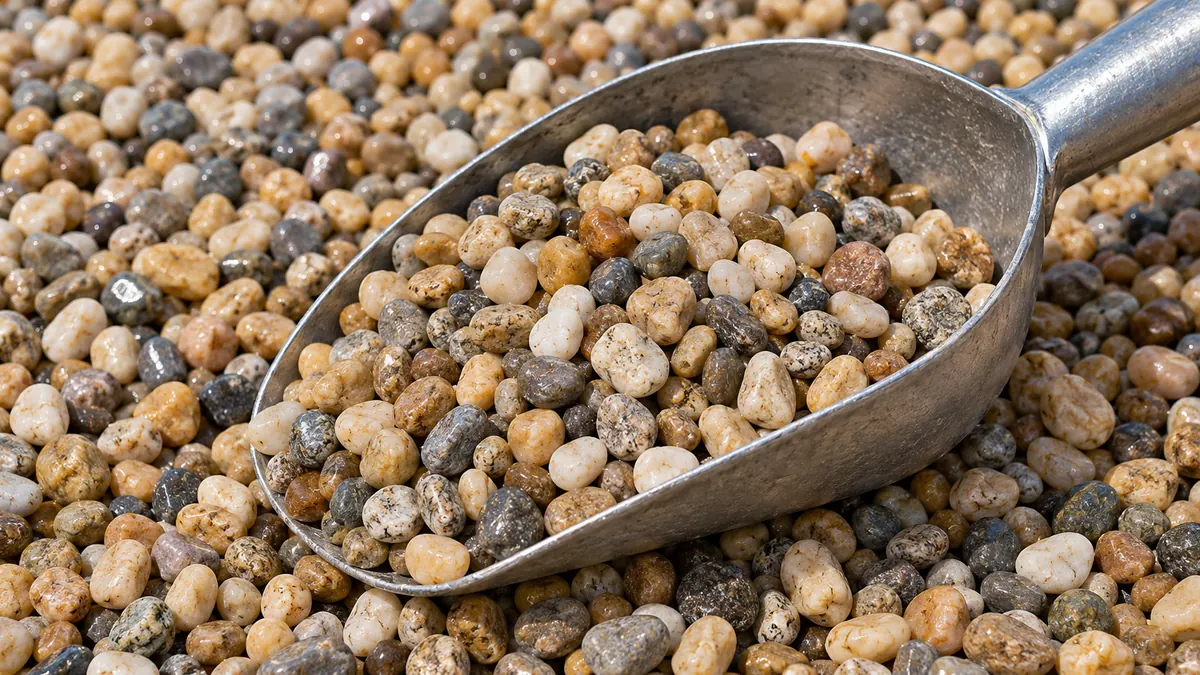
Small, rounded stone aggregate. Each stone measures between 1/8 and 5/8 inch in diameter, with 3/8 inch being the standard size sold by most suppliers. The stones are smooth and roughly spherical. The result of water erosion wearing away the sharp edges of rock fragments over thousands of years.
The name comes from its size. A standard 3/8-inch stone is about the same diameter as a garden pea. And the aggregate industry adopted this comparison to distinguish it from larger or angular gravels.
It goes by several other names depending on location and context. In the UK it is called pea shingle. In Australia, pea pebbles is common. US suppliers sometimes list it as pea stone, pea rock, or pea pebble. Some aggregate companies use the trade designation CM16. All refer to the same product: small, water-worn, rounded gravel in the 1/8 to 5/8-inch range.
How Pea Gravel Forms
Most aggregate comes from riverbeds and floodplains. Flowing water carries rock fragments downstream. As they tumble against each other and against the riverbed over thousands of years, the sharp edges wear away. What remains is smooth, rounded stone.
Glaciofluvial deposits, material left behind by retreating glaciers, produce the same result. Glacial meltwater moves quickly and carries large volumes of rock debris. The abrasion process is accelerated by the volume and force of glacial flow.
Some material comes from quarries. Mechanically crushed rock run through a tumbler or repeatedly screened produces a rounded finish, though quarry-sourced aggregate is generally less uniform than river-sourced material.
How the rock type determines color and hardness
The parent rock, the original rock before erosion, determines both the color and the durability of the finished stone. That is why the material from different regions looks completely different.
| Parent rock | Color of pea gravel | Hardness (Mohs) | Notes |
|---|---|---|---|
| Granite | Gray, pink, white, speckled | 6–7 | Most common source; feldspar content drives pink tones |
| Quartzite | White, cream, translucent | 7 | Hardest option; bright white in sunlight |
| Limestone | Buff, tan, off-white | 3–4 | Softer; avoid in aquaponics, raises pH |
| Basalt | Dark gray, black | 5–6 | Absorbs more heat in sun |
| Sandstone | Warm brown, rust, red | 4–6 | Color from iron oxide in the stone |
| Mixed river deposit | Multi-color blend | Varies | Most common retail bag product |
Two bags from different quarries can look nothing alike. Gray granite grades and white quartzite grades are both technically the same product classification. When color consistency matters for a project, always ask your supplier to confirm the source rock before ordering in volume.
Physical Properties
These are the numbers that matter for planning, ordering, and understanding how pea gravel behaves on site.
| Property | Value | Why it matters |
|---|---|---|
| Standard size | 3/8 inch (9.5mm) | Most widely available; suits paths, patios, driveways |
| Size range | 1/8 to 5/8 inch | Smaller for play areas; larger for French drains |
| Bulk density | 100 lb/ft³ · 1.35 tons/yd³ | Used in all coverage and weight calculations |
| Void ratio | ~36% void space | Higher than angular stone, explains fast drainage |
| Specific gravity | 2.6–2.7 (granite/quartzite) | Individual stone density; standard for aggregate calculations |
| Mohs hardness | 6–7 (granite/quartzite base) | Does not crush or break down under normal foot traffic |
| pH | Neutral (granite, quartzite) | Safe around plants; limestone grades raise soil pH |
| Compaction | Does not compact | Rounded stones roll rather than lock, stays loose |
The void ratio deserves particular attention. It holds approximately 36% open space between stones. Angular crushed stone compacts to around 25–28% void space under the same load. That 8–10 percentage point difference is why it drains measurably faster and why it stays permeable longer in drainage applications.
The material does not decompose, break down, or become acidic over time. It is chemically inert, attracts no insects or fungi the way organic mulch does, and does not crumble, split, or degrade through freeze-thaw cycling. The crunch underfoot does not diminish with age.
One property that surprises some buyers: surface temperature. Light-colored grades reach 8 to 12°F above ambient air temperature in direct sun. Dark grades reach 22 to 28°F above ambient. This is significantly cooler than asphalt (35 to 50°F above ambient) but warm enough to be uncomfortable for bare feet or dog paws on hot afternoons. Hosing the surface down before use solves this quickly.
Sizes: Which to Choose
| Size | Diameter | Best for | Avoid for |
|---|---|---|---|
| Fine | 1/8 inch | Zen gardens, play areas, aquariums, Zen garden raking | Driveways, high foot traffic (displaces too easily) |
| Standard | 3/8 inch | Paths, patios, garden beds, dog runs, French drains | Aquariums (gaps trap debris; use 1/4 inch instead) |
| Coarse | 5/8 inch | French drains, pipe bedding, drainage backfill | Barefoot areas (less comfortable underfoot) |
The 3/8-inch standard grade is right for most projects. Comfortable underfoot, reasonably stable with proper edging, free-draining, and the most widely available size at landscape supply yards, Home Depot, and Lowe's.
For a dedicated dog run or potty area, 3/8 to 1/2 inch works well. Large enough that small stones are unlikely to become lodged in paw pads. For a fish tank, use 1/4-inch grade. Small enough to look natural and sized so debris reaches the surface rather than falling into gaps.
Sizing is covered in full in the pea gravel sizes guide, including ASTM C33/C33M-24A gradation specifications for each grade.
Colors and What Causes Them
Color comes from the parent rock and the minerals within it. There is no standardized color naming across suppliers. One company's "natural mixed" looks completely different from another's. Visit your local supplier in person before ordering a full truckload of any color.
| Color | Source rock | Typical uses |
|---|---|---|
| White / cream | Quartzite | Formal gardens, contemporary landscaping, bright contrast borders |
| Gray | Granite | Most versatile; suits most exterior styles |
| Mixed natural | Mixed river deposit | General landscaping; most common retail product |
| Buff / tan | Limestone, sandstone | Warm-toned garden areas; Mediterranean styles |
| Brown / rust | Iron-rich sandstone | Cottage garden borders; warm color palettes |
| Black / dark gray | Basalt | Dramatic contrast; modern and minimal designs |
| Pink / rose | Feldspar-rich granite | Feature areas; flower bed highlights |
Dyed grades add artificial color. Red, blue, and vivid green products use pigment applied to the stone surface. The color fades in UV exposure within two to three seasons. Natural-color grades do not fade. The color is in the mineral structure of the stone itself, not a coating.
Colors, regional availability, and detailed type comparisons are covered in the pea gravel colors and types guide.
Washed vs Unwashed: Why It Matters
This distinction trips up a lot of buyers. Both products are sold as "pea gravel" at many suppliers. They perform very differently.
Washed pea gravel has been cleaned with water to remove clay fines, silt, and dust from the stone surface. The individual stones are clean. Drainage is excellent from day one.
Unwashed pea gravel still carries the fine particles from the quarry or riverbed. Those fines fill the void spaces between stones. The surface drains poorly. After rain, the fine particles migrate upward and create a muddy layer on the surface. Over time, the drainage rate drops significantly as fines accumulate.
Always order washed material for any application where drainage matters. Which is most applications. When ordering from a landscape supplier, say: "I need washed 3/8-inch pea gravel." Without specifying "washed," some suppliers will deliver unwashed material because it is cheaper for them to produce.
Bagged material at home improvement stores is almost always washed, but check the label. Bulk delivered material needs confirmation.
What Pea Gravel Is Used For
Landscape paths, patios, and driveways
This is where most people encounter it. A properly installed path or patio costs a fraction of concrete or pavers, drains naturally, and looks good for years without sealing, cracking, or requiring resurfacing.
For paths and patios, 3/8-inch washed pea gravel at 2 to 3 inches deep over a compacted crushed stone base is the standard build. Driveways need 4 inches of compacted base and 2 to 3 inches of pea gravel surface. The installation guide covers the full process step by step, including the correct landscape fabric for each soil type and how to set the drainage slope.
For driveway-specific depth, traffic class, and slope guidance, see the pea gravel driveway guide.
Garden beds, borders, and mulch replacement
It works as a long-term mulch alternative. Spread 1 to 2 inches over landscape fabric in garden beds and borders, and it suppresses weeds, retains soil moisture, and never needs annual replacement the way organic mulch does.
The trade-off: unlike organic mulch, it does not improve soil fertility as it decomposes. For vegetable gardens or areas where soil improvement matters, organic mulch is better. For low-maintenance ornamental beds and borders, it outlasts mulch by decades.
Adding a layer to the bottom of potted plants aids drainage and prevents root rot in containers prone to waterlogging.
One important note for trees: leave an 18-inch fabric-free zone around the base of any established tree. Landscape fabric under pea gravel significantly reduces soil mycorrhizal fungi activity over time, limiting the tree's ability to absorb water and nutrients. The aggregate without fabric works fine at that distance from the trunk.
Dog runs and pet areas
It is one of the most popular dog run surfaces for good reason. See the dedicated section below on dog safety.
French drains and drainage systems
The 36% void space makes it the standard aggregate for French drains. It surrounds the perforated pipe, filters fine particles, and maintains water flow. For French drain construction, 3/8 to 5/8-inch washed pea gravel is the correct specification.
The same aggregate fills drainage swales and dry creek beds where water management is the primary function.
Zen gardens, pool decks, and decorative areas
In a Zen garden, fine aggregate, 1/8 inch, is raked into patterns that represent water. The smooth surface takes a raked line cleanly and holds it until disturbed.
Pool decks use this material around pool edges and in surrounding garden areas. The smooth texture is comfortable on bare feet, drains pool splash immediately, and does not become slippery when wet the way sealed concrete can.
Construction and industrial uses
Beyond landscaping, several construction applications use this aggregate. As a fine aggregate for exposed aggregate concrete, pea gravel creates the textured decorative finish used on driveways, walkways, and concrete slabs where visual interest is wanted. As pipe bedding aggregate, it surrounds utility lines and drainage pipes to protect them from direct soil pressure and provide a drainage pathway. In block fill grout for masonry walls, pea gravel-size aggregate improves flowability while maintaining compressive strength. In hydroponics and aquaponics growing beds, it serves as a pH-neutral, inert substrate for root support and beneficial bacteria colonization.
Is Pea Gravel Safe for Dogs?
Yes. With two specific caveats.
The rounded edges cause no paw cuts or abrasions, unlike sharp crushed stone. Urine drains straight through rather than pooling on the surface, which reduces odor and bacterial build-up in potty areas. The surface does not go muddy in wet weather. Dogs that repeatedly use the same path through grass cause visible damage; a gravel strip along their patrol perimeter handles the traffic indefinitely.
The two caveats:
Heat. The surface gets warm in direct summer sun. On a 90°F day, the gravel surface can reach 115–120°F. Hot enough to burn paw pads. Hose the area down before letting a dog use it during hot afternoons, or ensure the dog run has shade cover.
Swallowing. Puppies and dogs that habitually chew or eat non-food items can swallow small stones. Ingested gravel causes digestive blockages that require veterinary attention. Supervise dogs prone to this behavior. The 3/8 to 1/2-inch size range is too large for most dogs to swallow easily, but not for all.
For the paw-contact surface of a dog run, 3/8-inch washed aggregate at 3 to 4 inches deep over landscape fabric is the standard setup. The full dog run construction process is covered in the pea gravel dog run guide (coming soon).
Is Pea Gravel Safe for Fish Tanks?
Natural, uncoated pea gravel is safe for freshwater aquariums. It looks natural, provides surface area for beneficial bacteria, and creates a realistic riverbed environment for most community fish species.
Four things to confirm before using it:
1. Natural and uncoated. Landscape pea gravel is sometimes treated with weed suppressant or coated with sealers. These are toxic in a closed aquarium system. Buy from a pet supplier or confirm with a landscape supplier that the product is natural, untreated stone with no additives.
2. Rinse thoroughly. New stone carries silica dust and fine particles. Rinse three to four times in a bucket under running water until the water runs clear. Skipping this step clouds the tank water for days.
3. Use 1/4-inch grade, not 3/8 inch. Standard 3/8-inch pea gravel creates gaps large enough for uneaten food and fish waste to fall between stones and decompose out of reach of a gravel vacuum. Fine 1/4-inch grade creates smaller gaps and is easier to clean.
4. Check the source rock. Limestone-based pea gravel raises aquarium pH. Most freshwater community fish prefer a neutral pH of 6.5 to 7.5. Quartzite and granite grades are pH neutral. If you buy a mixed bag, test a sample in a bucket of tap water over 24 hours with a pH test kit before committing it to the tank.
For aquaponics growing beds, pea gravel works well as a growing medium. The 1/8-inch grade gives the most surface area for nitrifying bacteria and the best root support for seedlings.
Pea Gravel vs Other Materials
| Material | Shape | Drainage | Stability | Comfort | Best for |
|---|---|---|---|---|---|
| Pea gravel | Rounded | Excellent | Low, stays loose | High | Paths, patios, drainage, dog runs |
| Crushed stone | Angular | Good | High, compacts solid | Low (sharp edges) | Driveways, bases, structural fill |
| River rock | Rounded | Excellent | Low, unstable to walk on | Low (too large) | Water features, decorative borders |
| Decomposed granite | Angular fine | Fair, compacts over time | Medium, semi-solid when compacted | Medium | Paths needing a firmer feel |
| Mulch (organic) | Irregular | Good | Low | High (soft) | Plant beds needing soil improvement |
| Lava rock | Irregular porous | Excellent | Medium | Low (abrasive) | Decorative beds, high-heat climates |
| Rubber mulch | Irregular | Good | Medium | High | Playgrounds (safety surfacing) |
Pea gravel vs crushed stone
These two materials are often used together rather than instead of each other. Crushed stone has angular edges that lock together under compaction. It becomes nearly solid when installed correctly. That makes it the right base material for driveways and patios.
The rounded edges never interlock. The surface stays loose regardless of compaction effort. That makes it the right surface material. Comfortable underfoot, free-draining, and easy to rake level.
The standard installation is crushed stone base with a gravel surface layer. Using rounded aggregate alone for a driveway produces a surface that ruts under vehicle tires and migrates to the sides. Using crushed stone as a surface is technically stable but uncomfortable and visually harsh. Both materials together perform better than either alone.
Pea gravel vs river rock
Both are water-worn and rounded. The difference is size. The rounded stones measure 1/8 to 5/8 inch. River rock is typically 1 to 5 inches. They come from the same geological process. River rock makes better decorative borders and natural water features. The smaller material makes better walking surfaces and drainage aggregate. The full comparison guide covers both in detail alongside decomposed granite, crushed limestone, and marble chips.
Pea gravel vs mulch
For garden beds, this comes down to a single question: do you want to improve the soil underneath, or do you want a permanent, zero-maintenance surface?
Organic mulch decomposes into the soil, adding organic matter and improving soil biology. It needs annual replenishment. The aggregate is inert. It does nothing to improve soil, but it never needs replacing. Mulch is better where soil health matters. The gravel wins where appearance and low maintenance matter more than soil building.
Pros and Cons
| Pros | Cons |
|---|---|
| Excellent drainage, 36% void space | Migrates without edging containment |
| Comfortable underfoot, no sharp edges | Gets warm in direct summer sun |
| Inert, no decomposition, no chemicals | Not suitable for steep slopes above 10% |
| Low cost vs concrete, pavers, asphalt | Does not compact, unstable for heavy loads |
| Easy DIY installation | Requires edging on all sides |
| No cracking, no sealing required | Tracks into the house from foot traffic |
| Cools faster than asphalt in evenings | Needs periodic raking and topping up |
| Deters rodents, hard to dig through | Snow removal disturbs the surface |
| Provides hiding spots for snakes near structures if piled deep | Choking risk for dogs that eat stones |
Two concerns come up repeatedly that deserve a direct answer.
Snakes. Pea gravel does not attract snakes, but it does provide cover if installed in deep piles close to walls or foundations. Keep pea gravel 6 inches away from foundation walls to reduce refuge points. In snake-prone regions, keep depths at 3 inches maximum and avoid installing pea gravel against warm south-facing walls where snakes bask.
Rodents. Mice and voles cannot burrow through a properly installed layer over landscape fabric. Organic mulch invites nesting. Gravel does not.
Where to Buy and What to Order
For projects over 50 square feet, buy bulk from a landscape supply yard. Bulk material delivers by the ton or cubic yard. It is significantly cheaper per square foot than buying 50-pound bags.
For small projects under 50 square feet, 50-pound bags from Home Depot or Lowe's are convenient. Each 50-lb bag covers roughly 5 square feet at 2 inches deep.
When ordering bulk, use this exact phrasing: "I need washed 3/8-inch pea gravel, delivered." This specifies the correct size, confirms the material is washed, and requests delivery. Without "washed," some suppliers send unwashed material. Without "3/8 inch," you may receive a mix of sizes. If color matters, add: "Can you confirm the source rock?". Then ask what colors are currently in stock from that source.
Costs vary by region and delivery distance. Use the 2026 cost guide for regional price ranges, and the cost calculator for an estimate based on your supplier's quoted price.
How Much Does Pea Gravel Cost?
Bulk material runs $30 to $55 per ton from landscape supply yards. One ton covers roughly 70 to 80 square feet at 3 inches deep. Bagged pea gravel costs $5 to $7 per 50-pound bag. At bulk prices, a 12×14-foot patio surface at the standard 3-inch depth needs roughly 2.3 tons including a 10% waste buffer. Around $70 to $130 in material.
These figures cover the surface layer only. A complete installation also needs crushed stone base, landscape fabric, and edging. The full cost breakdown covers all materials for common project types with 2026 pricing.
How Much Do You Need?
Enter your project dimensions and desired depth below. The coverage calculator returns the quantity in cubic yards, tons, and 50-lb bags.
Calculate your pea gravel quantity
Open Coverage Calculator →Also available: bags calculator · cost calculator · cubic yards calculator
Worked example: A 10×12-foot patio at 3 inches deep needs: 10 × 12 × (3 ÷ 12) = 30 ft³ = 1.1 yd³. Add 10% for waste: 1.21 yd³ to order. At 1.35 tons/yd³, that is 1.63 tons, or roughly 65 bags if buying bagged.
Worked Identification Examples
"Is this pea gravel?". How to identify it at the supplier. Pick up a handful. The stones should be rounded with no sharp edges. If any stone has an angular or broken face, it is crushed stone, not pea gravel. The stones should be roughly uniform in size, between 3/8 and 5/8 inch in most grades. The surface should feel smooth to the touch, not gritty. If the supplier is selling "pea gravel" that feels sharp or has irregular shapes, ask to see their specification sheet. It may be river rock, crushed gravel, or a mixed aggregate being mislabelled.
Pea gravel vs pea stone vs pea shingle. Terminology confusion. In the US, pea gravel and pea stone are used interchangeably by most suppliers. In the UK, the equivalent material is called pea shingle. All refer to the same product: small, rounded, water-washed aggregate in the 6 to 16mm range. The terminology varies by region. What matters is the specification: size range and whether it is washed. Always confirm both when ordering.
4 Common Mistakes When Buying and Using Pea Gravel
Mistake 1. Confusing pea gravel with crushed stone at the supplier. Both are small stone aggregate. The difference: pea gravel is rounded and smooth (water-worn). Crushed stone is angular with sharp edges (mechanically broken). Some suppliers use "gravel" loosely to mean either product. Always ask specifically for "washed, rounded pea gravel" and inspect the sample before ordering. Crushed stone spread on a patio or barefoot area is uncomfortable and potentially injurious. The application matters significantly for surface material choice.
Mistake 2. Buying unwashed pea gravel. Unwashed pea gravel carries clay and silt residue from the quarry. When installed, the first rain washes this residue into drainage systems, pool filters, or onto adjacent surfaces as a muddy film. Washed pea gravel has been rinsed at the quarry to remove all fine particles. The price difference is small: $3 to $8 per cubic yard. Always specify washed for any visible installation.
Mistake 3. Assuming all pea gravel is the same size. The term "pea gravel" covers several distinct size grades: 1/4 inch, 3/8 inch, and 5/8 inch are all sold as pea gravel by various suppliers. These grades behave very differently: 1/4 inch packs tightly and drains slowly, 3/8 inch is the general-purpose size, 5/8 inch drains fastest but is less comfortable barefoot. Always ask for the size in millimetres or inches, not just "pea gravel."
Mistake 4. Using pea gravel where angular stone is needed. The rounded shape that makes pea gravel comfortable underfoot also makes it less stable as a base layer and less effective in drainage engineering. Pea gravel under a patio or driveway sinks faster than angular stone under the same load because rounded particles cannot interlock. Pea gravel in a French drain drains less efficiently than angular #57 stone. The correct use of pea gravel is as a surface material. Not as a base layer or engineered drainage fill.
Frequently Asked Questions
What is pea gravel?
Why is it called pea gravel?
What is pea gravel made of?
Is pea gravel the same as river rock?
Is pea gravel good for drainage?
Is pea gravel safe for dogs?
Can you use pea gravel in a fish tank?
What is the difference between washed and unwashed pea gravel?
Does pea gravel attract snakes or bugs?
Does pea gravel get hot in the sun?
Does pea gravel decompose or break down?
Is pea gravel good for vegetable gardens?
How much does pea gravel cost?
Related Guides
Pea Gravel Sizes
Full size breakdown. The 1/8, 3/8, and 5/8 inch sizes are explained with use cases, ASTM gradation specs, and what to order for each project type.
How-ToHow to Install Pea Gravel
Step-by-step: depth by project type, fabric selection by soil type, base compaction in 2-inch lifts, edging, clay soil, slopes, and over-concrete installs.
CostsCost Guide 2026
Complete material, delivery, and installation costs for paths, patios, driveways, and drainage projects. With 2026 regional pricing.
Colors and Types
White, gray, brown, black, mixed natural, and dyed pea gravel. Which looks best for which projects, and what fades.
ComparisonPea Gravel vs Other Gravels
Side-by-side comparison with crushed stone, river rock, decomposed granite, marble chips, and more.
GuidePea Gravel Driveway
Traffic class, base depth, slope limits, climate zones, edging options, and snow removal. Everything specific to driveway use.
Sources & Methodology
- ASTM C33/C33M-24A: Standard Specification for Concrete Aggregates; aggregate gradation and size classifications
- USGS: Natural Aggregates Statistics: density reference data and production statistics for construction aggregates
- USDA NRCS: CPS Access Road (Code 560): gravel surface and aggregate installation standards
Last reviewed: October 2026 · Full methodology