
Pea Gravel Driveway: Cost, Depth, Base and Installation 2026
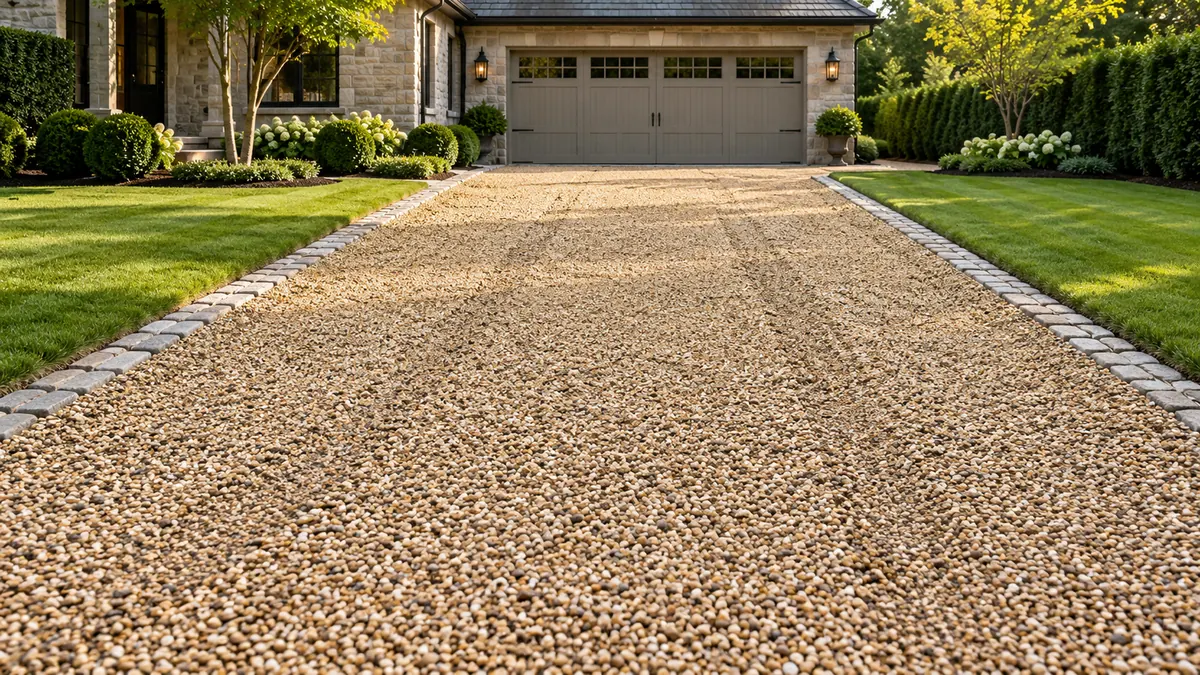
A pea gravel driveway costs $1.50 to $3.50 per square foot DIY. Compared to $8 to $15 per square foot for poured concrete. It drains better than any hard surface, installs in a day, and looks far better than bare soil or asphalt. The one rule most guides miss: pea gravel alone is not enough. You need a compacted base beneath it. Get that right and the driveway lasts 10 to 15 years with minimal maintenance.
In This Guide
- Does pea gravel work for a driveway?
- Depth and base specification
- Cost, single car, two car, per sq ft
- Pros and cons
- How to install, step by step
- Edging options
- Slope limits
- How to stop pea gravel moving
- Drainage performance
- Which size pea gravel to use
- Maintenance schedule
- Snow removal
- Pea gravel vs concrete vs asphalt
- Calculate your quantities
- Frequently asked questions
Does Pea Gravel Work for a Driveway?
Yes. With a compacted base underneath. Loose rounded gravel alone fails on driveways. The rounded stones have no interlocking ability. Under tire pressure they roll sideways, creating ruts in the tire tracks and ridges at the edges within weeks.
With a 4-inch compacted crusher run base, the pea gravel becomes a surface-only material. The base carries the structural load. The pea gravel provides visual finish, comfort underfoot, and surface drainage. This two-layer system is what professional landscapers install and what works long-term.
These driveways suit passenger cars and light trucks reliably. For heavy vehicles, delivery lorries, tractors, RVs, increase base depth to 6 inches and use 5/8 inch pea gravel on the surface. The driveway guide below specifies by vehicle class.
Depth and Base Specification
| Vehicle class | Base depth | Surface depth | Total excavation |
|---|---|---|---|
| Passenger cars, light trucks (up to 6,000 lb) | 4 in compacted crusher run | 2–3 in pea gravel | 6–7 in below finished grade |
| SUVs, vans, pickup trucks (6,000–10,000 lb) | 4–5 in compacted crusher run | 2–3 in pea gravel | 6–8 in below finished grade |
| Heavy vehicles, RVs, delivery trucks (10,000+ lb) | 6 in compacted crusher run | 3–4 in pea gravel | 9–10 in below finished grade |
| Occasional light use (visitor parking, turnoffs) | 2–3 in compacted crushed stone | 2 in pea gravel | 4–5 in below finished grade |
The pea gravel driveway base material is crusher run, also called road base, #411, or processed gravel, is the correct base for a pea gravel driveway. It is a blend of crushed stone and stone dust that compacts into an almost solid layer. Do not use pea gravel as the base. Do not use clean #57 crushed stone as the base alone. It does not compact as firmly as crusher run. Crusher run is cheaper than pea gravel and stronger for this application.
Compaction: Compact the base in two layers. Spread 2 inches, compact with a plate compactor, spread the second 2 inches, compact again. Single-lift compaction of 4 inches does not achieve adequate density. A plate compactor rental costs $65 to $85 per day and is non-negotiable for any driveway that will bear regular vehicle loads.
Geotextile fabric: On soft, wet, or clay-heavy subsoil, lay a layer of non-woven geotextile fabric directly on the excavated subgrade before adding base stone. This prevents the base stone from sinking into soft ground over time. On firm, well-drained soil, fabric between the base and subgrade is optional. Fabric between the base and the pea gravel surface layer is standard. It prevents the two materials from mixing over time.
Cost: 2026 Data
| Driveway size | Sq ft | DIY material cost | Professionally installed |
|---|---|---|---|
| Single-car (10×20 ft) | 200 | $300–$700 | $440–$900 |
| Single-car (12×24 ft) | 288 | $430–$1,000 | $630–$1,300 |
| Two-car (16×30 ft) | 480 | $720–$1,700 | $1,050–$2,200 |
| Two-car (20×40 ft) | 800 | $1,200–$2,800 | $1,750–$3,600 |
| Long rural driveway (12×100 ft) | 1,200 | $1,800–$4,200 | $2,600–$5,400 |
These figures cover all DIY materials: pea gravel surface, crusher run base, landscape fabric, steel edging, and delivery. The gravel itself accounts for 30 to 40 percent of the total cost. Edging, base stone, and delivery together cost as much as the pea gravel.
Per square foot breakdown:
| Item | Cost per sq ft |
|---|---|
| Pea gravel surface (3 in) | $0.45–$0.80 |
| Crusher run base (4 in) | $0.35–$0.65 |
| Landscape fabric | $0.10–$0.20 |
| Steel edging (perimeter) | $0.18–$0.35 |
| Delivery (spread over sq ft) | $0.08–$0.20 |
| Total DIY | $1.16–$2.20 |
| Labor (if hiring) | $0.85–$2.30 |
| Total installed | $2.00–$4.50 |
Homewyse confirms the national average installed cost in May 2026 at $2.18 to $2.99 per square foot for standard conditions. Compare to poured concrete at $8 to $15 per square foot and asphalt at $4 to $8 per square foot installed.
Use the driveway calculator to get exact cubic yards, tons, and cost at your supplier's price for any driveway dimensions. The 2026 cost guide covers regional price variation, delivery costs, and seasonal buying windows in detail.
Pros and Cons
| Pros | Cons |
|---|---|
| ✓ 50–70% cheaper than concrete | ✗ Surface stones displace under tires; needs monthly raking |
| ✓ Drains immediately, no standing water | ✗ Not suitable for slopes above 10% without geocell grid |
| ✓ Comfortable underfoot, smooth rounded stones | ✗ Snow removal requires care, no metal-blade snowblowers |
| ✓ Natural appearance suits most house styles | ✗ Stones can track onto shoes and into the house near entrances |
| ✓ Permeable, meets SuDS drainage requirements | ✗ Requires edging or stones migrate into adjacent lawn |
| ✓ Installs in one day DIY | ✗ Needs annual or biennial top-up in high-traffic zones |
| ✓ No cracking, no resurfacing, no sealing | ✗ Pea gravel alone without base is not suitable; base required |
| ✓ Lasts 10–15 years with minimal maintenance | ✗ Not ADA compliant; loose surface fails firmness standard |
How to Install: Step by Step
A standard two-car driveway takes one weekend DIY with one helper. Tools needed: plate compactor (rent), shovel, garden rake, utility knife, stakes, and a rubber mallet for edging.
Step 1. Mark and excavate. Mark the driveway edges with spray paint or string line. Excavate to the correct depth for your vehicle class. Typically 7 inches below finished grade for a standard passenger car driveway. Call 811 before any excavation to locate underground utilities. Remove all excavated material from site.
Step 2. Grade the subgrade. Establish a cross-slope of 1 to 2 percent from one side of the driveway to the other. This directs surface water away from the subgrade. A completely flat driveway base allows water to sit on the fabric and erode the base. Use a 4-foot level to check the grade at multiple points.
Step 3. Lay geotextile fabric on subgrade (soft soil). On soft, clay-heavy, or poorly draining subsoil, roll non-woven geotextile across the full excavated area, overlapping seams by 12 inches. Pin with landscape staples every 3 feet. On firm, well-drained soil this layer is optional.
Step 4. Spread and compact base layer. Spread crusher run to 2 inches depth across the full width. Run a plate compactor over the full surface twice. Once in each direction. Spread a second 2-inch lift. Compact again. Check depth with a tape measure. The compacted base should be exactly 4 inches. Do not skip the two-lift process. One 4-inch lift does not compact adequately.
Step 5. Install edging. Drive steel edging 6 inches into the compacted base along both driveway edges. Stake every 18 inches. Driveway edging requires tighter staking than garden edging because vehicle traffic generates higher lateral load. The top of the edging should sit at the intended finished surface height. See the edging section below for material options.
Step 6. Lay landscape fabric on base. Roll 4-oz woven landscape fabric across the compacted base surface. Overlap seams by 12 inches. Cut around the edging using a utility knife. Secure with staples at 2-foot intervals across the full surface. This fabric prevents pea gravel from mixing down into the base stone over time.
Step 7. Spread pea gravel surface layer. Tip or shovel pea gravel onto the fabric. Rake to an even depth of 2 to 3 inches across the full surface. Check depth with a ruler at multiple points. Aim for consistent depth rather than perfect flatness, following the cross-slope established in the base.
Step 8. Final rake and check. Make a final pass with the rake to level any high spots. Check edging is upright and flush with the gravel surface. Leave for 24 hours before first vehicle use. This allows the surface layer to settle slightly under its own weight before the additional load of tires.
Edging Options
| Edging type | Cost per linear ft | Durability | Best for |
|---|---|---|---|
| Steel edging (6 in) | $1.20–$2.50 materials | 15–20+ years | Best all-round: strong, clean line, handles driveway load |
| Concrete edging blocks | $5–$18 installed | Indefinite | Most permanent: professional appearance, no movement |
| Pressure-treated timber (4×4) | $2–$4 materials | 8–12 years | Budget option, suits rural and informal driveways |
| Railway sleepers | $15–$25 installed | 15–25 years | Heavy-duty and decorative, suits country and farmhouse styles |
| Brick or stone cobble edge | $8–$20 installed | Indefinite | Formal driveways, high visual impact, permanent |
Whatever edging material you choose, stake depth matters more than material on a driveway. Stakes must reach a minimum of 12 inches into the compacted base. Driveway edging takes far more lateral load than garden path edging. Tire pressure pushing displaced gravel outward works stakes loose over time if they are too shallow or too far apart.
Slope Limits
Slope is the single biggest reason pea gravel driveways fail. The rounded stones have no interlocking resistance on any grade. On flat ground this is managed with edging and raking. On sloped ground, stones roll downhill in rain regardless of edging depth.
| Slope grade | What to do |
|---|---|
| 0–5% (flat to gentle) | Standard installation: base, fabric, edging |
| 5–10% (moderate slope) | Geocell HDPE stabilization grid required before pea gravel layer |
| 10–15% (steep) | Resin-bound pea gravel or angular crusher run; loose pea gravel unsuitable |
| Above 15% | Pea gravel not suitable; use concrete, asphalt, or stabilized surface |
To measure your driveway slope: place a 4-foot spirit level horizontally from the high end of the slope. Measure the gap between the level and the ground at the low end in inches. Divide by 48. Multiply by 100. That is your percent grade. A 3-inch gap over 4 feet = 6.25% slope.
How to Stop Pea Gravel Moving
Displacement is the most common complaint about pea gravel driveways. Three solutions work at different levels of permanence:
Geocell stabilization grid: HDPE honeycomb panels installed on the fabric before spreading pea gravel. Each cell holds individual stones in place. Load capacity up to 1,880 lb per square foot. Handles any residential vehicle. This is the best permanent solution for driveways with daily traffic. The panels cut to shape and last decades.
Resin binder: Applied to the surface as a spray, it bonds stones together for 1 to 3 years. Permeable and non-toxic. Available at Home Depot (DOMINATOR brand). Best for lighter-use driveways or as a top-up solution between geocell installation. Reapply every 1 to 2 years.
Correct edging and regular raking: The minimum approach. Deep-staked edging every 18 inches on both sides contains lateral migration. Monthly raking redistributes displaced stones from edges back into tire tracks before ruts deepen. This alone does not stop movement. It just manages it.
For the full installation guide including fabric type by soil, see the installation guide. For the geocell and gravel binder options in detail, the landscaping ideas guide covers both.
Drainage Performance
The void space is approximately 36 percent. Water moves through immediately on contact. No pooling, no runoff sheet, no standing water after rain. This is significantly better than concrete and asphalt, which require surface grading and drainage channels to manage water.
A pea gravel driveway with a well-draining subgrade effectively recharges groundwater on every rainfall. This permeable performance meets Sustainable Drainage Systems (SuDS) requirements in UK and many US jurisdictions that mandate permeable surfaces for new or replacement residential driveways.
One drainage caution: slope the driveway cross-section at 1 to 2 percent from the center toward the edges, or from one side to the other. A completely flat driveway collects water at the lowest points even with pea gravel's good drainage. Particularly in high-rainfall areas or where the subgrade is clay-heavy.
Which Size Pea Gravel to Use
3/8 inch (9.5mm) is the standard for residential driveways. It balances surface stability, visual appearance, and comfort underfoot. For daily-use driveways with regular family traffic, 3/8 inch is the correct specification.
For heavier or higher-frequency use: 1/2 to 5/8 inch scatters less under tire pressure. The coarser stones are harder to displace. The trade-off is slightly less comfortable on bare feet near the house entrance.
Never use 1/8 or 1/4 inch on a driveway. Both grades scatter immediately under any tire contact and migrate to the driveway edges within weeks. The full size-by-project comparison is in the sizes guide.
Always specify washed pea gravel. Unwashed material contains clay fines that destroy drainage performance and turn the surface muddy after the first rain. See what is pea gravel for the full explanation of washed vs unwashed.
Maintenance Schedule
| Task | Frequency | Notes |
|---|---|---|
| Raking: redistribute displaced stones | Monthly | Focus on tire tracks; push stones from ridges back to center |
| Edging check: re-stake loose sections | Monthly | Vehicle vibration works stakes loose over time |
| Weed control: pre-emergent application | Twice yearly (spring + late summer) | Apply when soil reaches 50°F in spring; late August for second application |
| Depth top-up: high-traffic zones | Annually in tire tracks | Add 1 inch of same-grade washed pea gravel where depth drops below 1.5 in |
| Full surface top-up | Every 2–3 years | Order washed 3/8-inch from same supplier for color match |
| Spring recovery after winter | Once per year | Rake surface to redistribute snow-removal displaced stones; check edging for frost heave |
The full seasonal maintenance calendar including weed treatment methods, top-up calculation, and edging repair is covered in the maintenance guide.
Snow Removal
Snow removal is where most pea gravel driveway owners make mistakes. Done wrong, it scatters gravel across the yard and can damage the snowblower.
The right approach: Use a plastic-bladed snow shovel held at a shallow angle above the gravel surface. Remove the bulk of snow without digging the blade into the stones. Work in broad strokes that skim snow off the surface. Some gravel will mix with removed snow. Rake the surface in spring to recover displaced stones.
On light powdery snow: A leaf blower on maximum setting moves powdery snow before it freezes. Work quickly. Once snow starts to melt and refreeze it bonds to the gravel surface and becomes much harder to remove without disturbing stones.
Ice treatment: Rock salt or calcium chloride sparingly. Keep salt application light. Heavy salt application can eventually affect the subgrade in poorly draining installations. Never use sand. It mixes into pea gravel permanently and is nearly impossible to separate.
Never use a metal-bladed snowblower on a pea gravel driveway. The metal impeller throws pea gravel as readily as snow. Dangerous to anyone nearby, damaging to vehicles and windows, and scatters your entire surface layer across the garden.
Pea Gravel vs Concrete vs Asphalt
| Factor | Pea gravel | Concrete | Asphalt |
|---|---|---|---|
| Installed cost per sq ft | $1.50–$4.50 | $8–$15 | $4–$8 |
| Drainage | Excellent (permeable) | Poor (requires grading) | Poor (requires grading) |
| Installation time | 1 day DIY | 3–5 days + cure time | 1–2 days professional |
| Maintenance | Monthly raking, annual top-up | Crack repair, occasional sealing | Seal coat every 3–4 years |
| Freeze-thaw performance | Excellent | Poor, cracks over time | Good, flexible |
| Lifespan | 10–15 years to major work | 25–30 years | 15–20 years |
| Appearance | Natural, varied | Clean, formal | Dark, uniform |
| 5-year cost (800 sq ft) | $1,600–$2,800 | $6,400–$12,000 | $3,200–$6,400 |
The 5-year cost comparison strongly favors pea gravel for any budget-conscious homeowner. Even accounting for annual top-up and monthly raking, the total 5-year cost is 3 to 5 times lower than concrete over a typical two-car driveway. The full material comparison including drainage performance and stability is in the pea gravel vs other materials guide.
Calculate Your Driveway Quantities
Before calling a supplier, calculate exact quantities for both the base stone and the pea gravel surface layer. Use the driveway calculator. It handles separate depth inputs for base and surface layers and returns cubic yards, tons, and cost at your supplier's price.
Driveway Calculator
Enter your driveway dimensions and depths for base and surface layers separately. Returns cubic yards, tons, and bags for each material.
CalculatorCost Calculator
Enter your supplier's price per ton or per cubic yard to get the total material cost for any driveway size.
CalculatorCoverage Calculator
Calculate coverage for any area at any depth. Useful for top-up orders when only the surface layer needs replenishing.
4 Pea Gravel Driveway Mistakes That Require Expensive Fixes
Mistake 1. Installing without a base layer. Pea gravel alone on native soil cannot support vehicle weight. Under the first car, the rounded stones compress into the soil and the vehicle creates ruts that fill with mud. Within one season the driveway is a muddy, rutted surface worse than bare earth. The base layer, 4 inches of compacted crusher run, is not optional on a driveway. It costs approximately $35 to $55 per cubic yard and requires plate compactor rental for proper installation. Skipping it means starting over.
Mistake 2. Using pea gravel on steep driveways. Any driveway steeper than 8 to 10 percent is unsuitable for pea gravel. On gradients above 8 percent, vehicle tires displace gravel downhill with each passage and rainfall carries more material down. Within one season the lower section of the driveway has a foot of gravel while the upper section is bare base. If your driveway gradient exceeds 8 percent, use angular crusher run or compacted gravel road base instead of pea gravel.
Mistake 3. Not installing edging on both sides before spreading gravel. Vehicle tires push pea gravel sideways off the driveway edge on every pass. Without containment edging on both sides, the driveway narrows visibly within one season as gravel is pushed into the lawn edges. The gravel in the lawn is then a trip and mowing hazard. Install 4-inch steel edging on both sides, secured every 18 inches, before spreading any gravel. The edging is invisible once the gravel is spread but its presence determines whether the driveway holds its shape.
Mistake 4. Ordering too little base material. The most common driveway miscalculation. Homeowners calculate the surface pea gravel correctly but forget to calculate the base stone separately. A 300 x 12 ft driveway at 4-inch base depth needs 44 cubic yards of crusher run. More material by volume than the pea gravel surface layer. Always calculate and order base material and surface gravel as separate line items in the same delivery.
Frequently Asked Questions
Does pea gravel work for a driveway?
How deep should pea gravel be for a driveway?
How much does a pea gravel driveway cost?
What is the best base for a pea gravel driveway?
What are the pros and cons of a pea gravel driveway?
How do I stop pea gravel moving on my driveway?
Can I put pea gravel on a sloped driveway?
How long does a pea gravel driveway last?
How do I remove snow from a pea gravel driveway?
How much pea gravel do I need for a driveway?
What size pea gravel is best for a driveway?
Is a pea gravel driveway good for drainage?
Related Guides
Installation Guide
Full step-by-step installation including fabric type by soil, base compaction technique, edging height, and drainage slope.
CostsCost Guide 2026
Regional prices, bulk vs bag comparison, seasonal buying windows, and full driveway cost breakdown by size.
MaintenanceMaintenance Guide
Monthly raking schedule, weed control, depth top-up timing, and the full snow removal protocol for driveway gravel.
Sizes Guide
3/8 vs 5/8 inch for driveways. Size-by-vehicle-class table and the full explanation of why size matters underfoot.
ComparisonPea Gravel vs Others
Side-by-side comparison of pea gravel, crushed stone, and decomposed granite for driveways including 5-year cost.
IdeasLandscaping Ideas
20 project ideas including driveway design combinations with pavers, edging styles, and color selection by house exterior.
Sources & Methodology
- Angi: Pea Gravel Cost Guide (2026): installed cost ranges and driveway size data
- HomeGuide: Pea Gravel Cost (2026): per square foot cost benchmarks
- Homewyse: Cost to Install Pea Gravel Driveway (May 2026): national average installed cost data
- USGS: Natural Aggregates Statistics: density reference: 100 lb/ft³
Density formula: 100 lb/ft³ · 1.35 tons/yd³. All calculations use these locked constants. Full methodology
Last reviewed: October 2026