
Pea Gravel Patio: Ideas, Cost, Installation & DIY Guide 2026
In This Guide
- Cost, per square foot and by patio size
- Pea gravel patio ideas: 8 design approaches
- How deep should a pea gravel patio be?
- Base layer specification
- Weed barrier, which type works
- Edging options compared
- Furniture on pea gravel, how to make it work
- DIY installation, step by step
- Drainage performance
- Pros and cons, honest assessment
- Pea gravel vs concrete vs pavers
- Maintenance schedule
- Frequently asked questions
Cost: Per Square Foot and by Patio Size
Pea gravel is the least expensive permanent patio surface you can install. The low cost comes from two factors: the material itself is cheap and the installation requires no specializt skills or equipment beyond a plate compactor rental.
| Patio size | Sq ft | DIY materials only | Professional installation |
|---|---|---|---|
| Small seating area 10 × 10 ft | 100 | $50–$150 | $200–$500 |
| Standard patio 12 × 16 ft | 192 | $96–$288 | $384–$960 |
| Medium patio 16 × 20 ft | 320 | $160–$480 | $640–$1,600 |
| Large patio 20 × 24 ft | 480 | $240–$720 | $960–$2,400 |
DIY cost breakdown for a standard 200 sq ft patio at 3 inches deep: pea gravel 2.04 yd³ at $40/yd = $82. Crushed stone base 1.36 yd³ at $35/yd = $48. Landscape fabric 200 sq ft at $0.15/sq ft = $30. Steel edging 60 linear ft at $1.50/ft = $90. Plate compactor rental = $75 for half-day. Total: approximately $325 or $1.63 per square foot.
Compare against alternatives: concrete $6 to $17 per sq ft. Paver patio $10 to $30 per sq ft. Stamped concrete $8 to $20 per sq ft. Flagstone $15 to $30 per sq ft. Pea gravel is consistently 3 to 10 times cheaper than every hard surface option.
Pea Gravel Patio Ideas: 8 Design Approaches
Pea gravel works as a standalone patio surface or as a component of a mixed-material design. The most successful pea gravel patios use it deliberately rather than as a default cheap option.
One popular layout combines large pavers with gravel joints. The pea gravel between pavers guide covers joint widths, stone size, and how to work out the small quantity the joints need.
1. Fire pit surround. The most practical application. Non-combustible surface around the fire pit, with a concrete or flagstone pad directly under the fire. Casual seating with Adirondack chairs or benches. Works on any budget and any size yard.
2. Framed with pavers or flagstone. A border of large flat stepping stones or concrete pavers creates a stable perimeter and visual definition. The pea gravel fills the interior. The pavers solve the furniture stability problem. Chairs and tables sit on the pavers, gravel handles the aesthetic.
3. Japanese garden style. Raked pea gravel in a defined rectangular or circular space, bordered by timber or steel edging. Low-growing plants at the perimeter. Minimalist furniture. Works best with white or gray pea gravel against dark edging and green plantings.
4. Cottage garden seating area. Pea gravel in warm tan or brown tones surrounded by perennial plantings. Curved steel edging follows the garden bed shapes. Mix bench seating with a small round table. The informal surface suits the relaxed style.
5. Shaded woodland retreat. Under established trees where grass will not grow, pea gravel creates a usable shaded space. This is one of the most practical applications because it solves a real problem. No other patio material installs as easily under tree canopy without damaging roots.
6. Pool surrounds. Pea gravel around a pool drains standing water immediately, never gets as hot as concrete in direct sun, and feels comfortable underfoot. Use washed rounded pea gravel. No sharp edges to cut bare feet. Keep gravel away from the pool edge to prevent it entering the filtration system.
7. Side yard connector. Narrow side yards between house and fence often get neglected. Pea gravel creates a usable surface that handles foot traffic, drains well, and requires no mowing or weeding beyond initial installation.
8. Outdoor kitchen forecourt. Pea gravel immediately in front of an outdoor kitchen or barbecue station, with a concrete or paver pad under the actual cooking equipment. The gravel handles foot traffic around the cooking area without the high cost of extending the hard surface.
How Deep Should a Pea Gravel Patio Be?
| Depth | Use case | Notes |
|---|---|---|
| 2 inches | Absolute minimum for any patio | Bare spots appear within one season; not recommended |
| 3 inches | Standard residential patio | Correct depth for most applications; firm enough to walk on |
| 4 inches | High-traffic areas, seating zones | Better stability under chairs; comfortable underfoot |
| Over 4 inches | Not recommended | Too soft to walk on; furniture sinks; wasteful |
Three inches is the established standard because it represents the minimum depth at which pea gravel behaves as a surface rather than a thin decorative layer. At 2 inches, foot traffic and rain quickly displace the gravel and expose the fabric or base underneath. At 4 inches, the surface is noticeably soft. Heels sink in and walking requires more effort than on a firm surface.
The depth is measured after light compaction and watering to settle the gravel. Order slightly more than the calculated quantity. The calculator above includes a 10 percent buffer for this reason. After the first rainfall the gravel settles 5 to 10 percent and you will need to top up low areas.
Base Layer Specification
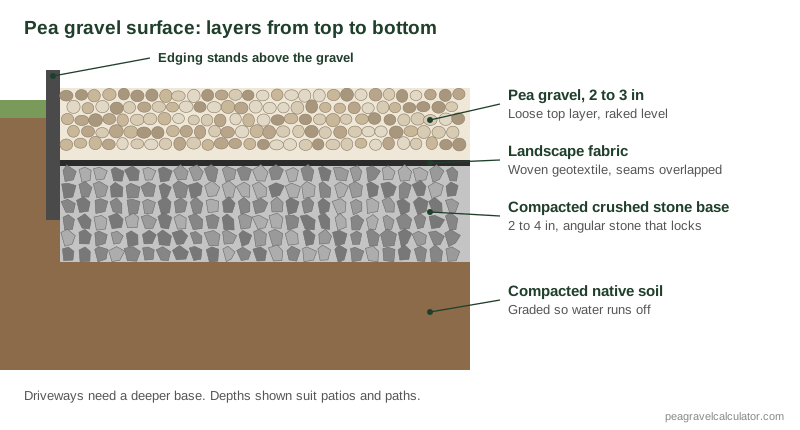
The base layer is the most commonly skipped step in DIY pea gravel patio installations. And the reason most DIY patios fail within 2 to 3 years. Without it, the pea gravel sinks into the native soil after rain and the surface becomes uneven, muddy, and thin.
2 to 3 inches of compacted #57 crushed stone or road base (crusher run). Compact in one lift with a plate compactor. The surface should feel firm. No visible movement when you walk on it.
Total excavation depth:3 inches base + 3 inches pea gravel = 6 inches total below finished grade. Excavate 6 to 7 inches to account for compaction.
On particularly soft or clay-heavy subsoil, add a layer of woven geotextile fabric directly on the subgrade before the crushed stone base. This separation fabric prevents the base material from mixing with the clay subsoil over time. A process called pumping that eventually causes the base to thin and the surface to sink. This is a different fabric from the landscape fabric that goes between the base and the pea gravel.
Weed Barrier: Which Type Works
Not all landscape fabric is equal. The type you choose determines whether your weed suppression lasts 2 years or 15 years.
| Type | Lifespan | Weed suppression | Cost | Verdict |
|---|---|---|---|---|
| Woven geotextile (heavy duty) | 15–20 years | Excellent | $0.15–$0.30/sq ft | Best choice |
| Non-woven geotextile | 8–12 years | Good | $0.10–$0.20/sq ft | Acceptable |
| Thin black plastic sheeting | 2–4 years | Initially good, then fails | $0.05–$0.10/sq ft | Avoid |
| Biodegradable fabric | 1–3 years | Short-term only | $0.10–$0.15/sq ft | Wrong product |
Thin black plastic sheeting is the most common mistake. It looks identical to proper landscape fabric in hardware stores but degrades rapidly under UV exposure and physical stress from the gravel above. Once it tears, typically within 2 to 4 years, weed roots grow through the gaps and the plastic becomes worse than useless: it creates a debris layer that makes future renovation more difficult.
Woven geotextile is made from polypropylene fibers woven together. It does not degrade, allows water through freely, and maintains its physical integrity under heavy gravel loads for decades. The price difference for a 200 sq ft patio is approximately $20 to $40. Irrelevant given the difference in lifespan.
Edging Options Compared
| Edging type | Cost per lin ft | Lifespan | Appearance | DIY ease |
|---|---|---|---|---|
| Steel edging (4-inch) | $1.00–$2.00 | 20–30 years | Minimal / invisible | Easy |
| Aluminum edging | $1.50–$2.50 | 20+ years | Minimal | Easy |
| Natural stone border | $3.00–$8.00 | Indefinite | Excellent | Moderate |
| Brick border | $3.00–$6.00 | 20+ years | Very good | Moderate |
| Timber sleepers | $2.00–$5.00 | 5–10 years | Natural | Easy |
| Plastic edging | $0.50–$1.00 | 3–7 years | Visible | Very easy |
| Concrete curbing | $10–$20 | 30+ years | Formal | Contractor only |
Steel edging installed correctly, pushed into the ground with the top at or just above gravel level, is invisible once the patio is established. It bends to follow any curve, holds its position against lateral pressure from the gravel, and does not rot, crack, or discolor. The 4-inch depth version (not the 2-inch) is essential for pea gravel. The extra depth prevents gravel from underrunning the edge and escaping into adjacent lawn.
Natural stone borders are the most attractive option and add genuine visual value to the patio design. The limitation is that any gaps between stones wider than the pea gravel diameter allow gravel to escape through them. Tight-fitting or mortared stone borders eliminate this problem but add complexity and cost.
Furniture on Pea Gravel: How to Make It Work
The instability of furniture on loose gravel is the most common complaint about pea gravel patios. And entirely solvable with the right approach. The problem is chair and table legs sinking into the gravel and rocking unevenly.
Solution 1. Furniture with wide flat feet. Adirondack chairs, Muskoka chairs, and any furniture designed for beach or garden use with wide slatted bases or large flat foot pads work well directly on pea gravel. The wide contact area distributes weight across many stones rather than concentrating it on a single point.
Solution 2. Furniture leg caps. Rubber or silicone leg caps with wide flat bases slip onto standard chair and table legs. They distribute weight and prevent sinking. Cost: $10 to $25 per set of four. Effective and completely reversible.
Solution 3. Paver islands within the gravel. Install a flat concrete paver, flagstone, or stepping stone under each furniture leg position. The paver sits within the gravel at grade level and provides a stable point for each leg. This is the best approach for heavy dining sets.
Solution 4. Central paver pad. For a dining area within a larger pea gravel patio, install a 6 × 8 ft or 8 × 10 ft paver pad in the center of the gravel space. The table and chairs sit on the hard pad. The pea gravel surrounds it. This design looks intentional, solves the stability problem, and allows full use of the space for dining.
DIY Installation: Step by Step
A pea gravel patio is one of the most accessible DIY hardscape projects. No concrete mixing, no complex cutting, no specializt tools beyond a plate compactor rental. A 200 sq ft patio takes one person a full weekend or two people a day.
Tools needed: Spade, wheelbarrow, rake, string line, stakes, plate compactor (rent), garden hose, utility knife, heavy work gloves.
Step 1. Mark and excavate. Mark the patio outline with string lines and stakes. Excavate 6 to 7 inches deep across the entire area. Remove all soil, roots, and vegetation. The excavated base should be as level as possible. Check with a long straight board or level.
Step 2. Compact the subgrade. Run the plate compactor over the bare soil two to three passes. This firms the native soil and reveals any soft spots. Fill soft spots with soil and compact again before proceeding.
Step 3. Install edging. Push steel edging stakes into the ground around the perimeter at the finished gravel height. Secure with ground anchors every 24 inches. For curves, make relief cuts every 6 to 8 inches in the top flange. Edging goes in before the base material. It is far easier to work within the edging outline than to install it around existing material.
Step 4. Add and compact base layer. Spread 2 to 3 inches of #57 crushed stone or crusher run. Compact thoroughly. Run the plate compactor at least three passes in different directions. The base should feel completely firm with no visible deflection when you step on it.
Step 5. Install landscape fabric. Lay woven geotextile fabric over the compacted base. Overlap seams by at least 6 inches and secure with landscape staples every 18 inches. Cut around the edges with a utility knife. The fabric should lie flat with no bubbles or gaps.
Step 6. Add pea gravel. Tip pea gravel directly onto the fabric and spread with a rake. Do not use a shovel. It tears the fabric. Work in 1-inch lifts, raking level after each. Check depth at multiple points with a tape measure. Finished depth should be 3 inches above the fabric.
Step 7. Water and settle. Water the finished surface with a garden hose on a gentle setting. The water settles the gravel and reveals low spots. Add small amounts of gravel to any low areas. The finished surface should be firm and level, with the gravel top sitting flush with the top of the edging.
Drainage Performance
Pea gravel drains faster than any other common patio surface. The rounded stones maintain consistent void spaces between particles because they do not compact. Unlike angular crushed stone which locks together more tightly under load. Water passes through at approximately 20 inches per hour under the gravel itself.
The drainage performance depends on what is underneath the gravel. On well-drained sandy or loamy soil, a pea gravel patio drains effectively in all conditions. On clay-heavy soil, the clay acts as an impermeable layer beneath the fast-draining gravel. Water reaches the clay and pools horizontally. Eventually finding the path of least resistance out of the area. This is not a failure of the pea gravel itself, but it means a pea gravel patio on clay soil requires the compacted stone base and proper site grading to direct water away from the house before it can pool.
The minimum grade for any patio surface to drain properly is 1 percent. A fall of 1 inch per 8 feet of patio width away from the house. Pea gravel is more tolerant of low spots than hard surfaces because pooled water eventually drains through rather than sitting on top. But establishing a slight grade during installation prevents standing water and makes the patio usable within minutes of rain stopping.
Pros and Cons: Honest Assessment
| Pros | Cons |
|---|---|
| Lowest cost of any patio surface | Gravel migrates away from edges and under furniture |
| Excellent drainage; no standing water | Not stable for dining sets with thin legs without modifications |
| No permits required in most municipalities | Requires top-up every 2–3 years |
| Completely DIY-friendly | Gravel tracks into the house on shoes |
| No cracking, heaving, or settlement | Not wheelchair or stroller accessible |
| Easy to extend or reconfigure | Snow removal is difficult; shovels displace gravel |
| Natural appearance suits most garden styles | Weeds eventually grow through fabric if unmaintained |
| No specializt installation required | Less formal appearance than pavers or concrete |
| Comfortable underfoot in bare feet | Hot in full summer sun (but less than concrete or pavers) |
Pea Gravel vs Concrete vs Pavers
| Factor | Pea gravel | Concrete | Pavers |
|---|---|---|---|
| Installed cost per sq ft | $2–$5 | $6–$17 | $10–$30 |
| DIY difficulty | Easy | Moderate–Hard | Moderate |
| Drainage | Excellent | Poor (needs slope) | Moderate–Good |
| Furniture stability | Poor (fixable) | Excellent | Excellent |
| Snow removal | Difficult | Easy | Easy |
| Permits needed | Rarely | Often | Sometimes |
| Lifespan | 15–25 years (with top-ups) | 25–50 years | 20–40 years |
| Repair ease | Very easy, add gravel | Difficult, patching visible | Easy, replace individual pavers |
| Resale value impact | Neutral | Positive | Positive |
Maintenance Schedule
Every spring: Apply pre-emergent herbicide around the patio perimeter and any visible weeds growing on top of the gravel. Rake the surface to redistribute gravel that has migrated to edges. Check edging is secure. Push any sections that have lifted back to grade level.
Every 2 to 3 years: Top up with 1 inch of fresh pea gravel. A 200 sq ft patio at 1-inch top-up needs approximately 0.68 cubic yards. Cost: $25 to $50 for bulk or $45 to $85 in bags. This top-up restores the patio to its original depth and refreshes the appearance. New pea gravel has a brighter color than weathered stone.
As needed: Hand-pull any weeds that establish in the gravel. Pull when small before they set seed. Trim grass and plants away from the edging perimeter to prevent roots working under the edging. Re-stake any edging sections that have shifted.
When to renovate: If the landscape fabric has degraded and weeds are growing from below through multiple areas, full renovation is the right approach. Remove all gravel, discard the old fabric, apply pre-emergent to the base, install new fabric, and add fresh gravel. This takes a day and costs $150 to $400 for a 200 sq ft patio. Far less than replacing a concrete or paver surface.
Frequently Asked Questions
How much does a pea gravel patio cost?
How deep should a pea gravel patio be?
Do you need a base layer under a pea gravel patio?
What edging works best for a pea gravel patio?
Can you put furniture on a pea gravel patio?
Does pea gravel drain well?
What are the pros and cons of a pea gravel patio?
How do I stop weeds in a pea gravel patio?
How many cubic yards for a pea gravel patio?
How long does a pea gravel patio last?
Is pea gravel good for a fire pit patio?
Pea gravel patio vs concrete; which is better?
Pea Gravel Patio Calculators
Patio Calculator
Rectangle and circle patio calculations. Cubic yards, tons, and bags with 3-inch depth default and 10% settling factor.
CalculatorCoverage Calculator
Enter any area and depth to get cubic yards, tons, and 50-lb bag count for pea gravel and other materials.
CalculatorCost Calculator
Enter your local supplier price per ton or cubic yard to get total project cost for any patio size.
How to Install Pea Gravel
Full installation guide covering base preparation, landscape fabric, edging, depth by project, and finishing.
GuidePea Gravel Cost Guide 2026
Regional prices per ton and per bag, bulk vs bag break-even, delivery fees, and seasonal buying windows.
GuideMaintenance Guide
Annual top-up schedule, weed control methods, edging repair, and seasonal care including freeze-thaw.
4 Pea Gravel Patio Mistakes That Are Expensive to Fix
Mistake 1. Installing at 2 inches instead of 3. Two inches is listed as the minimum depth but in practice a 2-inch patio thins to the landscape fabric at the centerline within one active season. Every footstep pushes stones sideways. The center goes bare while edges build up. A single additional inch of depth, approximately $15 to $20 in extra bulk material on a 200 sq ft patio, doubles the maintenance interval from one season to two or three years.
Mistake 2. Using thin-legged patio furniture. Bistro chairs and dining sets with thin metal legs sink 1 to 2 inches into pea gravel under body weight. The chair rocks with every movement and becomes uncomfortable. The fix: use Adirondack-style chairs with wide slatted bases, add rubber leg caps to existing chairs ($10 to $25 per set), or install a small flagstone pad within the pea gravel for the dining area. Plan furniture before ordering materials.
Mistake 3. Not raking edge build-ups annually. Foot traffic consistently moves gravel from the center toward the edges. Without annual redistribution, the patio center thins below the minimum depth while a ridge of excess gravel builds inside the edging. Most homeowners add new material thinking the gravel has "disappeared" when in fact it has migrated 12 to 18 inches to the perimeter. One spring raking session redistributes it without any new material needed.
Mistake 4. Choosing the wrong color for the setting. White pea gravel in a naturalistic garden setting looks stark and artificial. Tan gravel against a red brick house creates a color clash. Brown gravel in a modern minimalist garden lacks the visual contrast the design needs. Color choice is the one decision that cannot be corrected without removing all the gravel. Always look at material samples in the actual light conditions of your garden before ordering a full load.
Sources & Methodology
- USGS: Natural Aggregates Statistics: pea gravel density and aggregate data
- CPSC Handbook for Public Playground Safety; loose-fill depth standards referenced for context
Cost data: Based on 2026 landscape supplier pricing across US regions. Material prices vary by region. Use the cost calculator with your local supplier quote for accurate project estimates. Full methodology
Last reviewed: October 2026