
Pea Gravel Around Pool: Installation, Depth, Drainage & Safety 2026
In This Guide
- Why pea gravel is good around pools
- Size specification, which grade to use
- Depth and drainage slope
- How to keep gravel out of the pool
- Heat comparison, gravel vs concrete vs pavers
- Chemical resistance to pool water
- Safety considerations
- Layout design, borders, zones, access
- How much pea gravel do I need?
- Step-by-step installation
- Maintenance schedule
- Pea gravel vs alternatives around pools
- Cost guide 2026
- Frequently asked questions
Why Pea Gravel Is Good Around Pools
Pea gravel solves the three main problems of pool surrounds: heat, drainage, and cost. Concrete pool decks get uncomfortably hot in summer. Traditional concrete pools require specific drainage engineering to manage puddles. And the cost of concrete or pavers for a large pool surround is significant.
Pea gravel stays cooler than any hard surface at the same sun exposure. It drains pool water immediately. No puddles, no standing water, no wet concrete slip risk. It costs 3 to 8 times less per square foot than concrete or pavers. And its rounded surface is comfortable barefoot. Pool surrounds are one of the few environments where bare feet are the standard rather than the exception, making surface comfort a genuine practical priority rather than a preference.
The limitation to plan around: pea gravel requires management to prevent stones from entering the pool. This is a solvable installation problem, not a fundamental objection to using the material.
Size Specification: Which Grade to Use
For pool surrounds, use 3/8-inch (10mm) washed pea gravel exclusively. This specific size and specification matters more around a pool than in most other applications.
| Grade | Pool use | Reason |
|---|---|---|
| Below 1/4 inch (6mm) | Not suitable | Enters pool easily; lodges between toes uncomfortably; fine particles contaminate filtration |
| 1/4 inch (6mm) | Marginal | Still fine enough to enter pool in quantity; uncomfortable between toes |
| 3/8 inch (10mm); standard | Best choice | Comfortable bare feet, stays in place, too large for most pool intakes |
| 1/2 inch (12mm) | Acceptable | Less comfortable barefoot for extended walking; heavier stones if kicked |
| Above 1/2 inch | Not suitable | Uncomfortable to walk on barefoot; sharp tread risk on pool ladder steps |
Always use washed pea gravel for pool surrounds. Unwashed aggregate carries clay and silt residue. When this washes into a pool, through foot splash, rain runoff, or direct contact, the clay particles cloud the water and pass through the filtration system, coating the filter media and reducing filtration efficiency. Washed stone is cleaned at the quarry to remove all fine particles. The price difference is small ($3 to $8 per cubic yard). Never use unwashed stone around a pool regardless of the cost saving.
Depth and Drainage Slope
Depth: 2 inches of pea gravel over a 2-inch compacted base is the standard for pool surrounds. This shallower specification versus the 3-inch standard for patios is appropriate because pool surround foot traffic is lighter and more distributed. At 3 inches, the gravel surface is slightly softer. Still comfortable but with marginally less stability. Use 3 inches in high-traffic zones (around pool steps, access ladder, and gate entry) and 2 inches elsewhere.
Slope: 1 to 2 percent grade away from the pool on all sides. This is steeper than the 1 percent used for patios. The pool surround must drain water flowing off the pool deck and from bathers exiting the water quickly and completely.
Direction: Slope toward the outer edge of the pool surround, not toward the house or any structure. A French drain or drainage swale at the outer perimeter collects this water in heavy rain situations.
Why this matters: Standing water at a pool edge is a slip and fall risk. Water that does not drain also saturates the base layer, reducing its stability and eventually causing subsidence under the gravel surface.
How to Keep Gravel Out of the Pool
This is the most important installation detail for pool surrounds. Stones entering the pool damage filtration equipment, scratch pool surfaces, and create a slip risk on pool floors. Prevention is entirely an installation question. It cannot be solved by maintenance alone.
Method 1. Concrete coping border (most effective). Install a 12 to 18-inch wide concrete border immediately around the pool coping. The strip of hardscape where the pool deck meets the pool wall. The pea gravel fills the rest of the surround beyond this border. Bathers step from the water onto the concrete coping, then onto the gravel. This completely eliminates direct gravel-to-pool contact. The concrete strip also provides stable footing at the pool edge and gives furniture legs a firm surface to rest on.
Method 2. Bull-nose coping with raised lip. Some pool copings include a raised lip or bull-nose edge profile that sits 1 to 2 inches above the adjacent surface level. Install pea gravel to the lower finished grade alongside this coping. The raised lip acts as a physical barrier preventing gravel from rolling into the pool. Effective only if the coping lip is continuous around the entire pool edge.
Method 3. Paver transition strip. A row of 12 × 12-inch pavers set flush with the coping and flush with the planned gravel surface provides a stable transition that catches displaced stones before they reach the pool edge. Effective for rectangular pools with straight edges. More difficult to install around curved or free-form pools.
Method 4. Gravel depth management. Keep gravel at 2 inches (not 3 inches) within 18 inches of the pool edge. Shallower gravel means less loose material that can be disturbed. Combined with regular raking to keep gravel level and away from the pool edge, this reduces (but does not eliminate) stone ingress.
Heat Comparison: Gravel vs Concrete vs Pavers
| Pool surround surface | Surface temp; direct summer sun | Barefoot comfort |
|---|---|---|
| White pea gravel | 85–110°F | Excellent |
| Light tan / gray pea gravel | 95–115°F | Very good |
| Mixed pea gravel | 105–125°F | Good |
| Concrete (standard gray) | 130–160°F | Uncomfortable after 15 min |
| Tan or buff pavers | 120–150°F | Uncomfortable after 20 min |
| Dark pavers or slate | 150–180°F | Painful; brief contact only |
| Artificial turf | 130–165°F | Uncomfortable |
The 30 to 50°F surface temperature advantage of pea gravel over concrete is the most practical benefit for pool use. Pool surrounds are walked on barefoot by children and adults throughout the hottest part of the day. The hours when surface temperatures are at their peak. A pool surround that is too hot to walk on barefoot undermines the entire point of having the pool.
Hosing the gravel before afternoon use reduces surface temperature significantly. Wet gravel at 70°F water temperature drops to 80 to 90°F surface within minutes, staying cool for 30 to 60 minutes as the water evaporates. This is faster and more effective on pea gravel than on concrete because the open structure of the gravel allows the water to penetrate and cool the material throughout its depth.
Chemical Resistance to Pool Water
Standard pea gravel is chemically resistant to all common pool water treatment systems. The key consideration is which type of pea gravel you are using.
| Pool type | Pea gravel compatibility | Notes |
|---|---|---|
| Chlorinated pool | Fully compatible | No effect on quartz or quartzite. Avoid white limestone (pH sensitivity). |
| Saltwater pool | Fully compatible | Salt concentration too low to affect stone. Rinse edging regularly if using steel. |
| Bromine-treated pool | Fully compatible | No stone reaction at normal treatment concentrations. |
| Natural / mineral pool | Fully compatible | No chemical concerns with natural pool water. |
One practical consideration for saltwater pools: the steel edging used to contain pea gravel is affected by salt exposure over time. Use aluminum or stainless steel edging for saltwater pool surrounds rather than standard galvanized mild steel. The corrosion resistance difference is significant. Aluminum edging lasts 20 or more years in a saltwater environment while mild steel may rust within 5 to 8 years with regular salt water exposure.
Safety Considerations
Pea gravel is safer than smooth concrete or tile around pools in several important respects. And presents one specific management concern.
Wet traction. Wet pea gravel provides better traction than wet smooth concrete or tile. The rough texture of individual stones and the slight instability of the surface (which causes the foot to adjust its position) produces better grip than the consistently smooth, wet concrete that is responsible for the majority of pool-area slip-and-fall incidents. The comparison changes at the pool entry point where stability is important. A firm concrete or paver border at the ladder and step exit points provides the stable footing needed when people first exit the water.
No algae growth on walking surface. Smooth concrete and tile pool surrounds develop algae in wet conditions, creating a genuinely slippery surface that must be regularly pressure-washed. Pea gravel does not develop the same algae film on its walking surface. Individual stones and the drainage voids between them prevent algae from establishing the continuous wet surface film that makes hard surfaces dangerous.
The filtration risk. The main safety concern with pea gravel around pools is stones entering the filtration system. Pool pumps and skimmers are not designed to pass gravel. Even small quantities of stone in the pump basket can damage the impeller. Inspect and clear the pump basket weekly in gravel-surround pools. More frequently if children are active in the pool area. The concrete border installation method eliminates most gravel ingress and significantly reduces this maintenance burden.
Layout Design: Borders, Zones, Access
The most successful pea gravel pool surrounds use a two-zone approach: a hard surface immediately around the pool edge (typically concrete or pavers), with pea gravel filling the rest of the pool area from that border outward.
Zone 1. Hardscape border (12 to 18 inches from pool edge): Concrete pour or paver installation directly adjacent to pool coping. This zone handles: wet feet stepping out of the pool (where stability is most critical), pool furniture placement (legs on a firm surface), cleaning with pool brush and vacuum from the edge, and visual definition of the pool boundary.
Zone 2. Pea gravel surround: From the hardscape border outward. This zone handles: circulation around the pool, seating areas (Adirondack chairs and wide-footed furniture work directly on pea gravel), outdoor shower drainage, and connection to the wider garden. The depth here can be 2 inches with 3 inches at concentrated-use areas.
Pool equipment access: Leave a 24-inch clear path to pool equipment (pump, filter, heater) that is firm enough to work on. A stepping stone path through the gravel to equipment access points is practical. The equipment area itself should be on firm compacted base or concrete, not on pea gravel, for stability and easy maintenance.
How Much Pea Gravel Do I Need?
For a rectangular pool, calculate the gravel area by subtracting the pool surface from the total enclosed area, then deduct any hardscape border areas.
| Pool size | 4 ft wide surround, 2 in depth | 4 ft wide surround, 3 in depth | 6 ft wide surround, 2 in depth |
|---|---|---|---|
| 12 × 24 ft pool | 2.39 yd³ | 3.59 yd³ | 3.91 yd³ |
| 16 × 32 ft pool | 3.04 yd³ | 4.56 yd³ | 4.89 yd³ |
| 18 × 36 ft pool | 3.37 yd³ | 5.05 yd³ | 5.38 yd³ |
| 20 × 40 ft pool | 3.69 yd³ | 5.54 yd³ | 5.87 yd³ |
All figures include 10 percent waste buffer. Deduct the concrete border area if you are installing a hardscape strip at the pool edge. A 12-inch wide border around a 16×32 ft pool covers approximately 96 sq ft less gravel area. Use the pea gravel calculator for custom pool shapes and surround widths.
Step-by-Step Installation
Step 1. Mark and excavate. Mark the pool surround boundary with stakes and string. Excavate 4 to 5 inches deep (2 in base + 2 in gravel). Remove all sod, roots, and organic material. Grade the excavated surface with a 1 to 2 percent slope away from the pool. Check with a level at multiple points.
Step 2. Compact the subgrade. Run a plate compactor over the entire excavated area. The base must feel completely firm before any material is added.
Step 3. Install any hardscape border. If installing a concrete coping strip, form and pour it at this stage. Set it at the planned finished surface level. Allow it to cure fully before proceeding.
Step 4. Add crushed stone base. Spread 2 inches of #57 crushed stone or road base. Compact thoroughly. Use 2 or more passes with the plate compactor. Maintain the drainage slope through the base layer.
Step 5. Install landscape fabric. Lay woven geotextile fabric over the compacted base. Overlap seams by 6 inches. Cut around any concrete border strips. Secure with landscape staples every 18 inches.
Step 6. Install outer perimeter edging. Steel edging at the outer boundary of the gravel area. Not at the pool edge, where the pool coping serves as the boundary. Secure with ground anchors every 18 inches.
Step 7. Spread pea gravel. Tip washed pea gravel onto the fabric and spread with a rake. Check depth at multiple points. Maintain the drainage slope in the finished surface. Do not allow gravel to pile up against the pool coping.
Step 8. Water and settle. Water the finished surface. Check that the drainage slope is maintained after settling. Rake any areas where gravel has piled against the pool edge back toward the outer perimeter.
Maintenance Schedule
| Frequency | Task |
|---|---|
| Weekly (pool season) | Check pool pump basket for stones; skim pool floor near surround edge for any gravel |
| Monthly | Rake gravel to redistribute stones away from pool edge; check drainage slope maintained |
| Pre-season | Apply pre-emergent herbicide; top up gravel depth in any thin areas |
| Post-season | Rake leaves off surface before decomposition; inspect edging integrity |
| Every 2–3 years | Top up with 0.5 to 1 inch of fresh pea gravel; re-establish drainage slope if flattened |
Pea Gravel vs Alternatives Around Pools
| Surface | Heat | Cost per sq ft | Barefoot comfort | Maintenance |
|---|---|---|---|---|
| Pea gravel | Cool | $0.50–$1.50 | Excellent | Rake, top-up every 2–3 yr |
| Concrete | Very hot | $6–$17 | Poor in summer heat | Seal, pressure-wash annually |
| Pavers | Hot | $10–$30 | Moderate | Joint sand, resetting |
| Natural stone / travertine | Moderate | $15–$35 | Good (tumbled) | Sealing, staining |
| Artificial turf (pool grade) | Very hot | $8–$15 | Soft but burns | Brushing, rinsing, deodorizing |
| River rock (1–2 in) | Cool | $1.00–$2.50 | Moderate | Rake, similar to pea gravel |
| Wood deck | Moderate | $15–$35 | Good | Staining, sealing, board replacement |
Travertine and tumbled natural stone are the premium alternatives to pea gravel that match its comfort and low heat retention. They are cool and comfortable barefoot. The cost difference is significant: travertine at $15 to $35 per sq ft vs pea gravel at $0.50 to $1.50. For the same 400 sq ft pool surround: pea gravel $200 to $600 in materials vs travertine $6,000 to $14,000. Both perform well in the same climatic conditions. The choice between them is purely budget and aesthetic.
Cost Guide 2026
| Cost item | Amount | Example: 16×32 pool, 4 ft surround |
|---|---|---|
| Pea gravel (washed, 3/8 in) | $30–$55/yd³ | 3.04 yd³ = $91–$167 |
| Crushed stone base | $25–$45/yd³ | 2.07 yd³ = $52–$93 |
| Landscape fabric | $0.15–$0.30/sq ft | 448 sq ft = $67–$134 |
| Steel / aluminum edging | $1.50–$2.50/lin ft | 128 lin ft (outer perimeter) = $192–$320 |
| Concrete coping border (optional) | $6–$12/sq ft | 96 sq ft = $576–$1,152 |
| Delivery | $60–$120 per load | $60–$120 |
| Total DIY (no concrete border) | - | $462–$834 |
| Total DIY (with concrete border) | - | $1,038–$1,986 |
Worked Pool Surround Cost Examples
Standard 16 x 32 ft pool, 4-foot gravel surround. Gravel area: outer rectangle (24×40 ft) minus the pool itself = 448 sq ft (minus any concrete coping strips). At 2 inches: 3.04 yd³ pea gravel at $40/yd³ = $122. Crushed stone base 2.07 yd³ = $73. Landscape fabric 448 sq ft at $0.18/sq ft = $81. Steel edging around the outer perimeter of the surround, 128 lin ft at $1.50/lin ft = $192. Concrete coping border (optional, 12-inch wide at pool edge, 96 lin ft): 96 sq ft at $8/sq ft = $768. Delivery $90. Total without coping: $558. Total with coping: $1,326.
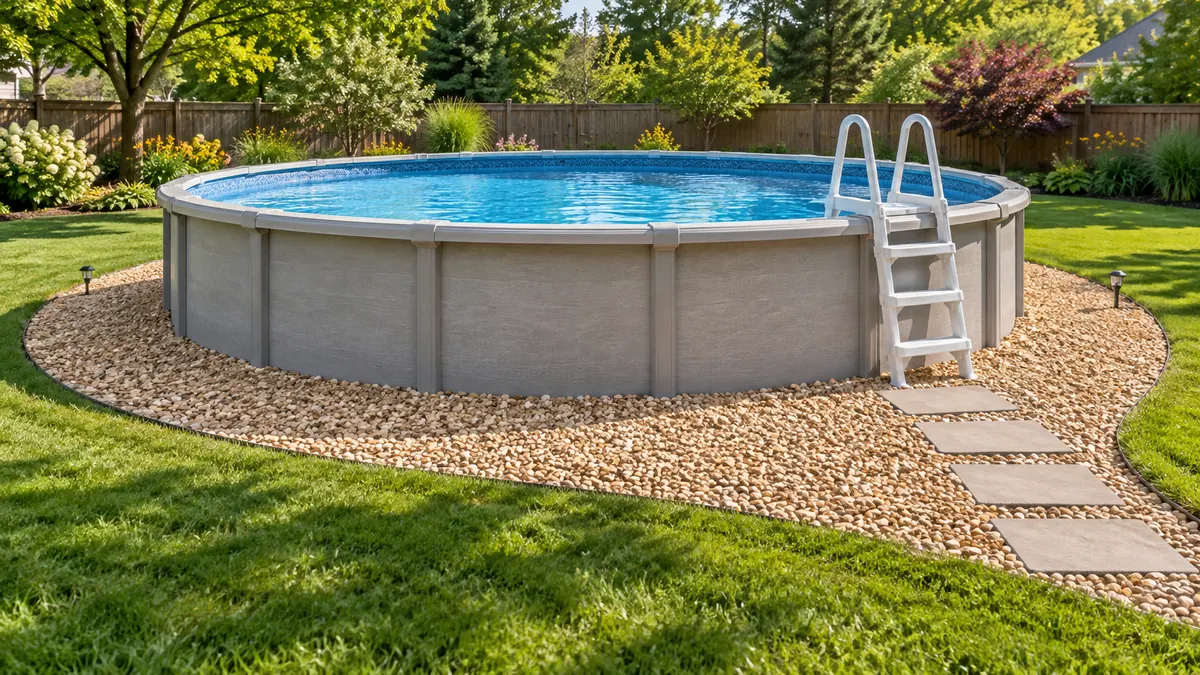
Above-ground 15-foot diameter pool, 3-foot gravel ring. Gravel ring area: π x 10.5² minus π x 7.5² = 346 minus 177 = 169 sq ft. At 2 inches: 1.15 yd³ gravel = $46. Base and fabric add $65. Steel edging (perimeter of outer ring, 66 lin ft) = $99. Total: $210. This is the entire material cost for a clean, professional-looking pool surround on an above-ground pool. A significant upgrade from bare earth or grass at very low cost.
4 Pool Surround Pea Gravel Mistakes
Mistake 1. Using unwashed gravel. Unwashed pea gravel carries clay and silt residue from the quarry. When bathers exit the pool with wet feet, this residue washes into the water. Within one season, the pool filter cartridge is clogged with silt and the water develops a persistent cloudiness that clarifiers cannot fix. The cost saving of unwashed over washed stone, typically $3 to $8 per cubic yard, is recovered in filter cartridge replacements within the first summer. Always specify washed pea gravel for pool surrounds.
Mistake 2. Skipping the concrete coping border at the pool edge. Installing pea gravel directly against pool coping without a solid transition zone means every person who exits the pool kicks gravel toward the water with their first steps. Within a season, the pool pump basket fills with stones, the impeller is damaged, and filter performance drops. A 12-inch concrete border immediately at the pool edge catches displaced stones before they reach the water and provides stable footing for the first steps out of the pool. It is the single highest-return addition to a pea gravel pool project.
Mistake 3. Installing on a flat grade. A pool surround on flat ground retains water from rain and from the pool itself. Wet pea gravel that does not drain creates a permanently damp environment that algae colonizes within weeks. The surround must slope 1 to 2 percent away from the pool on all sides. This slope must be established during excavation. It cannot be corrected after the gravel and base are installed without starting over.
Mistake 4. Installing more than 3 inches depth near the pool edge. Deeper gravel near the pool edge means more loose material that can be displaced into the water by foot traffic. The standard 2-inch depth within 18 inches of the pool coping minimizes the amount of gravel that can migrate toward the water while providing adequate surface coverage. Use 3 inches for the rest of the surround where distance from the water reduces the risk of pool contamination.
Frequently Asked Questions
Is pea gravel good around a pool?
How deep should pea gravel be around a pool?
How do you keep gravel out of a pool?
Does pea gravel get hot around a pool?
Is pea gravel safe around a pool?
Does pool water damage pea gravel?
How much pea gravel for around a pool?
What size pea gravel is best for pool areas?
Pea gravel vs concrete around pool; which is better?
Can you put pea gravel next to an above-ground pool?
How do you install pea gravel around a pool?
How do you maintain pea gravel around a pool?
Related Calculators and Guides
Pea Gravel Calculator
Calculate exact cubic yards, tons, and bags for your pool surround dimensions and depth.
GuideHow Much Pea Gravel?
Pre-calculated quantities. Check common pool surround sizes before calling suppliers for quotes.
GuidePea Gravel Depth Guide
Minimum vs optimal depths for every application including pool surrounds and hard-use surface areas.
Pea Gravel Pros and Cons
Complete honest assessment including pool surround performance, heat data, and comparison with hard surfaces.
GuideWhite Pea Gravel Guide
White gravel stays the coolest at 85–110°F. The best color choice for pool surrounds in hot climates.
GuidePea Gravel Cost Guide 2026
Regional pricing, bulk vs bag comparison, and full cost breakdown for pool surround projects.
Sources & Methodology
- USGS: Natural Aggregates Statistics: aggregate mineral composition and density data
Surface temperature data: Approximate figures from materials science research on solar radiation absorption by common pool surround surfaces. Actual temperatures vary with solar angle, humidity, stone color, and air temperature. Cost data: 2026 landscape supplier pricing. Pool surround quantities use typical 16×32 ft residential pool with 4-foot surround width as reference project. Full methodology
Last reviewed: October 2026