
How to Keep Pea Gravel in Place: 7 Methods That Work 2026
In This Guide
- Why pea gravel moves: 3 failure modes
- Method 1: Steel edging (the foundation)
- Method 2: Natural stone and brick borders
- Method 3: Gravel stabilizer resin
- Method 4: Base preparation
- Method 5: Correct depth
- Method 6: Slope-specific solutions
- Method 7: Annual maintenance routine
- Method comparison table
- 5 most common mistakes
- Frequently asked questions
Why Pea Gravel Moves: 3 Failure Modes
Understanding why pea gravel moves is the prerequisite to choosing the right containment method. There are three distinct failure modes and each requires a different solution. Applying the wrong solution to the wrong failure mode wastes money and does not solve the problem.
Failure mode 1. Lateral spread from foot traffic. Every footstep on the gravel surface pushes stones sideways. The stones at the path or patio centerline migrate toward the edges over weeks and months. Eventually the center thins and the edges build up. This is the most common failure mode. Solution: edging that prevents stones from leaving the installation area, plus annual raking to redistribute stones from edges back to center.
Failure mode 2. Water displacement. Rain and irrigation wash pea gravel toward the lowest point of the installation area. On flat areas, water displacement concentrates gravel at the downhill edge. On slopes, water carries stones steadily downhill. This is compounded when there is concentrated water flow. At downspouts, at low spots where water collects, or where irrigation heads produce a sustained flow across the surface. Solution: correct drainage grade, edging of sufficient depth to catch water-displaced stones, and using heavier stone in high-water-flow areas.
Failure mode 3. Vertical sinking. Pea gravel migrates downward through soft subsoil under the weight of the surface and foot traffic. This is most apparent in clay-heavy or waterlogged ground where the surface becomes soft enough for the gravel to work its way into the soil. The patio or path surface sinks unevenly and requires more gravel to top up than should be needed. Solution: compacted crushed stone base plus woven geotextile fabric between base and pea gravel.
Method 1: Steel Edging (The Foundation)
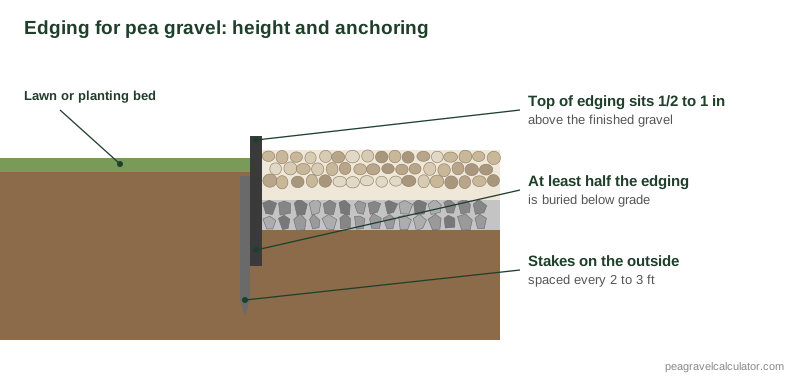
Steel edging is the primary containment method for every pea gravel installation. Every other method is supplementary. Without solid edging, no other technique effectively controls lateral spread.
Depth: 4 inches minimum. Not 2 inches. Two-inch edging allows gravel to underrun the shallow edge at its base.
Stakes: Ground anchors every 18 inches. Drive at 45-degree angle for anti-frost heave resistance.
Height: Edging top flush with or up to 0.5 inch above finished gravel surface. Not below. Gravel rolls over sunken edging.
Curves: Score top flange of steel edging every 6 to 8 inches for tight curves under 1.5 meters radius. Aluminum edging bends more naturally for curves.
The depth specification is the most commonly ignored detail. Hardware stores often stock 2-inch depth steel edging because it suits lawn edge applications. For pea gravel containment, 2-inch edging is inadequate. The pea gravel at the base of the edging migrates horizontally under the edging stake and into the adjacent lawn or bed. The 4-inch depth creates a true below-grade barrier that gravel cannot pass under.
Setting the edging top correctly is the second most important detail. If the edging top is even slightly below the gravel surface, gravel pushed against the edging simply rolls over it. Set the edging so that after final raking and settling, the gravel surface sits 0 to 0.5 inch below the edging top. This small lip physically retains the stones without being visible from above.
Method 2: Natural Stone and Brick Borders
Natural stone, brick, or concrete paver borders provide better visual definition than steel edging and work well in formal garden settings. For pea gravel containment they perform similarly to steel edging in most conditions. But with one specific vulnerability that steel edging does not have: gaps between individual border units allow pea gravel to escape.
For a stone or brick border to contain pea gravel effectively, the gaps between units must be smaller than the pea gravel stone diameter (typically 3/8 inch). Gaps larger than this allow stones to migrate through. Options: mortar the joints between border units, use larger border stones with tight butt-joints, or install steel edging as a backing behind the decorative stone border.
Concrete paver borders set in a continuous row with mortar joints or very tight dry-laid joints are effective pea gravel containment. A single row of 12 × 12-inch pavers set flush with the finished gravel surface works well. The visual weight of the pavers defines the space and the continuous edge prevents migration.
Method 3: Gravel Stabilizer Resin
Polymer-based gravel stabilizer (also called gravel binder or resin binder) is a relatively new product that reduces lateral migration by bonding stones at their contact points. The resin is diluted with water per manufacturer instructions and applied over freshly laid pea gravel using a watering can or pump sprayer.
How it works: The polymer penetrates the gravel layer and coats the contact points between adjacent stones. As it cures (typically 24 to 48 hours), it creates flexible bonds between stones that resist lateral displacement while maintaining the void spaces that give pea gravel its drainage performance. The bonds are strong enough to significantly reduce migration but weak enough to allow the gravel to shift slightly underfoot. The surface still feels like gravel, not concrete.
Realistic expectations: Stabilizer resin reduces lateral migration by 60 to 80 percent in controlled conditions. It does not eliminate migration. Foot traffic over months still gradually displaces stones, particularly at edges. Resin treatment works best as a supplement to good edging rather than a replacement for it.
| Stabilizer type | Cost per sq ft | Lifespan | Drainage maintained | Best use |
|---|---|---|---|---|
| Polymer resin (liquid) | $0.50–$1.50 | 3–7 years | Yes | High-traffic paths, driveway surfaces |
| Honeycomb plastic grid | $2.00–$4.00 | 15–25 years | Yes | Slopes 10–15%, overflow parking |
| Resin-bound installation | $40–$80/sq ft | 15–25 years | Yes | Formal driveways; permanent surface |
Resin-bound pea gravel (where stone is permanently set in a resin base during installation) is a different and more expensive product than resin stabilizer spray. Resin-bound surfaces cost $40 to $80 per square foot. Far more than loose pea gravel. They produce a completely fixed surface and solve the migration problem permanently. This is the premium end of the spectrum and is not a typical DIY product.
Method 4: Base Preparation
The compacted base layer prevents failure mode 3 (vertical sinking) and also improves resistance to failure modes 1 and 2. A firm stable platform under the pea gravel means less give in the surface when stepped on. Which means slightly less lateral displacement per step.
The base also provides a physical resistance layer above the subsoil. On clay or soft ground without a base, pea gravel sinks over two to three seasons and the required annual top-up volume increases substantially. With a properly compacted crushed stone base, the pea gravel has nowhere to sink to. The vertical movement failure mode is eliminated.
Woven geotextile fabric between the base and the pea gravel is part of the base system. It prevents the pea gravel from mixing with the crushed stone below over time, maintains the separation of the two layers, and keeps the drainage function of the base layer intact.
Method 5: Correct Depth
Depth is the most underestimated factor in pea gravel stability. Two inches of pea gravel over a firm base behaves completely differently from three inches. And the difference is not just how long it takes to wear thin.
At 2 inches, stones pushed sideways by a footstep can reach the landscape fabric in a small number of steps. Once the fabric is exposed at the surface, the path looks worn and requires immediate top-up. At 3 inches, the same lateral displacement leaves 2 inches of gravel above the fabric even at the thinnest point. The path still looks covered and functional. The maintenance interval doubles or triples.
The cost difference between 2 and 3 inches on a 200 sq ft area is approximately $20 to $35 in bulk gravel. That is a small sum for a substantially longer maintenance cycle. For any regularly used path or patio: install at 3 inches.
Method 6: Slope-Specific Solutions
Slopes require dedicated solutions beyond standard edging. Water displacement and gravity both act on the gravel simultaneously on any meaningful gradient.
| Slope gradient | Solution | Notes |
|---|---|---|
| 0–5% (gentle) | Standard 4-inch steel edging on downhill side | Normal installation; no slope-specific measures |
| 5–10% (moderate) | Timber or steel cross-risers every 4–6 ft + edging | Cross-risers create level terraced sections within the slope |
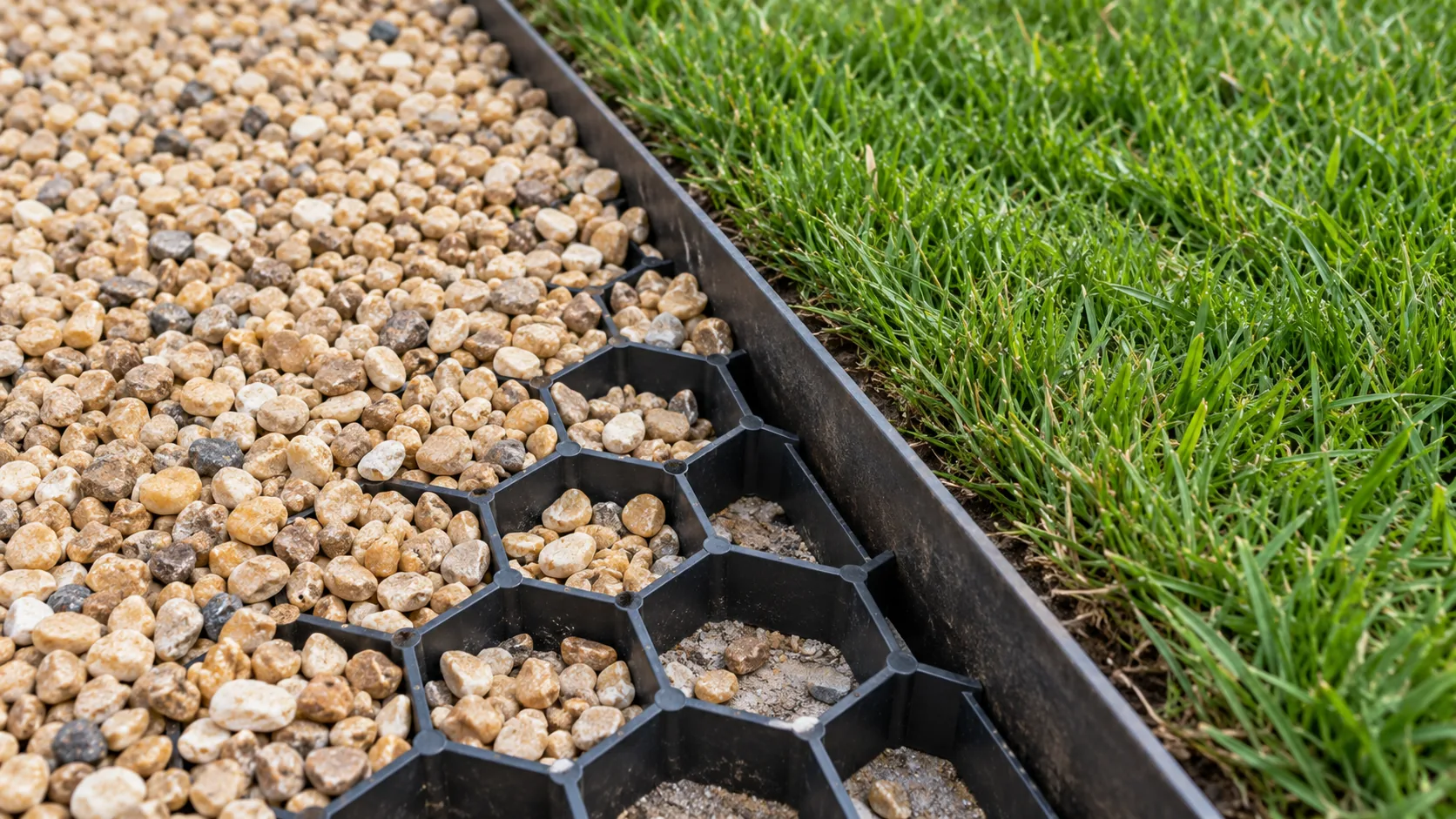
| 10–15% (steep) | Honeycomb plastic stabilization grid | Each grid cell holds gravel in position independent of slope |
| Above 15% | Medium river rock (2–4 inch) with gravel netting | Pea gravel not suitable above 15% grade regardless of method |
Cross-risers on moderate slopes are an underused technique. A timber sleeper, steel flat bar, or concrete curb set horizontally across the path or slope every 4 to 6 feet creates a series of level terraces. The pea gravel in each terrace section between risers can only migrate within that section. It cannot cascade the full length of the slope. This reduces the water displacement effect dramatically and is easy to install at the same time as the path.
Method 7: Annual Maintenance Routine
The best edging and installation degrades over time if not maintained. Annual maintenance resets the migration that has occurred over the previous year before it compounds into a bigger problem.
The annual redistribution technique: In spring, walk the perimeter of the gravel area with a stiff rake. The edge build-up, the ridge of accumulated gravel that forms inside the edging, is visible as a higher-than-normal strip along the perimeter. Pull this ridge back toward the path or patio center using the rake. After one pass around the perimeter, the edge ridge is gone and the center is restored to approximately its original depth. This takes 20 to 40 minutes for a standard garden path and 30 to 60 minutes for a 200 sq ft patio.
Do not rake the entire surface uniformly. This distributes the displaced stone but does not correct the underlying accumulation pattern. Target the edge build-up specifically, pulling it toward the centerline. The result is a restored surface without adding any new material.
Top-up after redistribution: After redistribution, add 0.5 inch of fresh pea gravel over the entire surface. This restores the overall depth to specification and compensates for the small amount of stone that has permanently escaped past the edging or been removed on shoes and in foot traffic. A 200 sq ft area at 0.5-inch top-up needs 0.34 cubic yards or 18 standard 50-lb bags.
Method Comparison Table
| Method | Addresses failure mode | Cost | Effectiveness | DIY ease |
|---|---|---|---|---|
| Steel edging (4 in) | Lateral spread | $1–$2/lin ft | High | Easy |
| Stone / brick border | Lateral spread | $3–$10/lin ft | High (if no gaps) | Moderate |
| Polymer resin stabilizer | Lateral spread (60–80%) | $0.50–$1.50/sq ft | Medium–High | Easy |
| Compacted base layer | Vertical sinking | $0.50–$1/sq ft | High (for sinking) | Moderate |
| Correct depth (3 in) | All; slows all modes | $0.20–$0.40/sq ft | Medium | Easy |
| Plastic stabilization grid | Lateral spread + slope | $2–$4/sq ft | Very high on slopes | Moderate |
| Annual redistribution | Lateral spread (reset) | Time only | High (maintenance) | Easy |
5 Most Common Mistakes
Mistake 1. Using 2-inch edging. The single most common and most impactful mistake. Pea gravel underruns 2-inch edging at its base within the first season. Always use 4-inch depth edging for pea gravel.
Mistake 2. Setting edging top below gravel surface. If the edging top is lower than the gravel surface, any gravel pushed against it rolls over rather than being retained. Set the edging so gravel sits flush with or just below the edging top after settling.
Mistake 3. Installing at 2 inches depth. Two inches is technically the minimum, but it disperses visibly within one season under regular use. Three inches is the correct working specification. The extra cost is minimal.
Mistake 4. Skipping the compacted base layer. Without a compacted crushed stone base, gravel sinks into the subsoil within 2 to 3 seasons. The base is the most commonly skipped step in DIY installations and the most impactful omission for long-term performance.
Mistake 5. No annual maintenance. The best installation degrades without maintenance. Not raking edge build-ups back to center annually means the edge accumulation grows year by year until the gravel eventually overruns the edging. One annual raking session resets the installation and prevents this compounding.
Worked Containment Examples
20 x 20 ft patio, no edging installed. After one season of normal use, approximately 15 to 20 percent of the original gravel has migrated into the surrounding lawn. The patio surface is visibly thinner at the center than at the edges, where stone has accumulated against the lawn edge. Reinstalling with 4-inch steel edging and raking the migrated stone back onto the patio restores the surface. The edging cost on installation day: $120. The cost to correct the problem a year later, including materials and labor time: $200 to $280.
3 ft wide, 40 ft garden path, correct installation. Steel edging installed at 4-inch depth, secured every 18 inches with stakes driven at 45 degrees. Pea gravel at 3-inch depth. After two seasons of daily use, the centerline has thinned to approximately 2.2 inches while edges have built up to 3.5 inches. One spring redistribution session (30 minutes with a rake) restores the surface to specification without any new material needed. This is exactly how a correctly installed path should behave.
10 percent slope with no cross-risers. A garden path on a 10 percent gradient with only edge containment develops visible downhill gravel migration within the first heavy rain season. The upper section of the path exposes fabric while the lower section builds up 4 to 5 inches. Adding horizontal timber risers across the path every 5 feet creates level terraced sections that retain the gravel regardless of rainfall intensity. The risers are installed by removing gravel in sections, setting the timber into the base, and replacing the gravel behind each riser.
Frequently Asked Questions
How do you keep pea gravel from spreading?
Why does pea gravel keep moving?
What is the best edging to keep pea gravel in place?
Does gravel stabilizer work for pea gravel?
How do I stop pea gravel washing away?
How do you keep pea gravel from sinking?
How do you keep pea gravel in place on a slope?
Does pea gravel depth affect how much it moves?
Can you use concrete to hold pea gravel in place?
What causes pea gravel to spread to the lawn?
How often should you rake pea gravel?
Do plastic grids help keep pea gravel in place?
Related Guides and Calculators
Pea Gravel Walkway Guide
Width, depth, edging, curved path techniques, centerline erosion prevention. All containment principles applied.
GuidePea Gravel Patio Guide
Complete patio installation guide. Correct base, edging spec, depth, and maintenance to minimize migration.
GuidePea Gravel Depth Guide
Correct depth for every application. Including how depth affects migration rate and maintenance frequency.
How to Install Pea Gravel
Full installation guide. Base preparation, landscape fabric, edging installation, and correct gravel depth.
GuideMaintenance Guide
Annual maintenance schedule. Raking technique, top-up quantities, and preventing compounding migration.
CalculatorPea Gravel Calculator
Calculate top-up quantities. Enter your area and 0.5 to 1 inch depth for annual redistribution material cost.
Sources & Methodology
- USGS: Natural Aggregates Statistics: aggregate material characteristics
Edging specifications: From hardscape industry practice. The 4-inch depth is standard for loose aggregate containment. Stabilizer resin performance: 60–80% migration reduction from product testing data. Slope thresholds: From landscape engineering practice. The 15% maximum grade for pea gravel regardless of containment method. Full methodology
Last reviewed: October 2026