
Pea Gravel Depth Guide: How Deep for Every Project 2026
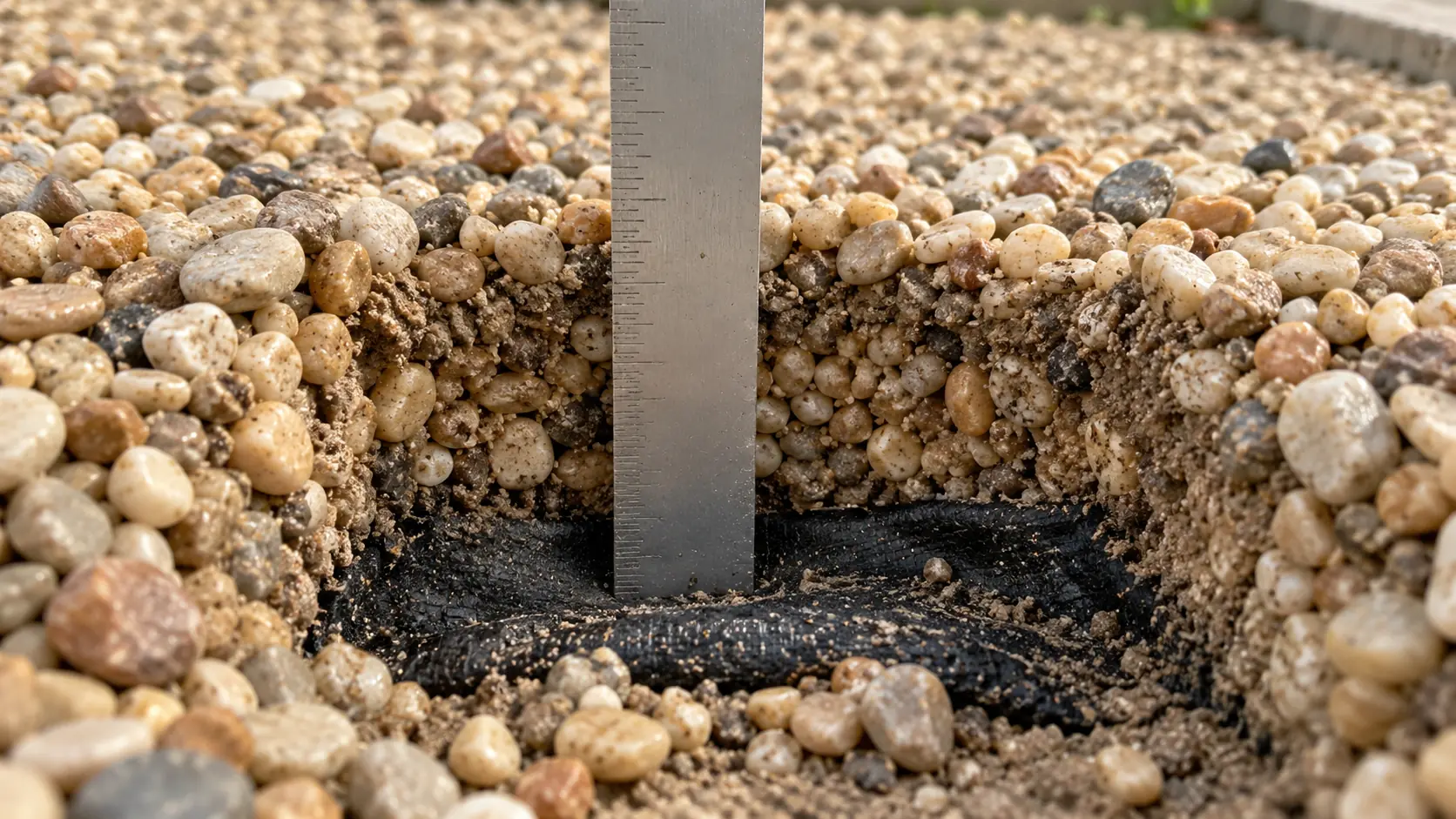
In This Guide
- Master depth table, all applications
- Why depth matters, minimum vs optimal
- Patio depth guide
- Driveway depth, base and surface
- Path and walkway depth
- Dog run depth
- Playground depth: CPSC requirements
- French drain depth
- Garden bed depth
- Climate adjustments, freeze-thaw guide
- Base layer specification
- Top-up schedule by project type
- Frequently asked questions
Master Depth Table: All Applications
| Application | Minimum | Standard | Optimal | Notes |
|---|---|---|---|---|
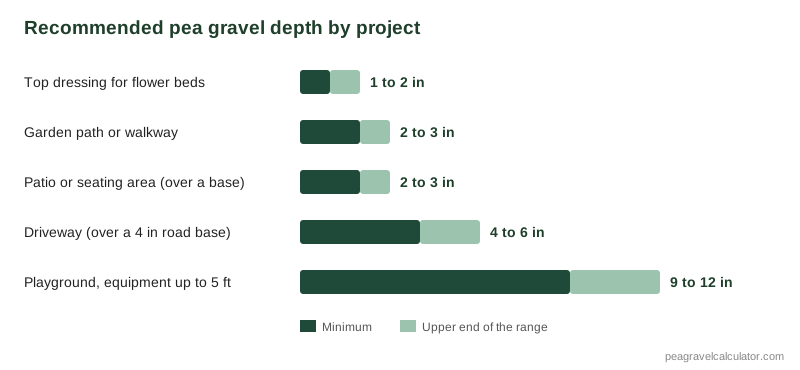
| Patio / seating area | 2 in | 3 in | 3–4 in | Over compacted base + landscape fabric |
| Garden path / walkway | 2 in | 2–3 in | 3 in | Edging required to contain gravel |
| Driveway surface layer | 2 in | 2–3 in | 3 in | Over 4–6 in compacted crushed stone base |
| Dog run | 2 in | 3 in | 3–4 in | Landscape fabric essential for drainage |
| Playground (under equipment) | 6–12 in (CPSC, by height) | 9–12 in | 12 in | Not recommended above 8 ft fall height regardless of depth; must remain uncompacted, rake regularly |
| Fire pit surround | 2 in | 3 in | 3 in | Concrete or stone pad under fire pit itself |
| Pool surround | 2 in | 2–3 in | 3 in | Washed pea gravel only; no sharp edges |
| Garden bed top dressing | 1 in | 1–2 in | 2 in | Over landscape fabric; not touching plant crowns |
| French drain fill | 8 in total | 8–10 in | 10 in | 2 in bed + 6–8 in around pipe |
| Tree ring / mulch ring | 2 in | 2–3 in | 3 in | Keep clear of trunk; 6-in gap minimum |
| Erosion control slope | 3 in | 3–4 in | 4 in | Angular stone better for steep slopes |
| Side yard / utility area | 2 in | 3 in | 3 in | Low-maintenance ground cover |
Why Depth Matters: Minimum vs Optimal
The minimum depth is the threshold below which the gravel stops functioning as intended. It fails as a surface, loses its drainage function, or creates a safety problem. The optimal depth is what delivers the best performance and longest service life for a given application.
Most landscaping guides list only a single number. That is misleading because a 2-inch patio is technically possible but requires more frequent maintenance. A 3-inch patio performs significantly better and lasts longer between top-ups. The difference in material cost between 2 and 3 inches on a 200 sq ft patio is approximately 0.68 cubic yards. Roughly $20 to $37 in bulk material. That small additional cost buys years of better performance.
Under-depth installation creates predictable failure modes. Below 2 inches, pea gravel migrates to edges under foot traffic and rain within one season, exposing the landscape fabric or base underneath. Below 1.5 inches, the surface is functionally a decorative sprinkle rather than a usable ground cover. At minimum depth, the surface needs topping up every 12 to 18 months rather than every 2 to 3 years at standard depth.
Over-depth also has consequences. Above 4 inches on a patio or path, the surface becomes noticeably soft. Heels sink in and walking requires extra effort. Furniture legs dig deeply and rock rather than sitting stably. The material cost of over-depth installation is wasted without any performance benefit.
Patio Depth Guide
Three inches is the established standard for pea gravel patios because it is the depth at which the surface remains stable under normal use while still feeling comfortable underfoot. Below 3 inches, moderate foot traffic redistributes stones and creates thin spots. Above 4 inches, the surface becomes too soft for comfortable furniture placement and walking.
Depth is only half of the build. See what to put under pea gravel for the base and fabric that sit below it.
| Depth | Performance | Top-up frequency | Best for |
|---|---|---|---|
| 2 inches | Adequate | Every 1–2 years | Low-traffic decorative areas |
| 3 inches | Good, standard | Every 2–3 years | Most residential patios |
| 4 inches | Excellent stability | Every 3–4 years | High-traffic, heavy furniture areas |
The 3-inch figure assumes installation over a properly compacted base. Without a base layer, even 4 inches of pea gravel will sink unevenly into the native soil within 2 to 3 years. The base layer is what keeps the surface level. Pea gravel depth only determines the surface quality, not the structural stability.
Driveway Depth: Base and Surface
A pea gravel driveway has two distinct layers with different depth requirements. These are not interchangeable. The base layer provides structural support and the surface layer provides the driving surface. Both are required for a driveway that lasts.
| Vehicle type | Base layer | Pea gravel surface | Total depth |
|---|---|---|---|
| Passenger cars (firm soil) | 4 in crusher run | 2 in | 6 in |
| Passenger cars (mixed soil) | 5–6 in crusher run | 2–3 in | 7–9 in |
| SUVs and light trucks | 6 in crusher run | 2–3 in | 8–9 in |
| Heavy vehicles / RVs | 8 in crusher run | 2–3 in | 10–11 in |
| Clay or soft subgrade | 8 in crusher run | 3 in | 11 in |
Never increase the pea gravel surface depth beyond 3 inches on a driveway. Deeper pea gravel does not improve driveway performance. It makes it worse. Tires sink further into deep loose gravel, creating ruts faster and making the surface harder to drive on. The structural work is done by the base layer. Surface pea gravel depth above 3 inches is just material cost without any performance benefit.
For resurfacing an existing driveway with a solid base: add 2 to 3 inches of fresh pea gravel over the existing surface. Do not excavate unless the base has failed. A failed base shows as significant rutting that returns within weeks of adding fresh gravel. If this is happening, the base needs rebuilding before resurfacing is worthwhile.
Path and Walkway Depth
Garden paths have more tolerance for shallower depths than patios because foot traffic is concentrated in a narrow line rather than spread across a wide area. The result is more displacement along the centerline of the path and gravel pushed to the edges.
| Path use | Recommended depth | Notes |
|---|---|---|
| Decorative (low traffic) | 2 inches | Occasional foot traffic only |
| Standard garden path | 2–3 inches | Daily use, comfortable underfoot |
| High-use connecting path | 3 inches | Between main areas of the garden |
| Wheelbarrow access | 3 inches | Loaded wheelbarrows displace shallower gravel |
| Side yard walkway | 3 inches | Also functions as drainage surface |
Dog Run Depth
Dog runs require more depth than a comparable patio of the same area because dog activity, running, digging, and concentrated urine, is harder on the surface than human foot traffic.
Three inches provides adequate drainage and comfortable footing for most breeds. Medium and large breeds that run actively benefit from 4 inches. Their paws create more displacement than smaller dogs and the additional depth extends the time between top-ups. The drainage function is critical in a dog run because urine must pass through the gravel immediately rather than pooling on the surface. Shallow gravel that becomes compacted loses its drainage efficiency and starts to hold odor.
Install pea gravel in dog runs over woven geotextile fabric directly on the compacted subgrade. Without fabric, the gravel gradually mixes with the soil below and the drainage efficiency declines within 2 to 3 years. With fabric, the drainage layer remains clean and functional for 5 to 10 years before renovation is needed.
Playground Depth: CPSC Requirements
Playground pea gravel depth is a safety requirement, not a preference. The CPSC specifies minimum depths based on equipment fall height because loose-fill surfaces must absorb impact energy from falls. A surface that is too shallow does not attenuate impact adequately and creates injury risk.
| Equipment fall height | Minimum pea gravel depth | Critical requirement |
|---|---|---|
| Up to 4 feet | 6 inches | Must remain uncompacted |
| 4 to 5 feet | 9 inches minimum, 12 inches as-installed | Check depth monthly |
| 5 to 7 feet | 12 inches as-installed | Rake regularly, check monthly, this is the upper edge of pea gravel's viable range |
| Above 8 feet | Not recommended | Use engineered wood fiber or tested rubber surfacing instead, regardless of depth |
The depth figures above are specified as uncompacted, meaning loose, freshly installed gravel. Pea gravel compacts under use and over time. A playground installed at 9 inches can be at 6 or 7 inches within 6 months if not maintained. Falling below the minimum for the equipment's fall height means the surface no longer meets impact attenuation requirements. This is not an aesthetic issue, it is a safety issue.
Check playground depth monthly by pushing a ruler into the gravel at multiple points across the play zone. Particularly in high-use areas under swings, at the bottom of slides, and at climbing structure landing zones. Top up immediately when any measurement falls below the minimum for your equipment's fall height. Many playground operators install several inches above the minimum initially to provide a buffer before the first top-up is needed.
French Drain Depth
French drain pea gravel depth is measured differently from surface applications. It refers to the total depth of gravel in the trench surrounding the perforated pipe, not just the surface.
Trench: 18 to 24 inches deep × 12 inches wide · Slope: 1% minimum (1 inch per 8 feet)
Layer 1. Gravel bed: 2 inches of pea gravel on the trench floor
Layer 2. Pipe: perforated pipe placed with holes facing down on the gravel bed
Layer 3. Gravel surround: 6 to 8 inches of pea gravel around and above the pipe
Layer 4. Fabric cap: landscape fabric folded over the gravel before backfilling with soil
Total pea gravel in the trench: 8 to 10 inches. The gravel depth around the pipe must be sufficient to allow water to flow freely from the surrounding soil into the pipe without that pathway becoming blocked by fine soil particles. Landscape fabric wrapped around the entire gravel assembly, not just laid on top, prevents soil migration into the gravel voids that would reduce drainage performance over time.
Garden Bed Depth
Pea gravel in garden beds functions as a decorative mulch alternative. Suppressing weeds, retaining soil moisture, and creating a clean visual boundary between plants and soil. The depth requirements are lower than any other pea gravel application because foot traffic is minimal.
| Use case | Depth | Notes |
|---|---|---|
| Decorative top dressing (low weed pressure) | 1 inch | Light weed suppression; adequate for established beds |
| Standard ornamental bed | 1–2 inches | Over landscape fabric; good weed control |
| High weed pressure area | 2–3 inches | Heavier layer reduces light reaching weed seeds |
| Around shrubs and trees | 2–3 inches | Keep 6-inch gap around trunk; gravel touching bark traps moisture |
Do not use pea gravel as a mulch alternative around vegetables or annual plants where regular soil cultivation is needed. Removing and replacing pea gravel each season is impractical. Pea gravel mulch is most effective in established perennial beds, around shrubs, and under trees where the planting scheme is permanent.
Climate Adjustments: Freeze-Thaw Guide
Standard depth recommendations assume temperate climates without severe winter conditions. In freeze-thaw climates, anywhere with repeated cycles of ground freezing and thawing, pea gravel installations need adjustments to maintain performance.
| Climate zone | Adjustment | Reason |
|---|---|---|
| Mild (rarely freezes) | Standard depths apply | No freeze-thaw disruption |
| Moderate (occasional frost) | Add 0.5 inch to standard depth | Minor heaving of base layer |
| Cold (regular hard freeze) | Add 1 inch to standard depth | Significant heaving redistributes gravel |
| Severe (USDA zones 1–4) | Add 1–2 inches + 6 in compacted base minimum | Deep freeze penetrates base layer |
Freeze-thaw cycling heaves the base layer upward when the ground freezes and settles it back when it thaws. This vertical movement is not uniform. High spots heave more than low spots, creating an uneven surface over time. The pea gravel above moves with the base and redistributes unevenly. Adding extra depth at installation provides a buffer against this thinning effect without requiring early top-ups.
In severe winter climates, use a 6-inch compacted base minimum. Not the standard 2 to 3 inches. A thicker base layer moves as a unit and creates a more uniform surface after thaw. Install the base in autumn before freeze-up and let it settle through one winter before adding the pea gravel surface layer. This one-season wait allows initial freeze-thaw movement to stabilize before the surface layer goes on.
Base Layer Specification
Pea gravel depth alone does not determine installation success. The base layer under the pea gravel is what provides structural stability and prevents the gravel from sinking into the subsoil. Every surface application of pea gravel, patio, path, dog run, driveway, performs better and lasts longer over a properly prepared base.
| Application | Base material | Base depth | Compaction required |
|---|---|---|---|
| Patio (light use) | #57 crushed stone or road base | 2–3 inches | Yes, plate compactor |
| Patio (heavy use) | Crusher run | 3–4 inches | Yes, plate compactor |
| Path (foot traffic) | Compacted soil or #57 stone | 2 inches | Firm by tamper |
| Driveway | Crusher run | 4–6 inches (see depth table) | Yes, plate compactor in lifts |
| Dog run | Compacted soil + fabric | Native soil compacted | Firm; hand tamper sufficient |
| Playground | Compacted soil | Native soil compacted | Firm |
The landscape fabric installed between the base layer and the pea gravel is a separate component from the base layer itself. The fabric prevents mixing of materials and suppresses weeds. It does not provide structural support. Use woven geotextile fabric, not thin black plastic sheeting. Woven geotextile lasts 15 to 20 years. Plastic sheeting degrades within 3 to 5 years.
Top-Up Schedule by Project Type
All pea gravel installations lose material over time through migration, settling, and displacement. Regular top-ups maintain the correct depth and extend the functional life of the installation without full renovation.
| Application | Check depth | Top up when | Top-up depth |
|---|---|---|---|
| Patio | Annually | Below 2.5 inches | 1 inch |
| Garden path | Annually | Below 1.5 inches | 0.5–1 inch |
| Driveway surface | Twice yearly | Below 1.5 inches | 1 inch |
| Dog run | Every 6 months | Below 2 inches | 1 inch |
| Playground | Monthly | Below CPSC minimum | As needed |
| Garden bed | Annually | Below 1 inch | 0.5–1 inch |
Calculate top-up quantity: Length × Width × Top-up depth (in) ÷ 324 = cubic yards. For a 200 sq ft patio at 1-inch top-up: 200 × 1 ÷ 324 = 0.62 yd³ or 34 standard 50-lb bags. For a 10 × 20 ft dog run at 1-inch top-up: 200 × 1 ÷ 324 = 0.62 yd³. Use the pea gravel calculator for exact quantities at your dimensions and top-up depth.
4 Most Common Pea Gravel Depth Mistakes
Mistake 1. Installing at 2 inches on a patio. Two inches is listed as the minimum for decorative applications, which leads many homeowners to install at exactly 2 inches to save material cost. Under regular foot traffic, 2-inch pea gravel thins to the landscape fabric within one season. Foot pressure pushes stones to the edges, the center goes bare, and the entire surface needs topping up within 12 months. The cost saving on the original order is lost in the first top-up. Three inches is the correct working depth for any surface that gets walked on.
Mistake 2. Using the same depth for a driveway as a patio. A driveway with 3-inch pea gravel and no base will fail under vehicle weight within the first year. The gravel compresses into the native soil, the surface becomes uneven, and stones are pushed into the lawn by tires. A driveway needs a 4-inch compacted crusher run base plus 2 to 3 inches of pea gravel surface. Two separate layers. Installing pea gravel alone on a driveway is the single most common expensive mistake in DIY pea gravel projects.
Mistake 3. Installing too deep on slopes. Above 3 inches on any gradient, pea gravel is unstable. A 4-inch deep path on a 5 percent slope develops visible migration channels after the first heavy rain. The correct approach for sloped areas: 2 to 3 inches maximum with cross-risers every 4 to 6 feet to create level terraced sections. Deeper gravel on a slope does not stay in place. It accelerates downhill movement.
Mistake 4. Not accounting for compaction loss. Pea gravel settles 10 to 15 percent after installation and watering. A 3-inch installation settles to approximately 2.5 to 2.7 inches within the first few weeks. For playgrounds where the CPSC minimum for the equipment's fall height must be maintained, installing at exactly the minimum means the surface is immediately below the safety threshold after settling. Always install at the next depth above your target to account for predictable settling.
Frequently Asked Questions
How deep should pea gravel be?
What is the minimum depth for pea gravel?
How deep should pea gravel be for a patio?
How deep should pea gravel be for a driveway?
How deep should pea gravel be for a path?
How deep should pea gravel be for a playground?
How deep should pea gravel be for a dog run?
Does pea gravel depth need adjusting for cold climates?
How deep is pea gravel for a French drain?
What happens if pea gravel is too shallow?
How much does depth affect quantity needed?
How often should pea gravel be topped up?
Calculators for Your Project
Pea Gravel Calculator
Enter length, width, and depth. Get cubic yards, tons, bags, and cost instantly for any project.
CalculatorCoverage Calculator
Works backwards. Enter cubic yards and depth to find the area they cover at any depth.
CalculatorGravel Driveway Calculator
Base and surface layers calculated separately with correct depth and compaction factors.
How Much Pea Gravel?
Pre-calculated quantities for every project type. Patio, driveway, path, dog run, playground.
GuideHow to Install Pea Gravel
Step-by-step installation guide. Base prep, fabric, edging, spreading, and settling.
GuidePea Gravel Sizes Guide
Which size for which project. Covers 1/8 inch to 5/8 inch grades and their correct applications.
Sources & Methodology
- CPSC Handbook for Public Playground Safety: minimum loose-fill depth requirements by equipment fall height
- USGS: Natural Aggregates Statistics: pea gravel density reference
Depth standards: Playground depths from CPSC specification. All other depths from landscape industry practice and civil engineering driveway standards. Minimum depths represent the threshold below which the application fails to perform as intended. Optimal depths represent best performance and longest service life. Full methodology
Last reviewed: October 2026