
Pea Gravel Walkway Guide: Installation, Width, Edging & Cost 2026
In This Guide
- Path width guide, by use type
- Depth guide, by traffic intensity
- How much pea gravel for a walkway
- Edging options, straight and curved paths
- Base layer and fabric specification
- Step-by-step installation
- Curved path techniques
- Stepping stones in pea gravel
- Centerline erosion, prevention and repair
- Maintenance schedule
- Cost guide 2026
- Frequently asked questions
Path Width Guide: By Use Type
Path width is the most commonly underestimated dimension in garden design. Paths that feel fine in plan look and feel cramped when installed. The standard residential garden path at 18 to 24 inches, which appears in many published guidelines, is actually quite narrow for regular use. A comfortable path that feels generous rather than pinched is 30 to 36 inches.
| Path type | Minimum width | Recommended width | Notes |
|---|---|---|---|
| Decorative garden path; low use | 18 inches | 24 inches | Access to garden features, occasional use only |
| Standard garden path; daily use | 24 inches | 30–36 inches | Main path through the garden |
| Two people side by side | 48 inches | 54–60 inches | Entertaining path, connecting social spaces |
| Primary entrance / front path | 36 inches | 48–54 inches | Creates dignified approach to the house |
| Service path | 30 inches | 36–42 inches | Wheelbarrow access, bin collection, maintenance |
| Side path between structures | 24 inches | 30–36 inches | Often constrained by existing structures |
Width also affects how the path reads visually within the garden. A path wider than its length looks like a patio section. A path narrower than 24 inches looks like a gap rather than a designed route. The 30 to 36-inch range is the sweet spot for most residential garden paths. Wide enough to feel intentional, narrow enough to read clearly as a path rather than a space.
Depth Guide: By Traffic Intensity
Depth determines how quickly centerline erosion develops and how often the path needs topping up. More depth means more material but longer intervals between maintenance.
| Traffic level | Recommended depth | Top-up interval |
|---|---|---|
| Decorative; occasional use (weekly or less) | 2 inches | Every 2–3 years |
| Standard; regular use (several times per week) | 3 inches | Every 2–3 years |
| High use; daily traffic | 3 inches | Every 1–2 years |
| Very high use; multiple people daily | 3–4 inches | Every 1–2 years |
| Service path; heavy equipment, wheelbarrows | 3–4 inches over compacted base | Every 1–2 years |
The jump from 2 to 3 inches increases material cost by 50 percent but improves the path's resistance to centerline erosion significantly. On a 3-foot wide, 30-foot long path the difference in material cost between 2 and 3 inches is approximately $20 to $35. A small sum for a meaningful improvement in path longevity.
How Much Pea Gravel for a Walkway
Calculate path area and multiply by depth. Base layer (crushed stone) is calculated separately at the same area and 2 inches depth.
| Path dimensions | Area | Pea gravel (3 in + 10%) | Base stone (2 in + 10%) | Total combined |
|---|---|---|---|---|
| 2 ft × 20 ft | 40 sq ft | 0.41 yd³ / 22 bags | 0.27 yd³ / 15 bags | 0.68 yd³ |
| 3 ft × 20 ft | 60 sq ft | 0.61 yd³ / 33 bags | 0.41 yd³ / 22 bags | 1.02 yd³ |
| 3 ft × 50 ft | 150 sq ft | 1.53 yd³ / 83 bags | 1.02 yd³ / 55 bags | 2.55 yd³ |
| 4 ft × 30 ft | 120 sq ft | 1.22 yd³ / 66 bags | 0.82 yd³ / 44 bags | 2.04 yd³ |
| 4 ft × 50 ft | 200 sq ft | 2.04 yd³ / 110 bags | 1.36 yd³ / 74 bags | 3.40 yd³ |
| 5 ft × 50 ft | 250 sq ft | 2.55 yd³ / 138 bags | 1.70 yd³ / 92 bags | 4.25 yd³ |
For paths needing more than 1 cubic yard of pea gravel, bulk delivery is cheaper than bags. Use the coverage calculator for any path dimension and depth.
Edging Options: Straight and Curved Paths
| Edging type | Cost per lin ft | Curved paths | Lifespan | Best for |
|---|---|---|---|---|
| Steel edging (4-inch) | $1.00–$2.00 | Excellent | 20–30 yr | All paths; especially curved |
| Aluminum edging | $1.50–$2.50 | Excellent | 20+ yr | All paths |
| Brick border | $3.00–$6.00 | Requires cutting | 20+ yr | Straight formal paths |
| Natural stone border | $4.00–$10.00 | Difficult | Indefinite | Formal or cottage garden paths |
| Timber sleepers | $2.00–$5.00 | Difficult | 5–10 yr | Informal garden paths |
| Plastic flexible edging | $0.50–$1.00 | Good | 3–7 yr | Temporary; not recommended long-term |
The single most important edging specification for pea gravel paths: use 4-inch depth edging, not 2-inch. The additional depth prevents gravel from underrunning the edge and escaping into the adjacent lawn or garden bed. With 2-inch edging, gravel pushed against the edge by foot traffic gradually works its way under and out of the path. With 4-inch edging, the deeper stake prevents this horizontal movement.
For a full comparison of materials, heights, and prices, see the pea gravel edging guide.
For natural stone borders, the gap between individual stones must be smaller than the pea gravel diameter. Approximately 1/4 inch maximum. Wider gaps allow gravel to escape through the joints. Mortared stone borders eliminate this problem but add cost and remove the ability to easily adjust or remove the edging later.
Base Layer and Fabric Specification
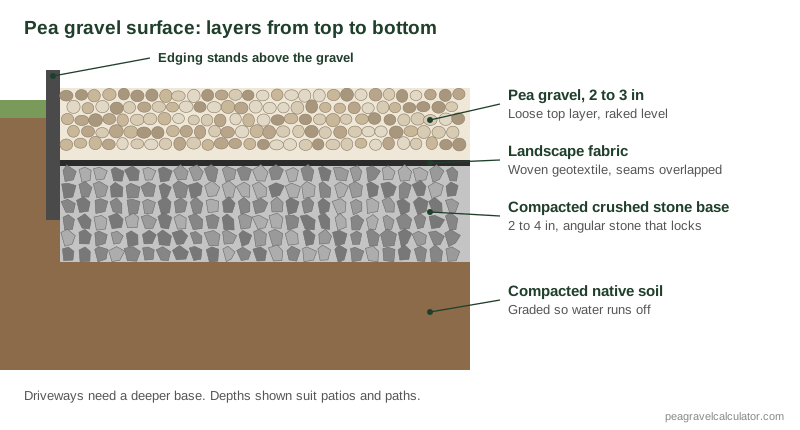
The base layer and landscape fabric together determine whether the path remains functional for 2 years or 15 years. Both are easy to install and both are frequently skipped by DIY installers who focus only on the surface gravel.
1. Native soil: Compact with plate compactor or hand tamper. The surface should feel firm. No visible movement when you step on it.
2. Base layer: 2 inches of compacted #57 crushed stone or road base. Compact thoroughly.
3. Landscape fabric: Woven geotextile, overlapping seams by 6 inches, secured with fabric staples every 18 inches.
4. Pea gravel: 3 inches, raked level, watered to settle.
Why the base matters: native soil, especially clay, becomes soft and plastic when wet. Foot traffic on soft ground pushes the gravel down unevenly, creating ruts and an irregular surface within weeks of the first heavy rain. The compacted crushed stone base provides a stable platform that does not deform under foot traffic regardless of weather conditions.
Why fabric type matters: thin black plastic sheeting (the cheaper landscape fabric sold at many garden centers) degrades under UV exposure and physical stress within 2 to 3 years. Once it tears, weeds grow through the gaps and the torn plastic becomes entangled in the gravel. It cannot be removed without removing the gravel too. Woven geotextile is specifically designed for this application, maintains its physical integrity for 15 to 20 years, and is clear and practical to pull up cleanly if renovation is needed.
Step-by-Step Installation
Tools needed: String lines and stakes, spade or rotary edger, wheelbarrow, rake, hand tamper or plate compactor, landscape staple gun, utility knife, garden hose, steel edging installation tool (or stiff rubber mallet).
Step 1. Mark the path. For straight paths: use string lines stretched between stakes at each end. For curved paths: lay a garden hose along the intended route, adjust until the curve looks natural from multiple viewpoints, then mark the line with sand or spray paint. Step back 10 meters and look at the path from the angle it will be seen from. Paths often look different from a distance than they do close up.
Step 2. Excavate. Excavate 5 to 6 inches deep along the marked path: 2 inches for base plus 3 inches for pea gravel, with a small allowance for compaction. Cut the sides cleanly and vertically. The path sides should be straight vertical cuts, not angled. Angled sides make edging installation harder and create a wider base than the surface width.
Step 3. Compact the subgrade. Run a plate compactor along the excavated base, or tamp firmly with a hand tamper for narrow paths. Check for soft spots. Low-quality or wet soil areas that feel spongy. Fill soft spots with a small amount of crushed stone and compact again before proceeding.
Step 4. Install edging. Push steel edging stakes into the ground on both sides of the path at the finished surface height. The top of the edging should sit flush with or 1/4 inch above the planned finished gravel surface. Secure with ground anchors every 18 inches. For curves, score the top flange of steel edging with a utility knife every 6 to 8 inches to allow it to follow the curve without buckling.
Step 5. Add and compact base layer. Spread 2 inches of #57 crushed stone or road base. Rake level. Compact with at least two passes of the plate compactor. The finished base should feel completely firm with no deflection when you step on it.
Step 6. Lay landscape fabric. Unroll woven geotextile fabric over the compacted base. Extend it to the inside edge of both edging strips on each side. Overlap any seams by 6 inches and secure with landscape staples every 18 inches. Cut to length with a utility knife.
Step 7. Add pea gravel. Tip pea gravel onto the fabric from the wheelbarrow and spread with a rake. Do not use a shovel. The blade drags and bunches the fabric. Work from one end toward the other. Check depth at multiple points. Target 3 inches above the fabric.
Step 8. Water and settle. Water the finished surface with a garden hose on a gentle setting. Water settles the gravel and reveals any low spots. Top up low areas with additional gravel before the first use.
Curved Path Techniques
Curved paths are more visually appealing than straight ones in most garden contexts. They suggest exploration, slow the visual pace through the garden, and follow the natural topography of planted areas more gracefully.
Design principle. One smooth curve per path section. A path that curves once is elegant. A path with multiple tight curves looks nervous and difficult to navigate. Single gentle curves with a radius of 3 meters or more look natural. Tighter curves are appropriate at decision points. Where the path turns to follow a different garden feature.
Marking technique for curves. The garden hose method gives a more natural curve than string lines or tape measures. Lay the hose along the intended path line and view from the planned entry point. Adjust one section at a time until the curve reads smoothly from that perspective. Photograph it before marking with sand or spray paint. It is easier to adjust the hose than to adjust marked lines.
Edging curves. Steel edging handles curves by flexing. It bends naturally to follow gradual curves. For tight curves (radius under 1.5 meters), score the top flange of the edging with a utility knife every 6 to 8 inches so the edging can follow the curve without buckling along its length. Natural stone or brick borders on curves require cutting individual units. A wet saw or angle grinder with a masonry disc. This adds significant time but produces a cleaner result in formal garden settings.
Stepping Stones in Pea Gravel
Stepping stones integrated into pea gravel paths combine the visual warmth of gravel with the practicality of a firm foothold. They are particularly useful at entry and exit points where people step from a hard surface onto the gravel path, and in wet climates where walking directly on gravel in dress shoes or bare feet is unpleasant.
Installation sequence: Always install stepping stones before adding the pea gravel. Set each stone into the compacted base layer at the correct height. With the top surface sitting flush with the planned finished gravel surface or up to 1/2 inch above it. Never set stepping stones on top of the gravel. They sink unevenly over time. Spacing for comfortable average adult stride: 18 to 22 inches between stone centers. A tighter spacing of 16 inches suits shorter strides and children.
Stone height above gravel. Stepping stones sitting flush with the gravel provide a continuous visual surface with defined firm footing. Stones raised 1/2 inch above gravel are more visible and slightly easier to step on deliberately. Stones raised 1 inch above gravel create a stepping stone path with gravel fill. A more formal appearance where each stone is the primary design element. Choose based on whether the gravel or the stones should dominate visually.
Centerline Erosion: Prevention and Repair
Centerline erosion is the most common maintenance problem on pea gravel paths. Every footstep on the middle of the path pushes gravel sideways toward the edges. Over months of use, the gravel thins in the center and builds up at the edges, eventually exposing the landscape fabric in a worn strip along the most-traveled line.
Prevention: Install at 3 inches rather than 2 inches. The additional inch provides a buffer before centerline thinning becomes visible. For high-use paths, 3.5 to 4 inches provides a longer interval before maintenance is needed. Stepping stones placed at regular intervals along the path center distribute foot traffic across a fixed point and significantly reduce lateral stone displacement along the most-used sections.
Annual maintenance repair: Each spring, rake gravel from the edge build-ups back toward the path center. Use the rake to pull stone from the accumulated ridges along the edging toward the thin centerline strip. This redistribution restores the path profile without adding any new material. It is simply moving existing gravel back to where it started. Add 0.5 inch of fresh pea gravel over the entire path after redistribution to restore depth lost to permanent edge displacement since the previous maintenance.
Maintenance Schedule
| Frequency | Task | Time (per 50 lin ft of 3 ft path) |
|---|---|---|
| Spring | Rake to redistribute from edges to center, remove surface weeds | 30–45 minutes |
| Summer | Pull any surface weeds before they seed | 10–15 minutes |
| Autumn | Rake leaves off surface before they decompose into grit | 20–30 minutes |
| Every 2–3 years | Top up with 0.5–1 inch of fresh pea gravel | 1–2 hours |
| Every 5 years | Check edging integrity, re-stake any sections that have lifted | 30 minutes |
Cost Guide 2026
| Cost item | Typical cost | Per linear foot (3 ft wide path) |
|---|---|---|
| Pea gravel (3 in, bulk) | $30–$55/yd³ | $1.50–$2.75 |
| Crushed stone base (2 in, bulk) | $25–$45/yd³ | $0.80–$1.50 |
| Landscape fabric (woven geotextile) | $0.15–$0.30/sq ft | $0.45–$0.90 |
| Steel edging (4-inch, both sides) | $1.00–$2.00/lin ft | $2.00–$4.00 |
| Plate compactor rental (half day) | $60–$120 flat fee | Divided across project area |
| Total DIY per linear foot | - | $5–$10 |
| Total professional per linear foot | - | $14–$28 |
Upgrading from steel edging to natural stone or brick borders adds $3 to $8 per linear foot to the edging cost. A 3-foot wide, 50-foot path with stone borders instead of steel edging costs $150 to $400 more in edging material alone, plus cutting and installation time. The aesthetic upgrade is significant but the cost is real.
Worked Walkway Examples
3-foot wide, 40-foot garden path connecting patio to vegetable garden. Area = 120 sq ft. At 3 inches: 120 x 3 ÷ 324 x 1.10 = 1.22 yd³ pea gravel. Base: 0.82 yd³ crushed stone. Edging: 80 lin ft steel edging at $1.50/lin ft = $120. Fabric: 120 sq ft at $0.18 = $22. Total materials: $242 to $330 depending on region. Installation time: one full day for one person. This is the most cost-effective permanent path surface available. Comparable surfaces in brick or concrete cost $600 to $1,200 for the same dimensions.
4-foot wide, curved front garden path, 25 feet. Area = 100 sq ft. The key consideration is the edging. Curves require scoring steel edging every 6 to 8 inches or using aluminum edging which bends naturally. Aluminum costs slightly more per linear foot but saves time on installation for any path with curves under 5-foot radius. Budget $60 to $80 for 50 lin ft of aluminum edging versus $50 to $65 for steel. The difference is small for the time saved.
Side passage path, 2.5 feet wide, 15 feet between house and fence. This is a common challenging scenario. The passage is too narrow for comfortable two-person passage and too tight to maneuver a wheelbarrow easily. The recommended approach: widen to 3 feet if structurally possible, use 3/8-inch pea gravel at 2-inch depth (shallower to reduce the amount of gravel that scatters into tight adjacent spaces), and install steel edging on both sides with stakes driven at 45 degrees for maximum stability in the confined space.
4 Pea Gravel Walkway Mistakes That Require Rebuilding
Mistake 1. Making the path too narrow. The most common walkway mistake across all material types. A 24-inch wide path feels adequate when measured on paper but is uncomfortable in practice. Two people cannot pass, furniture cannot be moved along it, and it feels cramped rather than welcoming. The minimum comfortable residential garden path is 36 inches. For a main entrance path, 48 inches. Widening after installation requires buying more edging, more fabric, and more gravel. And re-excavating the additional width. Width is the one specification that costs more to change later than to get right initially.
Mistake 2. Skipping the compacted base on clay soil. Pea gravel installed directly on clay without a crushed stone base sinks unevenly within one to two seasons. The clay absorbs water, expands, contracts, and heaves the gravel surface. Low spots develop where the clay has compacted most, and the path surface becomes increasingly uneven. A 2-inch compacted #57 stone base provides the stable platform that prevents this. On sandy soil a base is optional; on clay it is not.
Mistake 3. Using lightweight plastic edging. Plastic edging warps in heat, pops out of the ground with frost heave, and fails to contain pea gravel migration within two to three seasons. Every walkway section then develops ragged edges as gravel spreads into adjacent lawn or beds. Steel or heavy-gauge aluminum edging at 4-inch depth set with ground stakes every 18 inches holds indefinitely. The cost difference is $1 to $1.50 per linear foot. On a 40-foot path that is $40 to $60 more for a permanent solution vs a temporary one.
Mistake 4. Installing without a drainage slope. A level path with no drainage slope retains water after rain, creating a wet surface that takes days to dry in cool weather. In freeze-thaw climates, standing water on a path freezes and lifts the gravel surface by frost heave over winter. The path must slope at least 1 percent from the center to the edges (cross slope) or along its length toward a drainage point. This slope is set during excavation. A path installed flat cannot have drainage slope added afterwards without removing and re-grading.
Frequently Asked Questions
How do you make a pea gravel walkway?
How wide should a pea gravel walkway be?
How deep should a pea gravel walkway be?
What is the best edging for a pea gravel walkway?
How do you stop pea gravel from spreading on a walkway?
How much does a pea gravel walkway cost?
Should I use landscape fabric under a pea gravel path?
How do you make a curved pea gravel path?
Can you put stepping stones in a pea gravel walkway?
How long does a pea gravel walkway last?
Is pea gravel good for a front walkway?
What causes centerline erosion in pea gravel paths?
Related Calculators and Guides
Coverage Calculator
Enter path dimensions and depth to get exact cubic yards, tons, and bags needed for any walkway project.
GuideHow Much Pea Gravel?
Pre-calculated quantities for common path widths and lengths. Quick reference without the calculator.
GuideHow to Install Pea Gravel
Full installation guide. Base preparation, landscape fabric, edging, spreading, and settling for all project types.
Pea Gravel Depth Guide
Correct depth for every application. Minimum vs optimal, climate adjustments, top-up schedule.
GuidePea Gravel Patio Guide
Complete patio guide. Depth, base spec, edging, furniture tips, and DIY installation steps.
GuidePea Gravel Sizes Guide
Which size for which application. The 3/8-inch size that suits most walkways and why size matters.
Sources & Methodology
- USGS: Natural Aggregates Statistics: pea gravel density reference data
Width standards: From landscape design practice and industry guidelines. Depth recommendations: From published landscape installation guidance. The standard is 3 inches as standard for daily-use paths. Cost data: 2026 landscape supplier pricing. Full methodology
Last reviewed: October 2026