
Pea Gravel Weed Control: Complete Prevention & Treatment Guide 2026
In This Guide
- Two weed sources, why one solution is never enough
- Landscape fabric, types, lifespan, and which to use
- Pre-emergent herbicide guide
- Prevention system for new installations
- Surface weed treatment, existing installations
- Renovation protocol, heavily weeded gravel
- Non-chemical treatment options
- Annual maintenance schedule
- Frequently asked questions
Two Weed Sources: Why One Solution Is Never Enough
Most weed control guides for pea gravel treat all weeds as the same problem. They are not. There are two completely distinct sources of weeds in pea gravel, each with a different mechanism and a different solution. Applying the wrong solution to the wrong source wastes time and does not fix the problem.
Source 1. Below-fabric weeds. These are weeds whose roots originate in the soil beneath the pea gravel installation. They push upward through the base layer and, if no fabric is present, directly through the gravel. These weeds are typically vigorous perennials, bindweed, couch grass, dandelions, and ground elder, with established root systems that have enough energy reserves to push through several inches of material. Landscape fabric prevents these by creating a physical barrier the roots cannot penetrate.
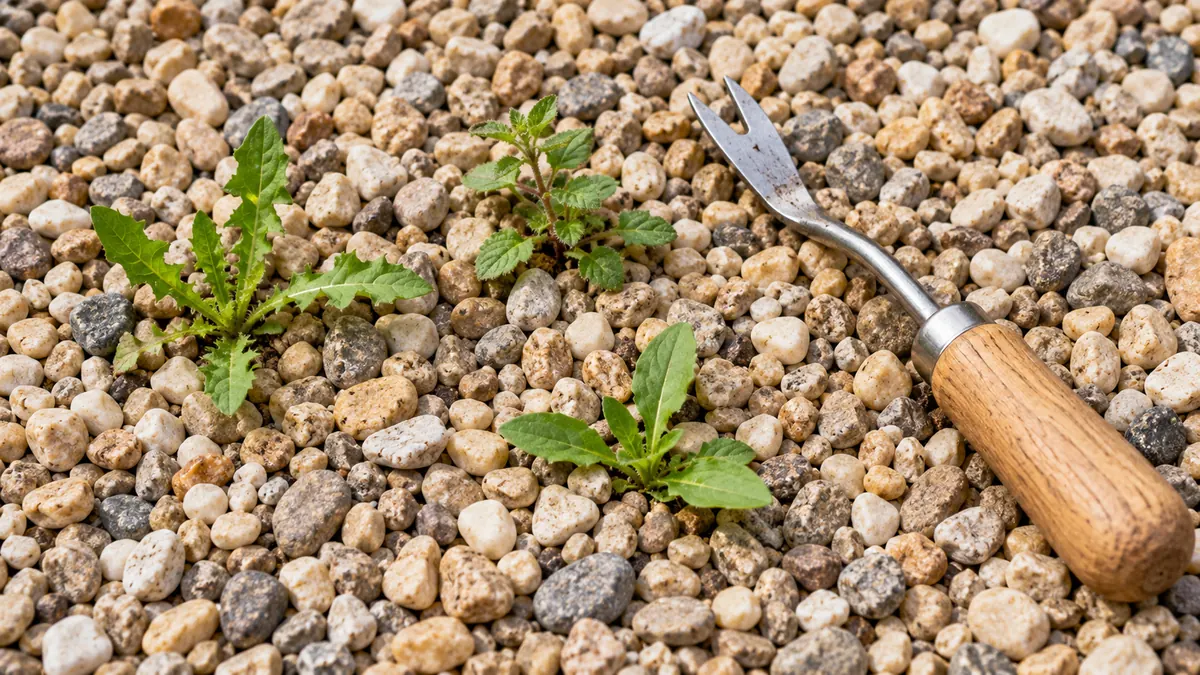
Source 2. Above-fabric weeds. These are weeds whose seeds arrive from outside the installation area. Blown in by wind, dropped by birds, or carried in by water. They germinate not in the soil below the fabric, but in the thin layer of organic matter (fine dust, decomposed leaf fragments, pollen) that accumulates on top of the gravel over time. Even a freshly installed gravel surface with perfect fabric underneath develops this surface seed germination within 2 to 3 years. Landscape fabric cannot prevent this. The seeds never reach below it. Pre-emergent herbicide applied to the gravel surface is the correct solution.
This explains a common frustration: "I installed landscape fabric but weeds keep coming back." The fabric is working. It is blocking below-ground roots. The weeds reappearing are a different category growing on top of the fabric, not through it.
Landscape Fabric: Types, Lifespan, and Which to Use
| Fabric type | Lifespan | Drainage | Weed suppression | Verdict |
|---|---|---|---|---|
| Woven geotextile (3–4 oz/sq yd) | 15–20 years | Excellent | Excellent below-ground | Best choice |
| Woven geotextile (1–2 oz/sq yd) | 8–12 years | Good | Good | Acceptable |
| Non-woven geotextile (spunbond) | 5–10 years | Good | Moderate | Budget option only |
| Thin black plastic sheeting | 2–4 years | None; blocks drainage | Initially good, then fails | Avoid |
| Biodegradable / paper fabric | 1–3 years | Good | Short-term only | Wrong product for gravel |
The weight rating matters. Most basic landscape fabric sold at hardware stores in bulk rolls is 1 to 1.5 oz per square yard. Adequate for mulch beds but prone to tearing under the weight and abrasion of gravel. For pea gravel installations, use 3 oz per square yard minimum. This weight class maintains its integrity under gravel load for 15 to 20 years without tearing.
Thin black plastic sheeting is the most common and most damaging mistake in DIY pea gravel installations. It blocks drainage completely. Water pools above it and creates a permanently wet layer between the gravel and the plastic. Within 2 to 4 years the plastic degrades into fragments that become entangled in the gravel. Renovating an installation with degraded plastic sheeting requires removing all the gravel to pick out the plastic pieces before new fabric can be installed. This adds significantly to renovation time and cost.
Pre-Emergent Herbicide Guide
Pre-emergent herbicides prevent weed seeds from germinating. They do not kill established weeds. Applied to the gravel surface before the main weed germination periods, they are the single most effective tool for managing above-fabric surface weeds.
| Active ingredient | Common products | Control duration | Application | Notes |
|---|---|---|---|---|
| Pendimethalin | Scotts Halts, Pendulum | 3–6 months | Granular or liquid | Most widely available; safe around established ornamentals |
| Isoxaben | Gallery, Snapshot (with trifluralin) | 6–12 months | Granular | Broader spectrum; longer residual; primarily pro product |
| Oryzalin | Surflan | 3–5 months | Liquid | Good grass control; available to homeowners |
| Corn gluten meal | Various organic brands | 4–6 weeks | Granular | Organic option; much shorter residual; requires high rate |
Application timing is critical. Pre-emergent herbicides must be applied before weed seeds germinate to be effective. Once a seed has germinated, pre-emergent has no effect on it. The soil temperature trigger for most annual weed germination is 55°F. In most northern states this occurs in mid-March to April. In southern states it can occur as early as February.
A simple rule: apply pre-emergent when forsythia begins to bloom in your area. This timing coincides with the 55°F soil temperature threshold across most of the US. A second application in August to September targets cool-season annual weeds and prevents autumn germination.
Application method: Apply granular pre-emergent to dry gravel. Water lightly (0.25 to 0.5 inch) after application. The water activates the pre-emergent by moving it into the soil or gravel surface layer where seeds germinate. Do not apply before heavy rain. Heavy rain washes the pre-emergent off the surface before it activates.
Prevention System for New Installations
The most effective time to control weeds in pea gravel is before the gravel goes down. A properly prepared new installation needs only annual pre-emergent applications to stay largely weed-free indefinitely.
Step 1. Clear the area completely. Remove all vegetation, roots, and sod. Any perennial weed roots left in the soil will eventually push through even good landscape fabric given enough time and energy. For areas with known bindweed or couch grass, apply glyphosate to the cleared area and wait 2 weeks before proceeding. This kills any root fragments that were missed during clearing.
Step 2. Apply pre-emergent to bare soil. Before the fabric goes down, apply a granular pre-emergent to the cleared soil surface. This kills any weed seeds in the top inch of soil before they can germinate upward into and through the base layers. Water lightly to activate.
Step 3. Install woven geotextile fabric. Lay 3 oz per square yard woven geotextile over the compacted base. Overlap seams by 6 inches minimum. Secure with landscape staples every 18 inches. Cut around any plants or structures. Do not leave gaps.
Step 4. Add 3 inches of pea gravel. The gravel layer physically prevents any seeds resting on the fabric from receiving enough light to germinate, and it holds the fabric flat against the ground so roots cannot find gaps at the edges.
Step 5. Annual surface pre-emergent. Each spring, apply granular pre-emergent to the gravel surface. This is the maintenance step that keeps surface-germinating weeds in check indefinitely after the initial installation.
Surface Weed Treatment: Existing Installations
For established gravel areas with moderate weed populations, surface treatment without full renovation is practical if the fabric underneath is intact.
| Treatment | Target | Effectiveness | Residual | Near plants |
|---|---|---|---|---|
| Hand-pulling | Any weed | Excellent (if root removed) | None | Safe |
| Glyphosate (directed) | Any weed | Excellent | None (soil inactivated) | Keep away from leaves |
| Horticultural vinegar (20%) | Annual weeds best | Good for young weeds | None | Non-selective; use carefully |
| Pre-emergent (surface) | Ungerminated seeds | Excellent (prevention) | 3–12 months | Safe around established plants |
| Boiling water | Young weeds in small areas | Good for surface weeds | None | Safe; kills on contact only |
| Household vinegar (5%) | Young annual weeds | Kills tops only | None | Safe |
| Salt solution | Any plant | Good, kills plants | Years, damages soil | Not recommended |
The most effective surface treatment combination for established gravel: hand-pull all visible weeds in spring when soil is moist (roots release more completely in wet soil), then immediately apply granular pre-emergent to the cleared surface. This two-step approach removes existing weeds physically and prevents new ones for the season in a single spring maintenance session.
Never use salt in gravel areas. Salt persists in the soil for years, prevents any future plant growth in the treated zone, and washes into adjacent lawn and garden beds during rain. A heavily salted gravel area cannot be converted back to lawn or planting without significant soil remediation.
Renovation Protocol: Heavily Weeded Gravel
When a gravel area has become so weedy that surface treatment is no longer practical. Weeds covering more than 30 to 40 percent of the surface, roots visibly pushing up through the gravel. Full renovation is more cost-effective than continued surface treatment.
Step 1. Remove gravel and store. Rake all gravel to one side of the area and spread it on a tarp or hard surface where it can be temporarily stored. Identify whether the existing gravel is worth keeping. If it is contaminated with significant soil, roots, and organic debris, adding fresh gravel to supplement it is worthwhile.
Step 2. Kill all existing vegetation. Apply glyphosate to all visible weeds and any remaining root fragments. Wait 14 days for the herbicide to fully translocate to the root system and kill it. Do not proceed until all treated vegetation has turned brown. Green stems still indicate live roots.
Step 3. Remove dead vegetation and roots. After 14 days, rake or hand-remove all dead plant material. For persistent perennials like bindweed or couch grass, a second glyphosate application after the first brown-off may be needed if any green regrowth is visible.
Step 4. Apply pre-emergent to cleared soil. Before fabric installation, apply pre-emergent to the bare soil to kill any weed seeds in the soil surface layer.
Step 5. Install new woven geotextile fabric. Old fabric that has degraded, tears, holes, or areas where roots have penetrated, should be replaced entirely. Patching degraded fabric with new sections is not effective because roots find the overlap gaps.
Step 6. Restore gravel. Rake saved gravel back over the new fabric. Add fresh pea gravel to reach 3 inches depth across the area. Top up additional depth where old gravel has become soil-contaminated.
Non-Chemical Treatment Options
For gardens where chemical use near plants or children is a concern, several non-chemical approaches provide useful weed management without herbicides.
Horticultural vinegar (20% acetic acid). This is a contact killer that breaks down cell walls on contact. Significantly stronger than household white vinegar at 5 percent. It kills young annual weeds effectively and causes significant damage to perennial weeds, though deep-rooted perennials often regrow. Apply on a dry sunny day for maximum effectiveness. Does not provide residual prevention. Wear gloves and eye protection. The 20% acetic acid concentration causes skin and eye irritation.
Boiling water. Effective for young weeds in small areas. For example, the 2 to 3 weeds that appear in a path corner. The boiling water scalds and kills plant tissue including shallow roots on contact. Not practical for large areas. Does not damage soil biology the way salt does. Safest non-chemical option for spot treatment immediately adjacent to plants.
Flame weeding. A propane weed torch kills weeds by rapidly heating the plant cells. Effective for gravel paths and areas well away from plants. Not appropriate in dry conditions or near combustible materials. Never use near mulched areas or dried vegetation. The flame does not need to burn the weed. A brief pass causing the leaf to wilt slightly is sufficient for cell death.
Corn gluten meal. A certified organic pre-emergent derived from corn processing. Works by inhibiting root development in germinating seeds. Requires application at high rates (20 lb per 1,000 sq ft) and provides only 4 to 6 weeks of prevention. Significantly shorter than synthetic pre-emergents. Multiple applications per season are needed for effective control. Best suited for organic gardens where synthetic herbicides are not acceptable and the additional application frequency is manageable.
Annual Maintenance Schedule
| Timing | Task | Notes |
|---|---|---|
| Early spring (before 55°F soil temp) | Apply granular pre-emergent to gravel surface | Water lightly after. Forsythia bloom = correct timing |
| Spring (April–May) | Hand-pull any weeds that appear before they set seed | Pull when soil is moist for complete root removal |
| Summer (June–August) | Spot-treat any breakthrough weeds | Directed glyphosate or horticultural vinegar |
| Late summer (August–September) | Second pre-emergent application | Targets cool-season annual germination window |
| Autumn (October–November) | Remove leaves with leaf blower before decomposition | Decomposed leaves build organic layer that feeds surface germination |
| As needed | Rake gravel surface to redistribute and expose weed roots | Exposing roots to air kills surface seedlings |
The leaf removal step in autumn is underappreciated. Decomposing leaf litter on the gravel surface builds a thin layer of organic matter that is the primary germination medium for surface weeds. A leaf blower set to low is the most efficient tool for removing leaves from gravel without disturbing the stone. Annual leaf removal in autumn significantly reduces the following spring's weed pressure without any chemicals.
4 Weed Control Mistakes That Make Problems Worse
Mistake 1. Using thin plastic sheeting instead of woven geotextile. Thin black plastic sheeting is the most common and most damaging landscape fabric mistake. It blocks drainage completely, creating a permanently wet layer between the gravel and the soil. Within 2 to 4 years the plastic degrades into fragments that become entangled in the gravel. When renovation is needed, removing fragmented plastic from contaminated gravel takes hours. The cost saving over woven geotextile is $0.05 to $0.10 per square foot. On a 200 sq ft patio that is $10 to $20 saved, recovered in the first renovation session's additional labor cost many times over.
Mistake 2. Applying pre-emergent after weeds have already germinated. Pre-emergent herbicide prevents seed germination. Once a weed has sprouted, pre-emergent has zero effect on it. This is the most common pre-emergent application error. Homeowners see weeds appearing in May and apply pre-emergent in response. The correct timing is before soil reaches 55°F, typically March to April in most US states. Apply when forsythia blooms. Not when weeds appear.
Mistake 3. Pulling weeds without removing the root. Annual weeds pulled from the top without root removal regrow within 2 to 3 weeks. Perennial weeds pulled at the stem without the root regrow faster than annuals, often producing multiple shoots from the broken root fragment. Pull weeds when soil is moist. Roots release completely from moist soil. In dry conditions, watering the area 30 minutes before weeding significantly improves root removal success rate.
Mistake 4. Using salt for weed control in gravel. Salt kills weeds on contact and persists in the soil for years. A salted gravel area cannot be converted back to a garden bed without significant soil remediation. Importing fresh topsoil and waiting multiple seasons for salt levels to dilute. Salt also washes into adjacent lawn during rain, creating brown patches and bare areas that spread over subsequent seasons. Directed glyphosate or horticultural vinegar achieve the same result without the persistent soil damage.
Frequently Asked Questions
How do you stop weeds growing in pea gravel?
Does landscape fabric stop weeds in pea gravel?
What is the best landscape fabric for pea gravel?
What pre-emergent herbicide works best on pea gravel?
How do you get rid of weeds already in pea gravel?
Does vinegar kill weeds in pea gravel?
Why do weeds keep coming back in pea gravel?
How do you renovate weedy pea gravel?
How often should you apply pre-emergent to pea gravel?
Is it safe to use weed killer near pea gravel plants?
How deep should pea gravel be to prevent weeds?
Can I use salt to kill weeds in pea gravel?
Related Guides
How to Install Pea Gravel
Step-by-step installation covering base preparation, landscape fabric, edging, and correct depth for long-term performance.
GuideMaintenance Guide
Annual top-up schedule, weed control, edging repair, and seasonal care to extend installation life.
GuideKeep Gravel in Place
7 methods to prevent migration. Edging, stabilizer resin, base prep, depth, and annual maintenance routines.
Pea Gravel Depth Guide
Correct depth for every application. Minimum vs optimal, climate adjustments, and top-up schedule.
GuidePros and Cons Guide
Honest assessment including the surface weed limitation and how it compares to mulch for weed suppression.
CalculatorPea Gravel Calculator
Calculate how much fresh gravel you need for a renovation top-up or new installation.
Worked Weed Control Examples: What Works and What Does Not
New installation, woven fabric, pre-emergent applied. A 300 sq ft garden path installed with 3 oz woven geotextile, pre-emergent applied to the soil before fabric, and annual spring pre-emergent applied to the gravel surface. After 4 years: zero below-fabric weeds. Approximately 6 to 10 surface weeds per year (wind-blown annuals), hand-pulled before they seed. Total annual weed control time: 20 minutes. This is the correct installation done correctly.
Existing patio, plastic sheeting degraded after 4 years. A 200 sq ft patio installed with thin black plastic sheeting instead of woven fabric. By year 4, the plastic has degraded into fragments entangled in the gravel. Weeds push through from below in 15 to 20 locations, with roots that cannot be pulled cleanly because of the fragmented plastic beneath. Surface weed pressure is also high because the patio owner stopped applying pre-emergent after year 2. Renovation required: remove all gravel, pick out plastic fragments, treat soil with glyphosate, wait 14 days, install woven fabric, replace gravel. Time: 2 full days. Material cost for fabric and replacement gravel: $180 to $240.
Established garden with heavy weed pressure, renovation. A homeowner with an 8-year-old pea gravel path covering 150 sq ft, with weeds covering approximately 40 percent of the surface. Surface treatment has failed to control them because the weeds are rooted below the original (now degraded) fabric. Full renovation: rake gravel to tarp, spray glyphosate on all weeds, wait 14 days, install new woven fabric, replace gravel adding 0.5 inch of fresh material. Time: 5 hours total over 2 weeks. Material cost: $120. This renovation resets the path to day-one performance.
Sources & Methodology
- USDA. Plants and Crops. Weed germination temperature thresholds and pre-emergent timing reference
- USGS. Natural Aggregates Statistics. Aggregate characteristics reference
Herbicide information: Active ingredient data from manufacturer label specifications. Application timing thresholds (55°F soil temperature) from agricultural extension service weed management guides. Fabric lifespan data: From geotextile industry specifications for woven polypropylene fabric under aggregate load. Always follow herbicide label directions. Label is the law. Full methodology
Last reviewed: October 2026