
Pea Gravel Fire Pit Guide: Safety, Depth, Design & Installation 2026
Never use pea gravel, river rock, or any ordinary stone inside the fire pit basin or directly under an open flame. Moisture trapped inside stones turns to steam when rapidly heated. This can cause stones to crack or explode violently, sending hot fragments in all directions. Pea gravel is for the surround only. Use fire-rated sand or fire bricks inside the pit.
In This Guide
- Safety, where gravel goes and where it does not
- Why pea gravel is ideal for fire pit surrounds
- Surround sizing guide, by fire pit diameter and people
- Depth specification
- What to put under and inside the fire pit
- Seating layout, furniture on pea gravel
- Clearance requirements from structures
- How much pea gravel do I need?
- Step-by-step installation
- Maintenance schedule
- Cost guide 2026
- Frequently asked questions
Safety: Where Gravel Goes and Where It Does Not
The most important thing to understand before building a pea gravel fire pit area is the strict separation between the gravel surround and the fire area itself.
| Zone | Pea gravel | Correct material |
|---|---|---|
| Inside fire pit basin (under fire) | NEVER | Fire-rated silica sand, fire bricks, or fire pit liner |
| Directly under fire pit structure | NO | Concrete pad, flagstone, or compacted sand |
| Immediate surround (0–6 in from pit base) | NO | Keep clear or use large flat flagstones |
| Fire pit surround (6 in to seating area) | YES; ideal | 3/8-inch washed pea gravel, 3 in deep |
| Seating area and paths | YES; excellent | 3/8-inch washed pea gravel, 3 in deep |
Why stones explode under fire: any stone, river rock, limestone, quartzite, pea gravel, contains microscopic pores and fissures that hold moisture. When stone is placed in an active fire, it heats rapidly from the outside while the interior remains cooler. The moisture inside vaporizes faster than it can escape through the stone, building pressure until the stone fragments violently. This happens particularly to stones that have been rained on recently. The explosion is not predictable and can project sharp fragments several feet in any direction.
This risk applies specifically to stones placed inside the fire zone. Directly in or under the flames. The pea gravel in the surrounding area, several feet from the fire, does not reach temperatures high enough to cause this effect even from falling embers.
Why Pea Gravel Is Ideal for Fire Pit Surrounds
Of all the materials used for fire pit surrounds, pea gravel has the best combination of practical properties for the specific demands of a fire pit environment.
Non-combustible. Embers and sparks that land on pea gravel go out. There is no fuel for them. On wood chip mulch, the same ember starts a fire. On artificial turf, it melts the surface. On pea gravel, nothing happens. The ember cools and sits on the stone surface until raked away.
Barefoot comfort. Fire pit areas are used in warm weather by people in bare feet and sandals. Pea gravel at 95 to 115°F in afternoon sun is warm but comfortable. Concrete at 130 to 160°F is painful to stand on. The fire itself radiates additional heat toward the surround. Starting with a cooler base surface is a practical advantage.
Excellent drainage. Fire pit areas get wet from rain and dew, then are used immediately. Pea gravel drains within minutes after rain. Concrete or pavers pool water and remain slippery for longer. A fire pit area that can be used within 30 minutes of the last rain is more functional than one that needs time to dry.
Natural aesthetic. Pea gravel is the surface that most naturally matches the informal outdoor gathering context of a fire pit. Formal pavers or concrete around a fire pit can look institutional. Pea gravel grounds the space in a natural material that suits the casual outdoor setting.
Surround Sizing Guide: By Fire Pit Diameter and People
| Fire pit diameter | Seating capacity | Minimum gravel circle diameter | Recommended gravel circle diameter |
|---|---|---|---|
| 24 inches (small tabletop) | 2–4 people | 10 feet | 12 feet |
| 36 inches (standard) | 4–6 people | 12 feet | 14 feet |
| 48 inches (large) | 6–8 people | 14 feet | 16 feet |
| 60 inches (extra large) | 8–10 people | 16 feet | 18–20 feet |
The surround diameter is calculated to accommodate: the fire pit itself, a clear non-gravel zone around the base (24 inches), comfortable seating positions (chairs 18 to 24 inches from the pit edge), and 18 inches of gravel behind the rearmost chair position. This ensures the entire activity zone, from fire to pushed-back chair, is on the gravel surface.
Square or rectangular surrounds work equally well. A 12 × 12 ft square surround suits a standard fire pit with 4-person seating. A 16 × 16 ft square accommodates 6 to 8 people comfortably. Rectangular surrounds allow more flexibility in integrating the fire pit area into an existing garden layout.
Depth Specification
Three inches of pea gravel over a 2-inch compacted base is the standard for fire pit surrounds. This depth provides stable footing for outdoor chairs, comfortable walking, and a long maintenance interval before top-up is needed.
| Zone within fire pit area | Recommended depth | Notes |
|---|---|---|
| General surround / walking surface | 3 inches | Over 2-inch compacted base + fabric |
| Primary seating zone | 3 inches | Wide-foot chairs needed for stability |
| Immediately around fire pit base | 3 inches | Kept clear 6 inches from pit structure |
| Path leading to fire pit area | 2–3 inches | Can use standard path depth specification |
What to Put Under and Inside the Fire Pit
The fire pit structure itself requires a different approach from the surrounding gravel area.
Under the fire pit: A concrete pad or flagstone base 18 to 24 inches in diameter under the fire pit structure. This provides a stable, level, non-combustible platform that prevents the fire pit from shifting or tipping. The concrete or flagstone is set flush with the surrounding pea gravel surface. Not raised above it. The pea gravel fills up to the edge of this pad on all sides.
Inside the fire pit basin: Fire-rated silica sand at 2 to 4 inches depth. Fire-rated sand is processed to remove moisture and is stable under repeated high-heat exposure. It does not explode, does not conduct heat to the ground, and can be raked smooth after each fire. Alternatives: fire bricks lining the pit interior (for permanent built-in fire pits), or purpose-made fire pit liners (steel or cast iron bowls designed to sit within a stone or brick ring).
Never use: ordinary gravel, river rock, pea gravel, limestone, sandstone, or any porous or sedimentary rock inside the fire area. The explosion risk is most acute with stones that have been exposed to rain or dew within 24 to 48 hours.
Seating Layout: Furniture on Pea Gravel
Fire pit seating on pea gravel works well with the right furniture. The key principle: wide flat feet provide stability, thin pointed legs sink and rock.
Best furniture types for pea gravel fire pit areas:
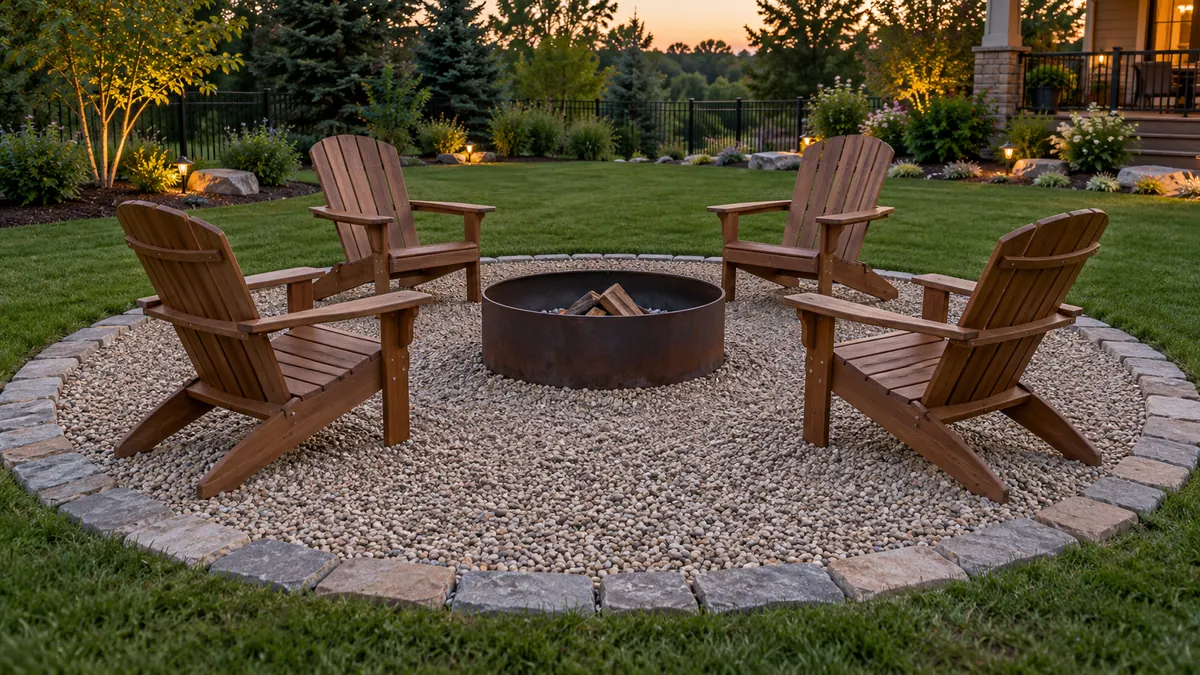
Adirondack chairs are the classic choice. Their wide slatted bases distribute weight across many stones and they are inherently stable on pea gravel. Heavy teak or hardwood garden chairs with wide flat bases also work well. Low lounge chairs and seats close to the ground feel comfortable around a fire pit. Wooden benches are stable if they have wide continuous feet.
Furniture types that need modification:
Metal bistro chairs and dining chairs with thin pointed legs sink and rock on pea gravel. Solutions: rubber leg caps ($10 to $25 per chair set), flat patio pads under each leg ($2 to $5 per leg pad), or a central flagstone area within the gravel for a small side table. A 3 × 3-foot flagstone pad placed between two chairs handles the side table stability problem without requiring a concrete pour.
Clearance Requirements from Structures
Fire pit clearance requirements are set by local fire codes and vary by municipality. The figures below represent typical US requirements. Always verify with your local fire department or building authority before installation.
| Obstruction type | Typical minimum clearance | Notes |
|---|---|---|
| Any structure (house, shed, fence) | 10 feet from pit edge | Some codes require 15–25 feet |
| Overhanging tree branches | 25 feet vertical clearance | Embers rise; overhead clearance critical |
| Dry grass or combustible ground cover | 10 feet clear radius | Pea gravel surround satisfies this requirement |
| Propane tank | 25 feet minimum | Check local codes; some require more |
| Property line | Varies; check local code | Typically 10–25 feet in residential areas |
The pea gravel surround itself satisfies the combustible ground cover clearance requirement. A fire pit with a 14-foot diameter pea gravel surround has 7 feet of non-combustible surface between the fire edge and the surrounding lawn. Meeting the typical 10-foot clearance requirement combined with the fire pit's own diameter.
How Much Pea Gravel Do I Need?
Fire pit surrounds are usually circular. Use the circle area formula: π × radius² = sq ft, then subtract the fire pit base area.
| Gravel circle diameter | Net gravel area (approx) | At 3 inches (+ 10%) | 50-lb bags |
|---|---|---|---|
| 10 ft diameter | 72 sq ft | 0.74 yd³ | 40 bags |
| 12 ft diameter | 106 sq ft | 1.08 yd³ | 58 bags |
| 14 ft diameter | 147 sq ft | 1.50 yd³ | 81 bags |
| 16 ft diameter | 194 sq ft | 1.97 yd³ | 106 bags |
| 18 ft diameter | 248 sq ft | 2.52 yd³ | 136 bags |
| 20 ft diameter | 307 sq ft | 3.12 yd³ | 168 bags |
Net gravel area deducts a 36-inch diameter fire pit base area from the total circle. For square or rectangular surrounds, use the pea gravel calculator with your dimensions. Add the base stone (crushed stone) separately. Typically 1.33 yd³ of crushed stone base per 2 yd³ of pea gravel at a 2-inch base depth.
Step-by-Step Installation
Step 1. Mark and plan. Mark the fire pit center with a stake. Use a string tied to the stake at the desired radius (half the circle diameter) and a can of spray paint to mark a precise circle. Check all clearance distances from the circle center to structures, trees, and property lines before excavating.
Step 2. Excavate. Excavate the entire marked circle to 4 to 5 inches depth. Remove all sod, roots, and organic material. Grade slightly toward the outer edge. A 1 percent slope ensures drainage away from the fire pit center.
Step 3. Compact subgrade. Run a plate compactor over the entire excavated area. The base must feel completely firm.
Step 4. Install fire pit base pad. If using a concrete pad under the fire pit: pour or set it now, at the center of the circle. Set the top of the pad flush with the planned finished gravel surface. Allow to cure before proceeding if using poured concrete.
Step 5. Add crushed stone base. Spread 2 inches of #57 crushed stone or road base over the entire surround (not over the concrete pad). Compact thoroughly. Use 2 or more passes with a plate compactor.
Step 6. Install landscape fabric. Lay woven geotextile fabric over the crushed stone base. Cut around the concrete pad. Overlap seams 6 inches. Secure with landscape staples every 18 inches.
Step 7. Install edging. Steel edging at the outer perimeter of the gravel circle. For a circular edge, score the top flange every 6 to 8 inches to allow the edging to follow the curve without buckling. Secure with ground anchors every 18 inches.
Step 8. Spread pea gravel. Tip pea gravel onto the fabric and spread with a rake. Target 3 inches depth. Check at multiple points. Keep gravel away from the fire pit base pad edges. A 6-inch gap between the gravel and the fire pit structure prevents stones from being pushed into the fire zone.
Step 9. Water and settle. Water the surface. Add fresh pea gravel to any low spots. Position the fire pit on its base pad. Place chairs and test stability.
Maintenance Schedule
| Frequency | Task |
|---|---|
| After each fire | Remove ash that has fallen onto surrounding gravel; stiff brush and metal dustpan |
| Monthly | Rake to redistribute gravel displaced by chairs and foot traffic |
| Each spring | Pre-emergent herbicide application; check fire pit base pad for cracks; top up thin areas |
| Every 2–3 years | Add 0.5–1 inch of fresh pea gravel over entire surround |
Cost Guide 2026
| Cost item | Amount | Example: 14 ft circle (147 sq ft) |
|---|---|---|
| Pea gravel (3/8 in washed, 3 in) | $30–$55/yd³ | 1.50 yd³ = $45–$83 |
| Crushed stone base (2 in) | $25–$45/yd³ | 1.00 yd³ = $25–$45 |
| Landscape fabric (woven) | $0.15–$0.30/sq ft | 147 sq ft = $22–$44 |
| Steel edging for 14 ft circle | $1–$2/lin ft | 44 lin ft = $44–$88 |
| Concrete pad under fire pit | $6–$12/sq ft | 4 sq ft = $24–$48 |
| Delivery | $60–$120 per load | $60–$120 |
| Total DIY materials | - | $220–$428 |
Worked Fire Pit Project Examples
Standard 36-inch fire pit, 14-foot gravel circle, 6 people. Gravel area: π x 7² = 154 sq ft minus pit base 7 sq ft = 147 sq ft. At 3 inches: 147 x 3 ÷ 324 x 1.10 = 1.50 yd³. Crushed stone base: 0.99 yd³. Landscape fabric 147 sq ft. Steel edging 44 lin ft. Concrete pad under pit (18-inch square). Total material cost: $220 to $430 depending on region. Installation time: one day for two people.
Large fire pit area, 18-foot circle, 8 to 10 people. Gravel area: π x 9² = 254 sq ft minus pit = 247 sq ft. At 3 inches: 2.52 yd³ gravel. Total materials including base, fabric, edging, and concrete pad: $290 to $580. This size accommodates 8 Adirondack chairs placed comfortably around a 48-inch fire pit with adequate circulation space between chairs and between chairs and the fire.
4 Fire Pit Pea Gravel Mistakes That Cause Real Problems
Mistake 1. Putting pea gravel inside the fire pit basin. This is the most dangerous mistake in any fire pit project and it comes up repeatedly because the gravel looks neat and clean as a pit floor material. Pea gravel inside the pit can crack or explode when heated rapidly, projecting sharp stone fragments in all directions. The interior of any fire pit, gas or wood burning, must use fire-rated sand, fire bricks, or a purpose-made fire pit liner. Never ordinary stone of any kind.
Mistake 2. Setting the fire pit directly on pea gravel. A metal fire bowl sitting on pea gravel shifts and becomes unstable as the gravel beneath it redistributes under the weight and heat. The pit tips, logs roll, and embers scatter. A concrete or flagstone pad 18 to 24 inches in diameter set flush with the gravel surface provides the stable level base the fire pit structure needs. This is a 2-hour addition to installation day that eliminates a permanent problem.
Mistake 3. Not verifying clearance distances before digging. Most fire codes require 10 feet from any structure and 25 feet from overhead tree branches. Homeowners who skip this check sometimes discover after full installation that their fire pit violates local code. Requiring moving the entire installation. Measure clearances before breaking ground. Check with your local fire department if any distance is close to the requirement.
Mistake 4. Making the gravel circle too small for the seating intended. A 10-foot diameter circle around a standard fire pit leaves barely 2 feet of gravel between the pit edge and the chair. Chairs get pushed off the gravel constantly. The minimum useful diameter for 4-person seating is 12 feet. For 6 people, 14 feet. Extending the gravel area costs one extra cubic yard, approximately $40 to $55 in bulk, which is a negligible cost for a permanent improvement to usability.
Frequently Asked Questions
Can you use pea gravel around a fire pit?
Is pea gravel safe around a fire pit?
How deep should pea gravel be around a fire pit?
How big should a pea gravel fire pit area be?
What should you put under a fire pit base?
How much pea gravel for a fire pit area?
What is the best gravel for a fire pit area?
How far should a fire pit be from structures?
Can pea gravel explode from fire pit heat?
Should the fire pit sit on pea gravel or concrete?
Do you need landscape fabric for a fire pit area?
How do you maintain a pea gravel fire pit area?
Related Calculators and Guides
Pea Gravel Calculator
Calculate cubic yards, tons, and bags for your fire pit circle. Enter diameter as both length and width for a square approximation, or use the circle formula.
GuidePea Gravel Patio Guide
Installation principles for pea gravel seating areas. Depth, base, edging, and furniture tips all apply to fire pit surrounds.
GuidePea Gravel Pros and Cons
Non-combustibility is listed as one of the 9 pros. Complete honest assessment of pea gravel for all applications.
Pea Gravel Depth Guide
Full depth specifications by application including fire pit surrounds, seating areas, and paths.
GuideKeep Gravel in Place
7 methods to prevent gravel migration. Edging, stabilizer resin, and maintenance routines for circular fire pit surrounds.
GuideCost Guide 2026
Regional pricing, bulk vs bag comparison, and delivery fees for fire pit surround projects.
Sources & Methodology
- USGS: Natural Aggregates Statistics: aggregate mineral composition reference
- CPSC; Consumer Product Safety guidelines for outdoor fire safety equipment referenced for context
Safety information: Stone explosion risk from rapid heating is documented in fire safety literature. The mechanism (moisture-to-steam expansion) applies to porous and non-porous stones placed directly in fire zones. Pea gravel in surrounds at normal fire pit distances does not reach the temperatures required for this effect. Clearance distances: Represent typical US municipal fire code requirements. Always verify with your local fire department. Full methodology
Last reviewed: October 2026