
How Much Pea Gravel Do I Need? 2026 Guide
Jump to Your Project
- The formula, step by step
- Coverage per cubic yard at every depth
- How much for a patio?
- How much for a driveway?
- How much for a path or walkway?
- How much for a dog run?
- How much for a playground?
- How much for a garden bed?
- How much does a 50-lb bag cover?
- Quick reference table, all common sizes
- Why you need 10% extra
- Estimated cost by project size
- Frequently asked questions
The Formula: Step by Step
Every pea gravel quantity calculation uses the same three-step process regardless of project type or size.
Length (ft) × Width (ft) × Depth (in) ÷ 324 = Cubic yards
Step 2: Add waste buffer:
Cubic yards × 1.10 = Amount to order
Step 3: Convert to tons or bags:
Cubic yards × 1.35 = Tons · Cubic yards × 54 = 50-lb bags
Why 324? There are 12 inches in a foot and 27 cubic feet in a cubic yard. 12 × 27 = 324. So dividing by 324 converts a measurement in square feet and inches directly to cubic yards in one step.
Example: 15×20 ft patio at 3 inches: Area = 300 sq ft. Step 1: 300 × 3 ÷ 324 = 2.78 yd³. Step 2: 2.78 × 1.10 = 3.06 yd³ to order. Step 3: 3.06 × 1.35 = 4.13 tons. 3.06 × 54 = 165 bags. Order 3.1 cubic yards or 165 standard 50-lb bags.
For circular areas: Area = π × radius². A 12-ft diameter circle (6-ft radius) at 3 inches: π × 36 = 113 sq ft. 113 × 3 ÷ 324 × 1.10 = 1.15 yd³. Use the patio calculator for circles and irregular shapes.
Coverage Per Cubic Yard at Every Depth
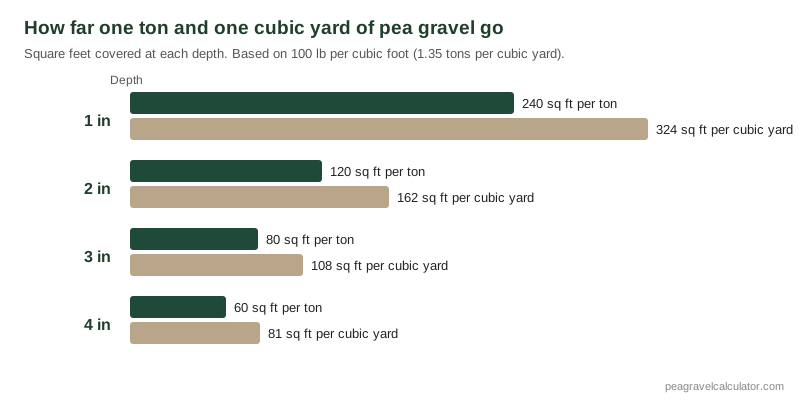
This table answers the reverse question. How much area does a given quantity cover?
| Depth | 1 yd³ covers | 2 yd³ covers | 5 yd³ covers | 10 yd³ covers |
|---|---|---|---|---|
| 1 inch | 324 sq ft | 648 sq ft | 1,620 sq ft | 3,240 sq ft |
| 2 inches | 162 sq ft | 324 sq ft | 810 sq ft | 1,620 sq ft |
| 3 inches | 108 sq ft | 216 sq ft | 540 sq ft | 1,080 sq ft |
| 4 inches | 81 sq ft | 162 sq ft | 405 sq ft | 810 sq ft |
| 6 inches | 54 sq ft | 108 sq ft | 270 sq ft | 540 sq ft |
| 9 inches | 36 sq ft | 72 sq ft | 180 sq ft | 360 sq ft |
| 12 inches | 27 sq ft | 54 sq ft | 135 sq ft | 270 sq ft |
How Much Pea Gravel for a Patio?
Standard patio depth is 3 inches over a compacted base. All figures below include the 10 percent waste buffer.
| Patio size | Sq ft | At 2 inches | At 3 inches | At 4 inches |
|---|---|---|---|---|
| 10 × 10 ft | 100 | 0.68 yd³ / 37 bags | 1.02 yd³ / 55 bags | 1.36 yd³ / 74 bags |
| 12 × 12 ft | 144 | 0.98 yd³ / 53 bags | 1.47 yd³ / 79 bags | 1.96 yd³ / 106 bags |
| 12 × 16 ft | 192 | 1.31 yd³ / 71 bags | 1.96 yd³ / 106 bags | 2.61 yd³ / 141 bags |
| 16 × 20 ft | 320 | 2.18 yd³ / 118 bags | 3.27 yd³ / 176 bags | 4.36 yd³ / 235 bags |
| 20 × 20 ft | 400 | 2.72 yd³ / 147 bags | 4.07 yd³ / 220 bags | 5.43 yd³ / 293 bags |
| 20 × 24 ft | 480 | 3.27 yd³ / 176 bags | 4.89 yd³ / 264 bags | 6.52 yd³ / 352 bags |
At 3 inches and above 2 cubic yards, bulk delivery from a landscape supplier is cheaper than bags. A 12 × 16 ft patio at 3 inches needs 1.96 yd³. At this volume compare bulk ($60 to $110 delivered) against bags (106 × $7 = $742). Bulk saves $630 for a project of this size. Use the cost calculator with your local price per cubic yard to get an accurate comparison.
How Much Pea Gravel for a Driveway?
A pea gravel driveway needs two layers: a compacted base (crushed stone) and a pea gravel surface. The figures below are for the pea gravel surface layer only. Calculate the base layer separately using the gravel driveway calculator.
| Driveway size | Sq ft | Surface at 2 inches | Surface at 3 inches | Surface at 4 inches |
|---|---|---|---|---|
| Single car 10 × 20 ft | 200 | 1.36 yd³ / 1.84 t | 2.04 yd³ / 2.75 t | 2.72 yd³ / 3.67 t |
| Single car 10 × 40 ft | 400 | 2.72 yd³ / 3.67 t | 4.07 yd³ / 5.49 t | 5.43 yd³ / 7.33 t |
| Standard 12 × 40 ft | 480 | 3.27 yd³ / 4.41 t | 4.89 yd³ / 6.60 t | 6.52 yd³ / 8.80 t |
| Two car 20 × 20 ft | 400 | 2.72 yd³ / 3.67 t | 4.07 yd³ / 5.49 t | 5.43 yd³ / 7.33 t |
| Two car 20 × 40 ft | 800 | 5.43 yd³ / 7.33 t | 8.15 yd³ / 11.0 t | 10.86 yd³ / 14.7 t |
Pea gravel is a surface-only driveway material. Its rounded shape means it cannot be compacted into a structural base. Use angular crushed stone or crusher run for the base. Without a base layer, pea gravel sinks into the soil and ruts within the first season regardless of surface depth. See the pea gravel driveway guide for the complete specification.
How Much Pea Gravel for a Path or Walkway?
Garden paths and walkways use 2 to 3 inches of pea gravel. Two inches is workable for lightly-used decorative paths. Three inches gives a more stable surface that stays in place better underfoot.
| Path dimensions | At 2 inches | At 3 inches | 50-lb bags (3 in) |
|---|---|---|---|
| 2 ft wide × 10 ft long | 0.14 yd³ | 0.20 yd³ | 11 bags |
| 2 ft wide × 20 ft long | 0.27 yd³ | 0.41 yd³ | 22 bags |
| 2 ft wide × 50 ft long | 0.68 yd³ | 1.02 yd³ | 55 bags |
| 3 ft wide × 20 ft long | 0.41 yd³ | 0.61 yd³ | 33 bags |
| 3 ft wide × 50 ft long | 1.02 yd³ | 1.53 yd³ | 83 bags |
| 4 ft wide × 20 ft long | 0.54 yd³ | 0.81 yd³ | 44 bags |
| 4 ft wide × 50 ft long | 1.36 yd³ | 2.04 yd³ | 110 bags |
How Much Pea Gravel for a Dog Run?
Dog runs need 3 to 4 inches of pea gravel for adequate drainage and comfortable footing for the dog. Pea gravel is one of the best dog run surfaces. It drains urine immediately, stays relatively cool in summer, is comfortable on paws, and can be hosed down easily. Use pea gravel over landscape fabric with solid edging to contain it.
| Dog run size | Sq ft | At 3 inches | At 4 inches |
|---|---|---|---|
| 5 × 10 ft (small) | 50 | 0.51 yd³ / 28 bags | 0.68 yd³ / 37 bags |
| 6 × 12 ft (medium) | 72 | 0.73 yd³ / 40 bags | 0.98 yd³ / 53 bags |
| 10 × 10 ft | 100 | 1.02 yd³ / 55 bags | 1.36 yd³ / 74 bags |
| 10 × 20 ft (large) | 200 | 2.04 yd³ / 110 bags | 2.72 yd³ / 147 bags |
| 10 × 30 ft (extra large) | 300 | 3.06 yd³ / 165 bags | 4.07 yd³ / 220 bags |
How Much Pea Gravel for a Playground?
Playground pea gravel depth is regulated. The CPSC Handbook for Public Playground Safety specifies minimum depths based on equipment fall height. These are not suggestions. They are safety requirements for any public or residential playground with overhead equipment.
| Equipment fall height | Minimum depth | Notes |
|---|---|---|
| Up to 4 ft | 9 inches | CPSC minimum for impact attenuation |
| Up to 6 ft | 9 inches uncompacted | Must remain loose; rake regularly |
| Over 8 ft | Not recommended | Use rubber surfacing above 8 ft fall height |
| Playground area | At 9 inches (CPSC min) | At 12 inches |
|---|---|---|
| 10 × 10 ft | 3.06 yd³ / 4.13 t | 4.07 yd³ / 5.49 t |
| 15 × 15 ft | 6.89 yd³ / 9.30 t | 9.17 yd³ / 12.4 t |
| 20 × 20 ft | 12.22 yd³ / 16.5 t | 16.30 yd³ / 22.0 t |
| 20 × 30 ft | 18.33 yd³ / 24.7 t | 24.44 yd³ / 33.0 t |
Playground pea gravel compacts over time and loses its impact-attenuation properties. Check depth monthly and rake regularly. Replace or top up when depth falls below the CPSC minimum for your equipment height. A playground at 9 inches that compacts to 7 inches is no longer code-compliant.
How Much Pea Gravel for a Garden Bed?
Pea gravel in garden beds is used as a top dressing. A decorative mulch layer over landscape fabric that suppresses weeds and retains moisture. The standard depth is 2 inches for ornamental beds and 3 inches for high-weed-pressure areas.
| Bed size | At 1 inch | At 2 inches | At 3 inches |
|---|---|---|---|
| 4 × 4 ft | 0.05 yd³ / 3 bags | 0.10 yd³ / 6 bags | 0.15 yd³ / 8 bags |
| 4 × 8 ft | 0.11 yd³ / 6 bags | 0.22 yd³ / 12 bags | 0.33 yd³ / 18 bags |
| 8 × 10 ft | 0.27 yd³ / 15 bags | 0.54 yd³ / 30 bags | 0.82 yd³ / 44 bags |
| 10 × 20 ft | 0.68 yd³ / 37 bags | 1.36 yd³ / 74 bags | 2.04 yd³ / 110 bags |
| 20 × 30 ft | 2.04 yd³ / 110 bags | 4.07 yd³ / 220 bags | 6.11 yd³ / 330 bags |
How Much Does a 50-lb Bag Cover?
A standard 50-lb bag of pea gravel contains approximately 0.5 cubic feet. Here is what that covers at common depths:
| Depth | Coverage per 50-lb bag | Bags needed per 100 sq ft |
|---|---|---|
| 1 inch | 6 square feet | 17 bags |
| 2 inches | 3 square feet | 34 bags |
| 3 inches | 2 square feet | 50 bags + 10% = 55 bags |
| 4 inches | 1.5 square feet | 67 bags + 10% = 74 bags |
| 6 inches | 1 square foot | 100 bags + 10% = 110 bags |
| 9 inches (playground) | 0.67 square feet | 150 bags + 10% = 165 bags |
The bag calculation shortcut: Area (sq ft) × Depth (in) ÷ 6 = number of bags needed before waste buffer. Add 10 percent and round up to the nearest whole bag.
Quick Reference Table: All Common Sizes
All figures at the standard depth for each project type, including 10 percent waste buffer.
| Project | Typical size | Depth | Cubic yards | Tons | 50-lb bags |
|---|---|---|---|---|---|
| Small garden path | 2 × 20 ft | 2 in | 0.27 | 0.37 | 15 |
| Garden path | 3 × 50 ft | 3 in | 1.53 | 2.06 | 83 |
| Small patio | 10 × 10 ft | 3 in | 1.02 | 1.38 | 55 |
| Standard patio | 12 × 16 ft | 3 in | 1.96 | 2.65 | 106 |
| Large patio | 20 × 20 ft | 3 in | 4.07 | 5.49 | 220 |
| Small dog run | 5 × 10 ft | 3 in | 0.51 | 0.69 | 28 |
| Large dog run | 10 × 20 ft | 3 in | 2.04 | 2.75 | 110 |
| Single-car driveway (surface) | 10 × 40 ft | 3 in | 4.07 | 5.49 | 220 |
| Two-car driveway (surface) | 20 × 40 ft | 3 in | 8.15 | 11.0 | 440 |
| Garden bed top dressing | 10 × 20 ft | 2 in | 1.36 | 1.84 | 74 |
| Playground (CPSC) | 15 × 15 ft | 9 in | 6.89 | 9.30 | 372 |
| Fire pit surround | 10 × 10 ft | 3 in | 1.02 | 1.38 | 55 |
Why You Need 10% Extra
The 10 percent waste buffer exists for three reasons that apply to every pea gravel project without exception.
Settling. Dry pea gravel delivered by a supplier has air pockets between the stones. After the first rainfall and several weeks of traffic and gravity, those pockets collapse and the gravel volume decreases by 5 to 10 percent. A 3-inch installation settles to approximately 2.7 inches without the buffer. Adding 10 percent ensures the finished depth meets specification after settling.
Edge losses. Gravel spread near edging rolls over and under the edge during installation. The 10 percent accounts for the material lost at perimeters during the spreading process. On small patios with a high perimeter-to-area ratio, edge losses are proportionally larger. Consider 15 percent for patios under 50 square feet.
Uneven ground. No ground is perfectly level. Low spots require more gravel to reach the specified depth. The 10 percent buffer covers depth variation across the installation area without requiring you to order a second delivery.
Running short on a bulk delivery is significantly more expensive than ordering slightly too much. A second delivery order, minimum delivery fee plus the cost of the small quantity, costs far more per cubic yard than ordering correctly the first time. Always round up to the nearest half cubic yard when ordering bulk.
Estimated Cost by Project Size: 2026
| Project | Cubic yards | Bulk material cost | Bags cost (50-lb, $7) | Best option |
|---|---|---|---|---|
| Small path (2×20 ft, 2 in) | 0.27 | $9–$15 + delivery | $105 (15 bags) | Bags |
| Small patio (10×10 ft, 3 in) | 1.02 | $31–$56 + delivery | $385 (55 bags) | Bulk if delivery under $300 |
| Standard patio (12×16 ft, 3 in) | 1.96 | $59–$108 + delivery | $742 (106 bags) | Bulk, saves $500+ |
| Large patio (20×20 ft, 3 in) | 4.07 | $122–$224 + delivery | $1,540 (220 bags) | Bulk, saves $1,200+ |
| Single-car driveway surface | 4.07 | $122–$224 + delivery | $1,540 (220 bags) | Bulk only |
| Two-car driveway surface | 8.15 | $245–$448 + delivery | $3,080 (440 bags) | Bulk only |
Bulk pea gravel costs $30 to $55 per cubic yard delivered in 2026. The delivery fee is typically $50 to $150 regardless of quantity. This is what makes small orders (under 1.5 cubic yards) more cost-effective as bags. Above 2 cubic yards, bulk is almost always cheaper even with the delivery fee factored in.
Worked Examples: Worked Calculations
Users searching "how much pea gravel for a 12x16 patio" need a specific answer, not a formula. Here are the four most common project sizes calculated in full.
12 x 16 ft patio at 3 inches. Area = 192 sq ft. Step 1: 192 x 3 ÷ 324 = 1.78 yd³. Step 2: 1.78 x 1.10 = 1.96 yd³ to order. Step 3: 1.96 x 1.35 = 2.64 tons. Step 4: 1.96 x 54 = 106 bags. Order 2 cubic yards in bulk or 106 bags from the hardware store. Bulk costs approximately $60 to $110 delivered. Bags cost approximately $742. Bulk wins at this size.
20 x 20 ft backyard patio at 3 inches. Area = 400 sq ft. 400 x 3 ÷ 324 x 1.10 = 4.07 yd³. 4.07 x 1.35 = 5.49 tons. Order 4 to 4.5 cubic yards. At $45 per cubic yard plus $80 delivery: total material cost $283.
3 ft wide x 50 ft long garden path at 2 inches. Area = 150 sq ft. 150 x 2 ÷ 324 x 1.10 = 1.02 yd³. 1.02 x 1.35 = 1.38 tons. This is right at the bulk vs bag crossover. 55 bags at $7 each = $385 vs bulk at approximately $126 delivered. Bulk is clearly better even for this modest path.
10 x 20 ft dog run at 3 inches. Area = 200 sq ft. 200 x 3 ÷ 324 x 1.10 = 2.04 yd³. 2.04 x 1.35 = 2.75 tons. Add crushed stone base at 2 inches: 200 x 2 ÷ 324 x 1.10 = 1.36 yd³ base material. Total delivery: one load for both materials, approximately $80 fee shared across the combined order.
4 Most Common Pea Gravel Quantity Mistakes
Mistake 1. Ordering by bag when bulk is available. At 1 cubic yard or more, bulk is always cheaper. A 200 sq ft patio needs approximately 2 cubic yards. At $7 per 50-lb bag that is $756 in bags. In bulk the same material costs $90 to $110 delivered. The difference funds edging, fabric, and base stone.
Mistake 2. Skipping the 10 percent waste buffer. Without the buffer you order exactly what you calculate. On delivery the driver tips the load and you discover the pile is smaller than expected because gravel was lost in transit, the truck measured short, or your area was slightly bigger than measured. Always add 10 percent to the calculated volume before ordering.
Mistake 3. Ordering by square footage without depth. Square footage alone tells you nothing about volume. A 200 sq ft area at 2 inches needs 1.36 yd³. The same area at 4 inches needs 2.72 yd³. Exactly double. Always confirm depth before calling for a quote. The most common depth confusion: homeowners tell the supplier "a 200 sq ft patio" with no depth, the supplier assumes 2 inches, and the delivered quantity is half what is needed.
Mistake 4. Not ordering base stone in the same delivery. Every pea gravel installation needs a 2-inch compacted crushed stone base. Ordering base stone separately means a second delivery fee of $60 to $120. Ordering both materials in one trip shares the single delivery fee across all material. On a 200 sq ft project this saves $80 to $120.
Frequently Asked Questions
How much pea gravel do I need?
How much does 1 cubic yard of pea gravel cover?
How much pea gravel for a 10x10 area?
How much pea gravel for a patio?
How much pea gravel for a driveway?
How much pea gravel for a dog run?
How much does a 50-lb bag cover?
How many 50-lb bags in a cubic yard?
How much pea gravel for a raised bed?
How much pea gravel per square foot?
How much pea gravel for a 200 sq ft area?
Why do I need 10% extra pea gravel?
Use the Calculator for Your Exact Measurements
Pea Gravel Calculator
Enter your length, width, and depth. Get cubic yards, tons, bags, and cost instantly for any pea gravel project.
CalculatorPatio Calculator
Rectangle and circle patios with 3-inch default depth, 10% settling factor, and cost estimate.
CalculatorCoverage Calculator
Works backwards. Enter cubic yards and depth to find the area they cover.
Bags Calculator
Get the exact 50-lb bag count for your project with bulk vs bag cost comparison.
CalculatorGravel Driveway Calculator
Base and surface layers calculated separately with compaction factors and cost.
GuidePea Gravel Cost Guide 2026
Regional prices per ton and per bag, bulk vs bag break-even, and delivery fee guide.
Sources & Methodology
- USGS: Natural Aggregates Statistics: pea gravel density at 100 lb/ft³ (1.35 t/yd³)
- CPSC Handbook for Public Playground Safety: minimum depths for loose-fill playground surfacing
Formula: Area (sq ft) × Depth (in) ÷ 324 = Cubic yards. All quantities include 10% waste buffer. Density: 100 lb/ft³ dry. 1 cubic yard = 27 cubic feet = 54 standard 50-lb bags = 1.35 tons. Full methodology
Last reviewed: October 2026