
Pea Gravel Drainage: Does It Drain Well? Complete Guide 2026
In This Guide
- How pea gravel drains, the physics
- Drainage rates, pea gravel vs other materials
- The clay subsoil problem, perched water table
- Performance by soil type
- Best drainage applications for pea gravel
- Pea gravel vs angular stone for drainage
- Why pea gravel pools water and how to fix it
- Frequently asked questions
How Pea Gravel Drains: The Physics
Pea gravel drains well because of one physical property: it does not compact. The rounded shape of pea gravel stones prevents them from locking tightly together the way angular stones or soil particles do. This means the void spaces between particles, approximately 35 to 45 percent of the total volume, remain open and connected regardless of how long the gravel has been in place.
Water moves through these interconnected voids driven by gravity. Because the voids are large relative to the particle size, and because the smooth stone surfaces create low friction resistance to water flow, water moves freely in all directions. Downward, laterally, and even upward under capillary action when the surrounding soil is drier than the gravel layer.
The rounded shape has one drainage advantage over angular crushed stone that is often overlooked: rounded particles create more consistent void spaces throughout the mass. Angular particles can interlock in some orientations and leave gaps in others. The void distribution is less uniform. This means pea gravel drains more predictably across the full area of an installation than angular stone of similar size.
Drainage Rates: Pea Gravel vs Other Materials
| Material | Drainage rate (in/hr) | Notes |
|---|---|---|
| Pea gravel (3/8 inch, clean) | 15–20 | Maintains rate indefinitely with clean voids |
| #57 angular crushed stone | 12–18 | Slightly lower due to tighter particle packing |
| Coarse sand | 2–6 | Reduces over time as fines migrate |
| Sandy loam soil | 1–2 | Good soil drainage |
| Loam soil | 0.5–1 | Moderate drainage |
| Clay loam soil | 0.1–0.5 | Poor; limiting factor under gravel |
| Clay soil | 0.01–0.1 | Very poor; causes perched water table |
| Organic mulch (fresh) | 2–5 | Decreases as mulch decomposes and compacts |
| Concrete (standard) | ~0 | Impermeable; all water is surface runoff |
| Asphalt (standard) | ~0 | Impermeable; all water is surface runoff |
These rates describe drainage through the material itself under ideal conditions. Actual field performance depends on what is below the material, how clean the voids are, and site grading. The rate of the slowest layer in the drainage path determines the overall system performance. Pea gravel draining at 20 inches per hour above clay draining at 0.05 inches per hour produces an overall effective drainage rate close to 0.05 inches per hour.
The Clay Subsoil Problem: Perched Water Table
The most common cause of pea gravel drainage failure is clay or compacted subsoil beneath the installation. Understanding this prevents the frustrating situation where well-installed pea gravel still pools water.
A perched water table forms when water drains rapidly through a permeable upper layer (pea gravel) and reaches an impermeable lower layer (clay) faster than the clay can accept it. Water accumulates at the interface between the two layers. As rain continues, this accumulated water rises up through the gravel voids until it reaches the surface. The pea gravel appears to be flooded despite having excellent drainage characteristics.
This is not a failure of the pea gravel. It is working exactly as designed. The limitation is entirely in the subsoil. Increasing the depth of pea gravel does not help. More gravel above the clay simply means more water storage capacity before the surface pools, but the rate of pooling under continued rain is the same.
How to identify if clay is your problem: After a heavy rain, dig down through the pea gravel to the base. If the base layer or native soil is saturated and soft, clay is the limiting factor. If the base is dry or only slightly moist, the problem is a grading or surface drainage issue rather than subsoil permeability.
Performance by Soil Type
| Subsoil type | Pea gravel drainage performance | Action needed |
|---|---|---|
| Sandy soil | Excellent, water drains rapidly to depth | None, standard installation sufficient |
| Sandy loam | Very good | Standard installation with good grading |
| Loam | Good | Ensure 1–2% drainage slope |
| Clay loam | Moderate; slow in heavy rain | Add site grading; consider edge drainage channel |
| Clay | Poor; perched water table likely | French drain or site regrading required |
| Hardpan / compacted subgrade | Poor; similar to clay | Break up hardpan layer before installation |
| Existing concrete or impervious surface | Poor; water cannot escape downward | Drainage outlet required at low edge |
The simplest test for subsoil drainage before installation: dig a hole 12 inches deep in the planned installation area. Fill with water and watch. If the water disappears in 1 to 4 hours, drainage is good and pea gravel will perform well. If water remains after 24 hours, clay or hardpan is present and additional drainage measures are needed alongside the pea gravel.
Best Drainage Applications for Pea Gravel
Patios and seating areas. Pea gravel is the most drainage-effective patio surface available at residential scale. Rain passes through immediately. No puddles, no standing water, no wet concrete slip risk. The patio is usable within minutes of rain stopping. This advantage over concrete and pavers is particularly significant in climates with frequent rainfall.
Garden paths and walkways. Paths covered with pea gravel drain water efficiently and remain usable in all weather. The drainage eliminates the muddy edge effect where foot traffic on wet soil creates compacted mud channels. Pea gravel paths stay firm and relatively clean underfoot in wet conditions.
Foundation borders. A 12 to 18-inch wide pea gravel border immediately adjacent to the foundation wall manages rain splash, disperses roof runoff from downspouts, and prevents the soil saturation directly against the wall that promotes moisture infiltration. This application addresses surface water only. Serious foundation drainage requires a French drain at the footing level.
Downspout dispersal areas. A 3 × 3-foot pad of pea gravel at each downspout outlet absorbs the impact energy of concentrated roof runoff and allows it to percolate gradually rather than channelling and eroding. The pea gravel also prevents the soil splash that deposits dirty water on siding and foundations.
Pool surrounds. Pea gravel drains pool water, rain, and splash immediately. No puddles form on the surface, which reduces the standing water slip risk that is a genuine hazard on concrete pool decks. The drainage advantage is most visible on rainy pool days when the surrounding pea gravel dries within minutes while concrete stays wet.
Dog runs. Dog runs require immediate drainage of urine and rain. Pea gravel achieves this more effectively than any other residential dog run surface, reducing odor accumulation and drying quickly between uses.
Pea Gravel vs Angular Stone for Drainage
| Factor | Pea gravel (3/8 in rounded) | #57 angular stone (3/4 in) |
|---|---|---|
| Surface drainage rate | 15–20 in/hr | 12–18 in/hr |
| Void content | 35–45% | 28–38% |
| Void consistency | More uniform | Less uniform (interlocking varies) |
| Comfort underfoot | Excellent | Poor; sharp edges |
| Structural base drainage | Moderate | Better; preferred for French drains |
| Resistance to clogging | Good | Good (both need clean stone) |
| Migration in water flow | Higher, lighter stones move more easily | Lower, heavier, angular stones lock together |
| Best for | Surface drainage, patios, paths, pool surrounds | French drains, sub-surface drainage, bases |
The choice between pea gravel and angular crushed stone for drainage applications is primarily determined by the application. Surface or sub-surface. For any application where people walk on the material, pea gravel's comfort advantage is definitive. For sub-surface drainage where hydraulic conductivity matters more than comfort, angular stone is preferred by drainage engineers because its sharper edges and more consistent sizing create the most reliable long-term drainage voids.
Why Pea Gravel Pools Water and How to Fix It
Pooling water in a pea gravel area has three possible causes, each with a different fix.
Cause 1. Impermeable subsoil (clay or hardpan). Water drains through the gravel rapidly but cannot penetrate the subsoil. Fix: install a French drain running to a lower outlet point, regrade the site so water exits the area before saturating the base, or break up the clay layer during installation with a deep tilling pass before adding the base layer and gravel.
Cause 2. Flat or inward-sloping grade. Even with permeable subsoil, water from adjacent areas flows into the pea gravel installation and cannot drain away because there is no slope to an outlet. Fix: regrade the perimeter to direct water away from the installation, ensure the pea gravel area has a 1 to 2 percent slope toward the nearest drainage point, and install edging on the uphill sides that is slightly raised to redirect surface flow away from the gravel area.
Cause 3. Clogged voids. Accumulated organic debris, silt, or fine soil has filled the voids between pea gravel particles, reducing permeability over years of use. Fix: rake and turn the gravel to break up compacted debris, flush with a garden hose to wash fines through the gravel layer, and apply pre-emergent herbicide to prevent organic growth. Regular leaf removal prevents the primary source of void-filling organic material.
Worked Drainage Examples
Patio on sandy soil. Drains perfectly. A 200 sq ft pea gravel patio installed over sandy loam subsoil drains rain completely within 5 to 10 minutes of a heavy shower. The pea gravel layer drains at 15 to 20 inches per hour and the sandy loam beneath accepts water at 1 to 2 inches per hour. Fast enough to prevent accumulation during normal rain events. This is the ideal condition. Most southeastern US states and coastal sandy regions behave this way.
Patio on clay. Perched water table forms. The same 200 sq ft patio installed over clay subsoil in the Midwest fills with surface water during a 1-inch-per-hour rain event within 15 to 20 minutes. The pea gravel drains at 18 inches per hour but the clay beneath accepts water at only 0.05 inches per hour. Water accumulates at the clay-gravel interface and rises up through the gravel voids until it reaches the surface. The gravel looks flooded but is working correctly. The clay is the problem.
Foundation border. Correct application. A homeowner with a wet basement installs an 18-inch pea gravel border along the foundation wall. Heavy rain produces visible water flow through the gravel to the perimeter drain. The gravel successfully intercepts surface runoff and roof splash, reducing the volume of water reaching the foundation wall. The basement stays dry during moderate rain but still gets damp during very heavy storms. Because the pea gravel handles surface water, not hydrostatic pressure from groundwater. A French drain at the footing level is needed for the remaining issue.
4 Mistakes That Make Pea Gravel Drainage Fail
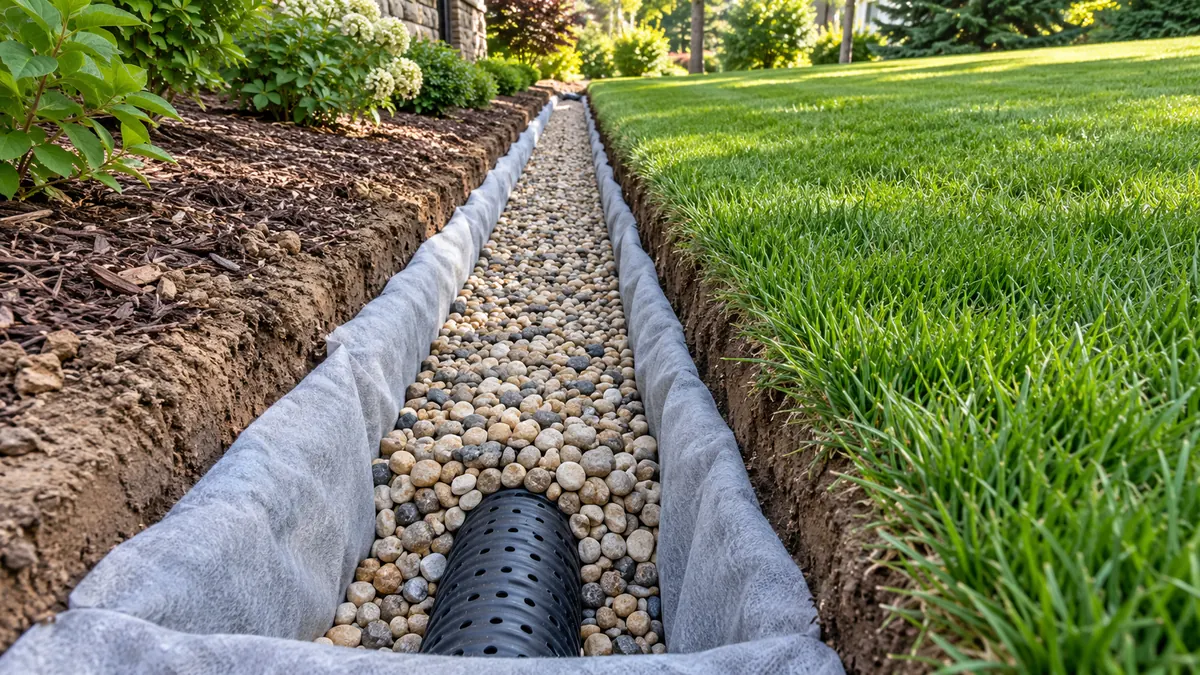
Mistake 1. Using pea gravel in a French drain instead of #57 stone. Pea gravel's rounded shape packs more tightly than angular stone, reducing the void space available for water transport. In a French drain, where volume of water carried matters, angular #57 crushed stone outperforms pea gravel significantly. Using pea gravel in a French drain produces a system that drains adequately at first but loses capacity faster as fines accumulate in the tighter void spaces.
Mistake 2. Installing pea gravel without testing the subsoil first. The 12-inch hole test takes 10 minutes and tells you whether your subsoil accepts water fast enough for pea gravel to drain effectively. Skipping this test on clay soil results in a patio or path that pools water regardless of depth or material quality. And fixing it requires removing everything, installing a French drain, and starting over.
Mistake 3. Assuming deeper pea gravel solves drainage problems. If the subsoil is clay, 6 inches of pea gravel does not drain better than 3 inches. It just holds more water before the surface pools. The depth only determines how much water can accumulate before it becomes visible. The fix is always in the subsoil or the site grade, never in the gravel depth.
Mistake 4. Installing pea gravel on flat or inward-sloping ground. Even with permeable sandy subsoil, a pea gravel area that collects water from surrounding surfaces will saturate and pool. The drainage slope must be established during excavation: 1 percent minimum toward a defined outlet. Adding slope after installation requires removing all the gravel, re-grading, and replacing it.
Frequently Asked Questions
Does pea gravel drain well?
How fast does water drain through pea gravel?
Why does pea gravel pool water even though it drains well?
Is pea gravel good for drainage?
Does pea gravel drain better than mulch?
What is the best gravel size for drainage?
Does pea gravel help with drainage around a foundation?
Is pea gravel permeable?
Does pea gravel get waterlogged?
How does pea gravel drainage compare to concrete?
How do you improve drainage in pea gravel?
Can pea gravel be used as a dry creek bed for drainage?
Related Calculators and Guides
French Drain Calculator
When pea gravel surface drainage is not enough. Calculate gravel, pipe, fabric, slope, and cost for a French drain.
CalculatorPea Gravel Calculator
Calculate cubic yards, tons, and bags for any pea gravel drainage project at any depth.
Pea Gravel Depth Guide
French drain depth specification and all other application depths. Minimum vs optimal.
GuidePros and Cons Guide
Complete honest assessment. Drainage as Pro 2, clay subsoil limitation included in Cons.
GuideHow to Install Pea Gravel
Base preparation, grading, landscape fabric, and drainage slope. All the steps that affect drainage performance.
Sources & Methodology
- USGS: Natural Aggregates Statistics: aggregate void content and permeability reference data
- USDA NRCS: Soil Health Guides: soil drainage rate by texture classification (sandy loam, clay loam, clay)
Drainage rates: Pea gravel 15–20 in/hr from aggregate hydraulics research. Soil drainage rates from USDA NRCS soil texture classification data. All rates represent typical conditions. Actual performance varies with void cleanliness, grading, and subsoil conditions. Full methodology
Last reviewed: October 2026