
Pea Gravel vs River Rock: Which Should You Choose? 2026
In This Guide
- At a glance, master comparison table
- Size and origin differences
- Cost comparison, upfront and long-term
- Drainage performance
- Stability, slopes and foot traffic
- Maintenance requirements
- Freeze-thaw climate performance
- Project-by-project verdicts
- Combining pea gravel and river rock
- When neither is the right choice
- Frequently asked questions
At a Glance: Master Comparison Table
| Factor | Pea gravel | River rock |
|---|---|---|
| Typical size | 3/8–5/8 inch | 1–12+ inches (varies) |
| Cost per cubic yard (bulk) | $30–$55 | $45–$95 |
| Cost per sq ft installed (3 in) | $0.50–$1.50 | $0.75–$2.50 |
| Comfort underfoot | Excellent | Poor (large sizes) |
| Stability on flat areas | Good with edging | Excellent |
| Stability on slopes | Poor above 5% | Good to 15% |
| Drainage | Excellent | Good |
| Erosion control | Poor | Excellent |
| Dog runs | Excellent | Not recommended |
| Driveways (surface) | Good | Not recommended |
| Dry creek beds | Not suitable | Excellent |
| Playgrounds | Good (CPSC compliant) | Not recommended |
| Garden beds | Good | Excellent |
| Patios | Good | Poor (large sizes) |
| Maintenance frequency | Every 2–3 years | Every 5–10 years |
| Freeze-thaw performance | Moderate | Good |
| Visual impact | Subtle, uniform | Bold, natural |
Size and Origin Differences
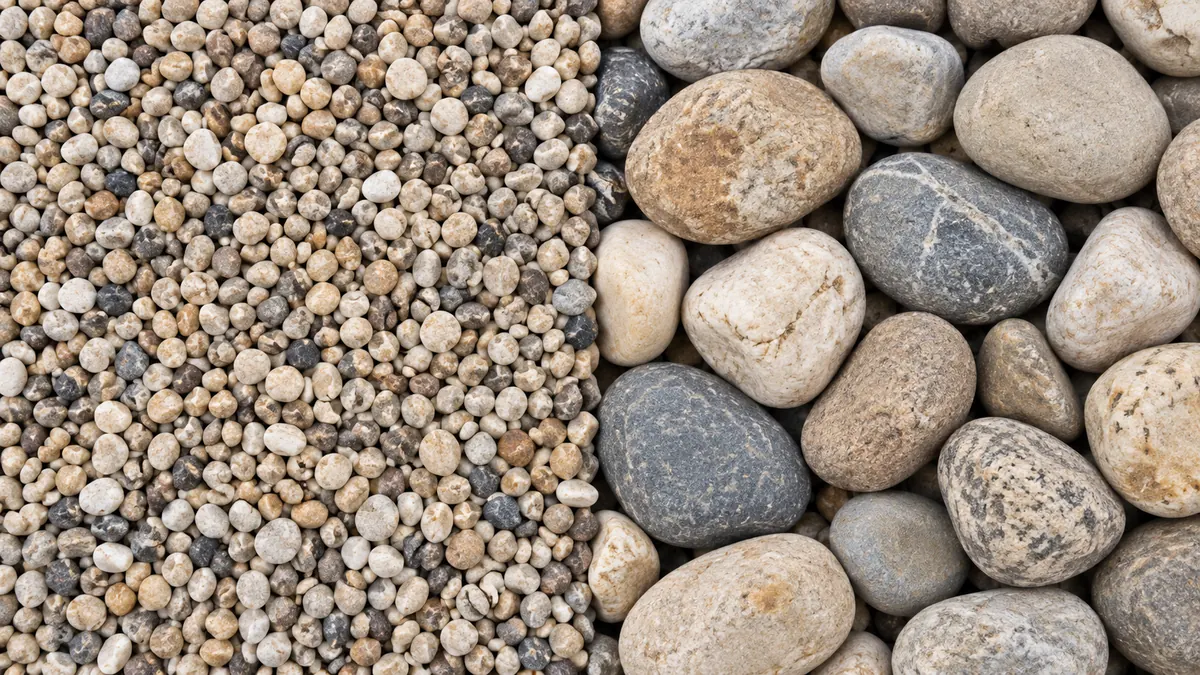
Both pea gravel and river rock are naturally rounded and smooth. Shaped by water erosion over time. The size difference is what drives every other performance difference between them.
Pea gravel ranges from 3/8 to 5/8 inch (roughly 10 to 15mm). It is named for its resemblance to a garden pea. This uniform small size is what makes it comfortable to walk on, easy to spread, and suitable for fine drainage applications. The uniformity also means it behaves predictably. It rolls and migrates consistently under pressure.
River rock ranges from 1 inch to 12 inches or more, with most landscaping applications using the 1 to 4 inch range. Individual stones have varied shapes, colors, and surface textures. This variation is what gives river rock its naturalistic appearance. It looks like stone gathered from an actual stream rather than a manufactured product. The larger size and heavier individual stone weight are what make it resistant to displacement.
Both materials are available washed and unwashed. Always use washed stone for any landscaping application. Unwashed stone carries clay, silt, and dust that turns to mud when wet, discolors surrounding surfaces, and fills the drainage voids between stones within one or two seasons. The price premium for washed stone, typically $3 to $8 per cubic yard, is always worth paying.
Cost Comparison: Upfront and Long-Term
| Cost factor | Pea gravel | River rock |
|---|---|---|
| Material per cubic yard (bulk) | $30–$55 | $45–$95 (size dependent) |
| Material per 50-lb bag | $5–$9 | $7–$18 (size dependent) |
| Installation cost per sq ft (DIY) | $0.50–$1.50 | $0.75–$2.50 |
| Installation cost per sq ft (professional) | $2–$5 | $3–$8 |
| Top-up cost (1 in per 100 sq ft) | $20–$35 bulk | $30–$55 bulk |
| Top-up frequency | Every 2–3 years | Every 5–10 years |
| 10-year total cost per 200 sq ft | $150–$350 | $200–$450 |
The 10-year total cost comparison is closer than the upfront material price suggests. A pea gravel installation at $1 per sq ft costs $200 upfront for 200 sq ft. With two top-up treatments over 10 years at $50 each, total 10-year cost is $300. A river rock installation at $1.50 per sq ft costs $300 upfront with one top-up at $75, giving a 10-year total of $375. The difference, $75 over 10 years, is less significant than the upfront price difference of $100 suggests.
The calculation shifts significantly for large areas. For a 1,000 sq ft installation, the upfront difference is $500 or more. At that scale, the choice of pea gravel purely on cost grounds becomes more defensible even accounting for long-term maintenance.
Drainage Performance
Both pea gravel and river rock drain well compared to hard surfaces. Far better than concrete, asphalt, or compacted soil. Water passes through either material at a rate that prevents surface pooling under normal rainfall conditions.
The technical difference: pea gravel's uniform small size creates consistent, evenly distributed void spaces. Water moves through predictably and at a consistent rate throughout the installation. River rock's varied sizes create irregular void spaces. Larger gaps between bigger stones and tighter gaps where smaller stones fill in. The drainage rate is variable rather than uniform, but adequate for all typical landscaping applications.
For French drain applications, neither pea gravel nor river rock is the best choice. Angular #57 crushed stone has better hydraulic conductivity than rounded stone of the same nominal size, because angular surfaces create larger, more consistent interconnected void spaces. If you must choose between pea gravel and river rock for a French drain, pea gravel is slightly preferable to small river rock. But #57 stone should be the first choice for any drainage engineering application.
For surface drainage, areas that receive sheet flow or concentrated runoff from roof drainage, river rock is unequivocally better than pea gravel. Flowing water displaces pea gravel easily, especially at downspout outlets and drainage swales. River rock stays in place under the same conditions.
Stability: Slopes and Foot Traffic
This is where the two materials diverge most significantly. Pea gravel migrates readily under pressure. Foot traffic, vehicle loads, and water flow all move it. The migration rate depends on how confined the installation is, the gradient of the surface, and traffic intensity. On flat areas with proper steel edging, pea gravel migration is manageable. On any slope, it is a persistent problem.
| Slope gradient | Pea gravel | River rock (1–2 in) | River rock (2–4 in) |
|---|---|---|---|
| Flat (0–2%) | Good with edging | Excellent | Excellent |
| Gentle (2–5%) | Marginal, drifts to low side | Good | Excellent |
| Moderate (5–10%) | Poor, significant migration | Moderate | Good |
| Steep (10–15%) | Not suitable | Poor | Moderate |
| Very steep (15%+) | Not suitable | Not suitable | Needs netting |
Under foot traffic on flat surfaces, both materials perform adequately with proper edging. The difference appears under heavy or repetitive traffic. A frequently-used garden path erodes pea gravel from the centerline toward the edges over time, creating a shallow channel effect. River rock on the same path shows minimal displacement. The practical implication: high-use paths that receive daily foot traffic perform better with river rock or a combination of pea gravel with river rock edging to contain migration.
Maintenance Requirements
Maintenance is where the total cost comparison between the two materials balances out. Pea gravel's lower upfront cost comes with higher ongoing maintenance. River rock's higher upfront cost requires minimal maintenance for years.
Pea gravel maintenance schedule: Rake and redistribute each spring. Top up with 1 inch of fresh material every 2 to 3 years. Pull wind-blown weeds that germinate on the surface annually. Re-stake edging sections that shift. Total time: 2 to 4 hours per 200 sq ft annually. Cost: $50 to $100 per 200 sq ft every 2 to 3 years for top-up material.
River rock maintenance schedule: Occasional weeding from the surface (1 to 2 times per year for wind-blown seedlings). Check for displaced stones on slopes after heavy rain. No regular redistribution needed on flat areas. Top up every 5 to 10 years. Total time: 30 to 60 minutes per 200 sq ft annually. Cost: $75 to $150 per 200 sq ft every 5 to 10 years for top-up material.
Freeze-Thaw Climate Performance
In climates with repeated freeze-thaw cycles, anything north of USDA hardiness zone 6, both materials experience disruption from ground heaving. The base layer freezes and expands upward, then thaws and settles. This movement redistributes surface material and creates an uneven surface each spring.
River rock handles this better because heavier stones require more energy to move. A 2-inch river rock that has been displaced by frost heave is easy to reposition. The individual stones are large enough to handle manually. A pea gravel surface in a freeze-thaw climate develops a lumpy uneven texture each winter that requires careful raking to restore.
Practical adjustment for freeze-thaw climates: increase standard depth by 1 inch for pea gravel (from 3 inches to 4 inches for a patio) and install a 6-inch compacted base layer rather than the standard 2 to 3 inches. This thicker base moves as a unit during freeze-thaw cycling rather than developing differential heaving. The same principle applies to river rock, though the larger stone size masks the surface texture changes better.
Project-by-Project Verdicts
| Project | Winner | Reason |
|---|---|---|
| Driveway surface | Pea gravel | 3/8-inch size comfortable under tires. River rock scatters under vehicle loads. |
| Patio | Pea gravel | More comfortable underfoot. River rock 1+ inch is painful to walk on barefoot. |
| Garden path (casual) | Pea gravel | More comfortable, cheaper. River rock acceptable for low-traffic paths. |
| Garden path (high use) | River rock (1–2 in) | Less migration under heavy foot traffic. Pea gravel requires constant redistribution. |
| Dog run | Pea gravel | Safe for paws, right size. River rock uncomfortably large for most dogs. |
| Playground | Pea gravel | CPSC compliant at tiered depths by fall height (6-12 in); not recommended above 8 ft. River rock not recommended for playground safety surfaces at any height. |
| Dry creek bed | River rock | Natural appearance at 1–4 inches. Pea gravel too small and uniform to look like a creek. |
| Erosion control | River rock | Weight keeps it in place on slopes. Pea gravel migrates on any meaningful slope. |
| Garden bed ground cover | Tie, preference | Pea gravel cheaper and uniform. River rock lower maintenance and more natural-looking. |
| Pool surround | Pea gravel | Comfortable barefoot, safer if stones enter pool than large river rock. |
| French drain | Neither, use #57 stone | Angular stone provides better drainage than either rounded material. |
| Water feature edge | River rock | Natural appearance, size variety, stays in place near moving water. |
Combining Pea Gravel and River Rock
The most practical installations often use both materials together. Pea gravel where walking comfort matters, river rock where stability and appearance matter. This combination solves the main limitation of each material.
Patio with river rock border: Pea gravel fills the patio interior. Comfortable, uniform, easy to spread. A single row of large river rock (3 to 5 inch) around the entire perimeter acts as a permanent physical edge, containing the pea gravel and eliminating migration. The border also defines the patio edge visually without the cost of steel edging and gives a more natural appearance.
Dry creek bed with pea gravel transitions: River rock (2 to 4 inch mixed) fills the main channel. Pea gravel transitions the creek bed edge into surrounding garden areas. The smaller pea gravel bridges the size gap between the creek rocks and the soil or lawn, giving a gradual natural transition rather than an abrupt hard edge.
Garden bed combination: Large river rock (3 to 6 inch) as accent boulders at strategic positions within a pea gravel ground cover. The large stones create visual interest and anchor points within the uniform smaller material. This combination is low-cost (pea gravel as the primary volume material) with the aesthetic appeal of river rock accent pieces.
When Neither Is the Right Choice
Both pea gravel and river rock are rounded materials. There are applications where angular stone is the correct choice regardless of the aesthetic preferences.
Structural driveway base: Neither material compacts into a stable structural base. Use crusher run or #3 crushed stone for driveway base layers. Pea gravel or river rock placed directly on subsoil without an angular compacted base will fail structurally within one to two seasons.
French drains: Angular #57 crushed stone has significantly better hydraulic conductivity than rounded stone. For any drainage engineering application where water flow rate matters, use angular crushed stone.
Concrete aggregate: Rounded pea gravel and river rock produce weaker concrete than angular aggregate. ASTM C33 concrete sand and angular coarse aggregate are specified for structural concrete for this reason.
High-traffic commercial areas: Both materials are residential landscaping materials. For commercial parking areas, walkways with hundreds of daily users, or public spaces, asphalt, concrete, or concrete pavers are more appropriate than either loose stone material.
Worked Project Decision Examples
Front garden bed, 200 sq ft, mixed shrubs and perennials. Both materials work here. The deciding factor is maintenance preference and budget. Pea gravel: $80 to $110 in bulk, comfortable to walk on when weeding, drains fast, good visual neutrality. River rock: $130 to $180 in bulk, no maintenance for 15 or more years, more decorative visual weight. For a homeowner who wants to plant and forget, river rock pays back its premium within 5 years of avoided top-up cost. For a homeowner who actively gardens and moves plants, pea gravel's lower initial cost makes more sense since the installation gets disturbed regularly anyway.
Dry creek bed drainage swale, 60 linear feet. River rock is the clear choice. Small pea gravel migrates downstream under water velocity in a functional drainage swale. After one heavy rain event the stones have redistributed unevenly. River rock (2 to 4 inch) stays in position under the water flow rates of a residential drainage channel. The visual result also reads more naturally as a creek bed, which is the design intent of a dry creek installation.
Pool surround, 400 sq ft. Pea gravel wins. River rock at 2 to 4 inches is uncomfortable barefoot for extended periods. The angular edges of some river rock grades cause discomfort when walked on without shoes. Pea gravel at 3/8 inch is smooth and rounded, comfortable at pool temperatures, and safe if kicked or fallen on. Pool surrounds are one of the few applications where pea gravel's barefoot comfort advantage is the definitive factor.
4 Mistakes When Choosing Between Pea Gravel and River Rock
Mistake 1. Using pea gravel in a water feature or drainage channel. Pea gravel displaces under water flow. In any application where water moves across or through the surface, pond edges, stream beds, drainage swales, channel liners, pea gravel migrates and the installation becomes uneven within one rain season. River rock or larger angular stone stays in position. Using pea gravel where water movement is part of the application means rebuilding the installation annually.
Mistake 2. Using river rock on a path that gets barefoot traffic. River rock larger than 1 to 1.5 inches is uncomfortable for extended barefoot walking. Homeowners who install 2-inch river rock on a garden path and then walk on it barefoot in summer immediately understand why 3/8-inch pea gravel exists. If the path will be used without shoes, to the pool, through a summer garden, around a fire pit, pea gravel is the correct surface.
Mistake 3. Buying river rock without checking the source. River rock from different quarries varies enormously in color, shape, and character. The smooth gray river rock from a Pacific Northwest supplier looks completely different from the warm brown and tan river rock from a Southeast supplier. Always ask for samples or see the material in person before ordering large quantities. Unlike pea gravel which is fairly consistent, river rock has significant visual variation by source.
Mistake 4. Installing river rock without landscape fabric on clay soil. River rock's weight causes it to sink into clay soil over time. Without landscape fabric between the clay and the rock, the stones gradually disappear into the ground and the bed requires topping up every 2 to 3 years. Fabric is more critical under heavy stone like river rock than under light pea gravel because the weight accelerates the sinking process.
Frequently Asked Questions
What is the difference between pea gravel and river rock?
Which is cheaper: pea gravel or river rock?
Is pea gravel or river rock better for driveways?
Is pea gravel or river rock better for drainage?
Is pea gravel or river rock better for a patio?
Is pea gravel or river rock better for erosion control?
Is pea gravel or river rock better for a dog run?
Is pea gravel or river rock better for garden beds?
Does pea gravel or river rock stay in place better?
Can you mix pea gravel and river rock?
Which is lower maintenance: pea gravel or river rock?
How does pea gravel vs river rock perform in freeze-thaw climates?
Calculators
Pea Gravel Calculator
Cubic yards, tons, bags, and cost for any pea gravel project at any depth and dimensions.
CalculatorCoverage Calculator
Enter cubic yards and depth. How much area does your quantity cover for either material.
Pea Gravel vs Other Gravel
Pea gravel vs crushed stone, decomposed granite, and river rock. Cost, drainage, stability compared.
GuidePea Gravel Cost Guide 2026
Regional prices per ton and per bag, bulk vs bag break-even, and seasonal buying windows.
Sources & Methodology
- USGS: Natural Aggregates Statistics: density and aggregate characteristics reference
- CPSC Handbook for Public Playground Safety: playground surfacing material specifications
Cost data: Based on 2026 landscape supplier pricing across US regions. Material prices vary by region. Performance comparisons: From landscape industry practice and field observation. Slope stability figures represent approximate performance thresholds. Actual performance varies with installation quality, base preparation, and local conditions. Full methodology
Last reviewed: October 2026