
French Drain Calculator: Gravel, Pipe, Fabric & Cost 2026
French Drain Calculator
Please enter a valid trench length greater than zero.
Gravel includes 10% waste. Pipe includes 10% for connections and outlet. Fabric includes 20% for overlap and top fold. Soil volume includes a 30% swell factor, dug soil takes up more space than it did compacted in the ground. Fall distance is minimum required at selected slope.
In This Guide
Formula Explained: Pipe Displacement
Most French drain calculators give you the full trench volume as gravel needed. Which overestimates the material because it ignores the space the pipe itself occupies. The correct formula subtracts pipe volume from trench volume before converting to cubic yards.
Trench volume (cu ft) = Length × Width (ft) × Depth (ft)Pipe volume (cu ft) = π × (pipe radius in ft)² × LengthNet gravel (cu ft) = Trench volume − Pipe volumeCubic yards to order = Net gravel ÷ 27 × 1.10
For a standard 4-inch pipe: radius = 2 inches = 0.167 feet. Pipe volume per linear foot = π × (0.167)² × 1 = 0.0875 cubic feet per foot. A 50-foot drain has 0.0875 × 50 = 4.38 cubic feet of pipe displacement. Not insignificant on a short drain but manageable to calculate with the calculator above.
Why it matters: On a 50-foot standard drain (12 in × 18 in trench), the pipe displacement is about 6 percent of the total trench volume. On a long drain with a small pipe this is minor. On a short drain with a large 6-inch pipe it can be 10 to 15 percent. Enough to meaningfully overorder if ignored.
Which Gravel to Use
| Gravel type | Size | Drainage rating | Use case |
|---|---|---|---|
| #57 crushed stone | 3/4 inch nominal | Excellent | Standard for all French drain applications |
| #3 crushed stone | 1–2 inches | Excellent | High-volume drains, curtain drains |
| Pea gravel | 3/8–5/8 inch | Good | Shallow decorative drains, light surface runoff only |
| Drain rock / clean round stone | 3/4–1.5 inch | Good | Acceptable alternative to #57 where angular unavailable |
| Crusher run / DGA | Mixed sizes to dust | Poor, avoid | NOT suitable, fines clog drainage voids |
| Pea gravel (fine, 1/4 in) | Under 3/8 inch | Poor, avoid | Too fine, migrates through fabric and clogs system |
#57 crushed stone is the standard for residential French drains because its angular shape creates and maintains larger void spaces between stones compared to rounded stone. The angular surface also locks stones together under load, preventing void collapse over time. Always use clean (washed) stone. Stone with dust or fines reduces hydraulic conductivity immediately on installation.
Depth Guide by Application
| Application | Minimum depth | Standard depth | Pipe position |
|---|---|---|---|
| Surface yard drainage (standing water) | 12 inches | 18–24 inches | 6–8 inches below surface |
| Curtain drain (slope seepage) | 18 inches | 24–36 inches | At or below seepage level |
| Foundation drainage (exterior) | 24 inches | 36–48 inches | At footing elevation |
| Basement footing drain | 36 inches | 48 inches | At or below footing base |
| Decorative / landscape drain | 12 inches | 12–18 inches | Bedded in gravel, no pipe needed |
Slope Requirements
A French drain relies entirely on gravity to move water from the inlet to the outlet. Without adequate slope, water sits in the pipe and the system does not drain. The slope requirement is simple but the math to verify it is often skipped on DIY projects.
| Slope | Fall per 100 feet | Performance | When to use |
|---|---|---|---|
| 0.5% (below minimum) | 6 inches | Poor, standing water likely | Avoid |
| 1.0% (minimum) | 12 inches | Adequate | Flat sites where more slope is not achievable |
| 1.5% | 18 inches | Good | Standard residential installation |
| 2.0% | 24 inches | Excellent | Preferred specification where site allows |
| 3.0%+ | 36+ inches | Excellent | Sloped sites, no special measures needed |
Before digging, verify the outlet elevation is achievable. Measure the elevation difference between the planned inlet (highest point) and the outlet (lowest point). Divide the elevation drop in inches by the trench length in feet. This is your available slope percentage × 12. If the result is less than 12 (less than 1 percent slope), either move the inlet uphill or the outlet further downhill, or add a sump pump at the outlet to lift the collected water.
Fabric: Burrito Wrap vs Pipe Sock
The landscape fabric method determines how long the French drain performs before becoming clogged with fine soil particles. Most French drain failures are fabric failures, not gravel failures.
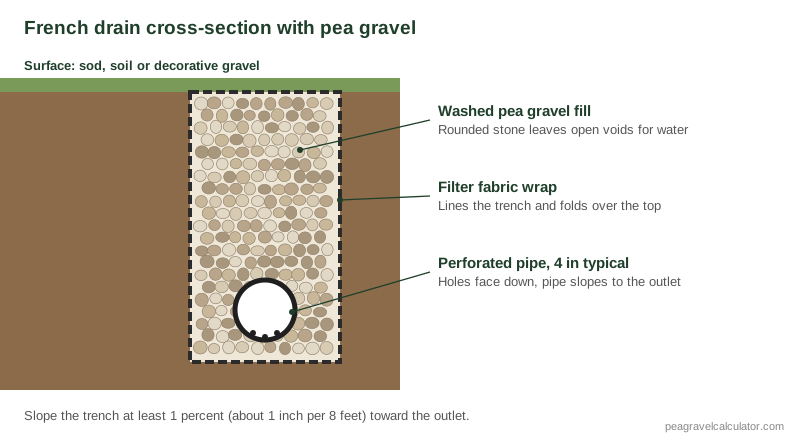
1. Lay non-woven geotextile fabric in the trench. Allow enough to fold over the top.
2. Add 2 to 3 inches of gravel on the fabric floor.
3. Lay the perforated pipe with holes facing down on the gravel bed.
4. Fill with gravel to 3 to 4 inches above the pipe.
5. Fold the fabric over the top of the gravel, overlapping the edges by 6 inches. Backfill with soil above.
The burrito wrap wraps the entire gravel column in fabric. The effective filter area is the full perimeter of the trench times the length. This large surface area means the filter loads slowly and the drain retains high performance for 25 to 40 years. The pipe sock, by contrast, has only the surface area of the pipe itself. It loads quickly in any soil with silt content and typically begins restricting flow within 3 to 7 years.
Fabric type for French drains: Use non-woven geotextile (spunbond), not woven. Non-woven fabric allows water to pass through in all directions across its surface. Woven fabric restricts lateral flow. Water can only enter through the fabric at approximately right angles to the surface, limiting infiltration capacity in a trench application.
Pipe Hole Direction
Perforated pipe holes must face down (6 o'clock position). A French drain collects groundwater rising from below. The holes at the bottom allow water to enter as it rises through the gravel. Holes facing up only collect water that has already risen to near the top of the gravel column. By which point the soil above may already be saturated.
This is the most common French drain installation error and it significantly reduces system performance without causing any visible problem during installation. Always mark the top of the pipe with a paint line or chalk before placing it in the trench so hole orientation can be verified before covering.
How Much Soil Will You Have to Remove?
Gravel and pipe get all the attention, but excavated soil is the part that surprises people. The dirt coming out of the trench does not fit back into the same size hole once removed. Compacted soil expands 25 to 30 percent when dug up, called the swell factor, because excavation breaks apart the compacted structure and introduces air pockets between particles.
For a 50 ft trench at 12 in × 18 in, the compacted trench volume is about 2.78 cubic yards, but the loose, swollen soil you actually need to haul away or pile up is closer to 3.61 cubic yards. That difference matters for two practical reasons: it determines whether the soil fits in your truck bed or trailer in one load, and it is what a disposal or hauling service will actually charge you for, since they price by loose volume, not the size of the hole you dug.
Options for the removed soil: reuse it to build up low spots elsewhere in the yard, have it hauled away by the gravel delivery truck on its return trip (often cheaper than a separate haul), or rent a dumpster for larger foundation-drain excavations. A standard pickup bed holds approximately 2 to 2.5 cubic yards of loose soil.
Pre-Calculated Quantities
All figures use standard 12-inch wide × 18-inch deep trench with 4-inch pipe, 1% slope, and 10% waste on gravel. #57 stone at 1.40 t/yd³.
| Trench length | Gravel yd³ | Gravel tons | Pipe (lin ft) | Fabric (sq ft) | Fall needed (in) |
|---|---|---|---|---|---|
| 25 feet | 0.77 | 1.07 | 28 | 125 | 3.0 |
| 50 feet | 1.53 | 2.15 | 55 | 250 | 6.0 |
| 75 feet | 2.30 | 3.22 | 83 | 375 | 9.0 |
| 100 feet | 3.07 | 4.30 | 110 | 500 | 12.0 |
| 150 feet | 4.60 | 6.44 | 165 | 750 | 18.0 |
| 200 feet | 6.14 | 8.59 | 220 | 1,000 | 24.0 |
Cost Guide 2026
| Material | Unit cost | 50 ft drain | 100 ft drain |
|---|---|---|---|
| #57 crushed stone (bulk) | $28–$45/ton | $60–$97 | $120–$194 |
| Perforated PVC pipe (4 in) | $0.40–$0.80/lin ft | $22–$44 | $44–$88 |
| Non-woven geotextile fabric | $0.10–$0.20/sq ft | $25–$50 | $50–$100 |
| Delivery fee | $60–$120/load | $60–$120 | $60–$120 |
| DIY total (materials only) | - | $167–$311 | $274–$502 |
| Professional installation | $10–$30/lin ft | $500–$1,500 | $1,000–$3,000 |
Frequently Asked Questions
How do you calculate gravel for a French drain?
What type of gravel is best for a French drain?
How deep should a French drain be?
What slope does a French drain need?
How much landscape fabric for a French drain?
Should I use a sock on my French drain pipe?
Which direction should pipe holes face?
Can you use pea gravel in a French drain?
How long does a French drain last?
How much does a French drain cost?
How much excavated soil will I need to remove or dispose of?
Do I need a permit for a French drain?
Related Calculators
Sources & Methodology
- USGS: Natural Aggregates Statistics: aggregate density values (#57 stone 1.40 t/yd³)
- OSHA: Trenching and Excavation Safety: call 811 requirement and excavation safety standards
Formula: Net gravel = (Trench volume − Pipe volume) ÷ 27 × 1.10. Pipe volume = π × r² × L where r = pipe radius in feet. Fabric = L × (W + D × 2) × 1.20. Slope fall = L × (slope% ÷ 100) × 12 inches. Minimum slope: 1% from civil engineering drainage practice. Full methodology
Last reviewed: October 2026