
Pea Gravel vs Mulch: Which Is Better for Your Garden? 2026
In This Guide
- The fundamental difference, soil chemistry
- Master comparison table
- Cost comparison, upfront and over 5 years
- Weed control compared
- Moisture retention compared
- Which plants need which material
- Project-by-project verdicts
- Combining pea gravel and mulch
- Environmental footprint
- 5 questions to ask before choosing
- Frequently asked questions
The Fundamental Difference: Soil Chemistry
Most comparisons of pea gravel and mulch focus on cost, appearance, and maintenance. The more important difference is what happens below the surface. This determines which material is right for your plants. Not just your budget.
Organic mulch (bark chips, wood chips, shredded leaves, straw) is a living system. As it decomposes, it feeds soil microbes, fungi, and earthworms. These organizms process the organic matter into humus. Stable soil organic matter that improves drainage in clay soils, improves water-holding capacity in sandy soils, and makes nutrients available to plant roots. A 3-inch layer of bark mulch added annually for five years transforms soil structure and biology in a way that benefits almost every plant except the narrow category that specifically requires lean, infertile conditions.
Pea gravel is chemically inert. It does nothing to the soil beneath it. Water passes through it, temperatures are moderated slightly, weed seeds find less purchase on the surface. But the soil chemistry is unchanged. For plants that evolved in gravelly, nutrient-poor conditions (lavender, rosemary, many alpine species), this inertness is exactly what they need. For plants that evolved in rich woodland soil (most garden perennials, shrubs, trees), pea gravel provides no soil benefit.
This is the most important question to answer before choosing: do your plants benefit from soil enrichment or do they prefer lean conditions? Everything else, cost, appearance, maintenance, is secondary to this.
Master Comparison Table
| Factor | Pea gravel | Organic mulch (bark/wood chip) |
|---|---|---|
| Upfront cost per cubic yard | $30–$55 | $25–$45 |
| Lifespan | Indefinite (top-up every 2–3 yr) | 1–4 years (then replace) |
| 5-year cost per 200 sq ft | $320–$580 | $650–$1,150 (annual replacement) |
| Soil enrichment | None, chemically inert | Excellent, feeds soil biology |
| Moisture retention | Low | High (25–50% evaporation reduction) |
| Weed suppression (below) | Good (with fabric) | Good (with fabric) |
| Weed suppression (surface) | Good (gravel is not a germination medium) | Moderate (decomposed mulch becomes germination medium) |
| Drainage | Excellent | Good |
| Heat retention | Moderate (warms root zone) | Low (insulates root zone) |
| Suitable for most garden plants | Partial, not for moisture lovers | Yes |
| Suitable for Mediterranean plants | Yes | Can cause root problems |
| Suitable for paths and patios | Excellent | Not suitable |
| Pest harbor risk | Low | Moderate (slugs, earwigs in damp mulch) |
| Environmental source | Mined aggregate | Renewable wood processing waste |
| Maintenance | Top-up, rake, weed surface | Annual replacement, rake, weed surface |
Cost Comparison: Upfront and Over 5 Years
The upfront cost of mulch is lower. The 5-year cost of pea gravel is usually lower. Understanding this reversal is important for accurate budget planning.
| Cost item | Pea gravel (200 sq ft) | Bark mulch (200 sq ft) |
|---|---|---|
| Initial material (3 in depth) | $80–$140 | $65–$115 |
| Landscape fabric | $20–$40 | $20–$40 (optional but recommended) |
| Edging (optional for mulch) | $60–$120 (required) | $0–$60 (optional) |
| Year 1 total | $160–$300 | $85–$215 |
| Year 2 replacement/top-up | $0 (no top-up yet) | $65–$115 |
| Year 3 replacement/top-up | $30–$50 (0.5 in top-up) | $65–$115 |
| Year 4 replacement/top-up | $0 | $65–$115 |
| Year 5 replacement/top-up | $30–$50 | $65–$115 |
| 5-year total | $220–$400 | $345–$675 |
At 5 years, pea gravel is typically $125 to $275 cheaper for the same coverage area. The savings increase over 10 years as pea gravel continues to need only small top-ups while mulch replacement costs accumulate annually. The exception: bark mulch installed every 3 to 4 years rather than annually, and premium mulch types (cedar, cypress) that last longer. These reduce the mulch cost gap significantly. Use the cost calculator with your local prices to compare for your specific project.
Weed Control Compared
Both pea gravel and mulch require woven geotextile landscape fabric underneath for effective suppression of weeds growing up from below. Without fabric, neither material provides adequate weed control.
With fabric, the comparison changes depending on the time horizon. In the first year, thick fresh mulch suppresses surface weed germination better than pea gravel. The dense mat of wood chips physically prevents small seeds from reaching the soil surface. Pea gravel's open structure allows more light to reach the surface, and wind-blown seeds have more opportunity to find a germination spot.
Over 3 to 5 years, the comparison reverses. As mulch decomposes, its top surface becomes a layer of partially composted organic matter. An excellent germination medium for weed seeds. Annual mulch replacement stirs new seeds into this layer. Pea gravel's surface remains largely inert. It does not provide organic matter for weed seeds to germinate in. The weeds that do appear on pea gravel surfaces are primarily wind-blown annuals with root systems that can be hand-pulled easily before they seed.
The conclusion: mulch is better for immediate weed suppression in a newly installed area. Pea gravel requires less weed management over multi-year periods. Both require fabric underneath and both require periodic hand-weeding of surface weeds.
Moisture Retention Compared
This is where mulch has a clear, significant advantage for most plants. A 3-inch bark mulch layer reduces soil moisture evaporation by 25 to 50 percent compared to bare soil, depending on temperature and humidity. This means less frequent watering, more consistent soil moisture, and less stress on plant roots during dry periods.
Pea gravel provides minimal moisture retention. It shades the soil from direct sunlight, which reduces some evaporation. But the open, airy structure of the gravel layer allows air movement that counteracts this benefit. Overall, soil under pea gravel dries out faster than soil under an equivalent mulch layer.
For water-conscious gardening and in regions with dry summers, this difference translates directly into irrigation frequency and cost. A mulched bed may need watering every 5 to 7 days during a dry summer where a pea gravel bed needs watering every 3 to 4 days. Over an entire season, the mulched bed uses 20 to 40 percent less water. For large garden areas or regions with water restrictions, this is a meaningful practical consideration.
Which Plants Need Which Material
| Plant type | Preferred material | Reason |
|---|---|---|
| Mediterranean herbs (lavender, rosemary, thyme) | Pea gravel | Need hot, dry, lean root zone; mulch causes crown rot |
| Succulents and agaves | Pea gravel | Require sharp drainage, dislike moisture retention |
| Alpine plants and rock garden species | Pea gravel | Evolved in rocky, infertile, well-drained conditions |
| Woodland perennials (hostas, ferns, astilbe) | Organic mulch | Need cool, moist, organic-rich soil |
| Most deciduous shrubs | Organic mulch | Benefit from steady organic matter input |
| Roses | Organic mulch | Heavy feeders; soil enrichment improves flowering |
| Vegetables and annual beds | Organic mulch or bare soil | Require soil cultivation; gravel prevents this |
| Established deciduous trees | Either (mulch preferred) | Mulch better for soil biology; gravel acceptable |
| Newly planted trees (first 3–5 years) | Organic mulch | Root establishment benefits from soil enrichment |
| Ornamental grasses (dry-adapted) | Pea gravel | Suits their preference for lean, well-drained conditions |
Project-by-Project Verdicts
| Application | Winner | Reason |
|---|---|---|
| Garden path / walkway | Pea gravel | Mulch is soft and unstable underfoot; breaks down quickly under traffic |
| Patio / seating area | Pea gravel | Mulch not suitable for any hard-use surface area |
| Mixed perennial bed | Organic mulch | Most perennials benefit from soil enrichment |
| Mediterranean / gravel garden | Pea gravel | Suits the plants and the aesthetic perfectly |
| Around established trees | Organic mulch | Soil biology support; easier to maintain grass boundary |
| Around newly planted trees | Organic mulch | Root establishment; soil enrichment critical in first years |
| Vegetable garden | Organic mulch | Soil cultivation required; moisture critical for yield |
| Dog run | Pea gravel | Mulch retains odor, harbors pests, compacts under traffic |
| Driveway | Pea gravel | Mulch not suitable for vehicle use |
| Slope erosion control | Pea gravel (large) or mulch | Both work; gravel stays in place better, mulch improves soil |
| High-weed-pressure area long-term | Pea gravel | Surface remains less productive for weed germination over time |
| Pool surround | Pea gravel | Mulch floats and tracks into pool; chips can be slippery when wet |
Combining Pea Gravel and Mulch
Many gardens benefit from using both materials in different zones rather than choosing one for the entire garden. The two materials have complementary strengths and the zones in which each excels are often spatially distinct.
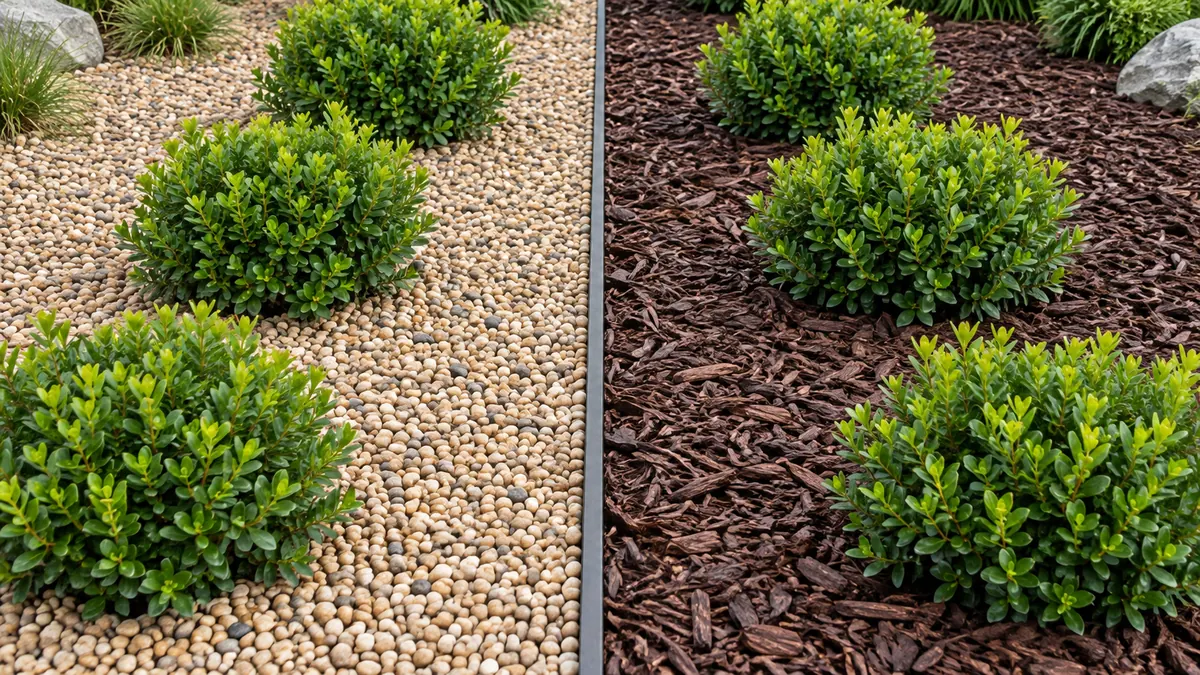
The standard combination approach: Organic mulch in all planted beds with most shrubs, perennials, and trees. Pea gravel for paths, connecting areas between beds, the patio, and any zones containing Mediterranean or drought-tolerant plants. Steel edging at the boundary between mulch beds and gravel areas prevents the materials from migrating into each other.
Transition zones: At the edge of a pea gravel patio where it meets a planted border, use a row of larger stones or a low planting to visually transition between the two materials. A hard edge between pea gravel and bark mulch at the same level looks unfinished. A slight height difference (pea gravel slightly lower) or a defined physical border resolves this.
Seasonal planting areas within gravel gardens: A common approach in Mediterranean-style gardens is to lay pea gravel as the permanent ground layer and create defined pockets of good soil (with organic mulch) for specimen plants that need soil enrichment. The pea gravel handles all the path and connective space. The mulched pockets handle all the planted zones. This gives the visual coherence of an all-gravel garden with the horticultural flexibility of proper soil management in the planting areas.
Environmental Footprint
Organic mulch has a lower lifecycle environmental impact for most gardeners. It is typically made from wood processing waste. Sawmill offcuts, tree service chippings, bark stripped from timber. Using this material for mulch diverts it from landfill. As it decomposes it sequesters carbon in the soil, improves soil biology, and reduces the garden's dependency on supplemental fertilizer.
Pea gravel is mined aggregate. Its extraction disturbs the quarry site, requires energy for crushing and processing, and the material does not return to the natural organic cycle. These impacts are real but are one-time events spread over the 15 to 25-year lifespan of the installation.
The comparison is more nuanced than it first appears. Annual mulch replacement means annual transport of 2 to 3 cubic yards of material from supplier to garden, year after year. The cumulative transport emissions over 10 to 15 years may approach or exceed the one-time mining and transport impact of a pea gravel installation, depending on source distances. If your mulch supplier is local (within 20 miles) and your pea gravel quarry is distant, organic mulch has a lower transport footprint. If both are equidistant, the comparison depends on how frequently you replace mulch and how long your pea gravel installation lasts.
5 Questions to Ask Before Choosing
1. What plants are going in this area? Mediterranean and drought-tolerant plants: pea gravel. Most other plants: organic mulch. This question overrides all others for planted areas.
2. Will this area be walked on? Any area with foot traffic needs pea gravel. Mulch is not a hard-use surface material.
3. How important is moisture conservation? If the plants need consistent moisture and you want to minimize watering, organic mulch is the better choice.
4. What is your long-term maintenance tolerance? Annual mulch replacement is not onerous but is a recurring obligation. If low ongoing maintenance matters more than soil enrichment, pea gravel is preferable.
5. What is your 5-year budget? If the budget is tight in year one, mulch has a lower entry cost. If you want to minimize total expenditure over 5 to 10 years, pea gravel is usually more economical despite the higher upfront cost.
Worked Decision Examples
Mediterranean garden with lavender and rosemary. Pea gravel wins. A 300 sq ft planting bed with lavender, rosemary, santolina, and ornamental grasses. The plants prefer hot, dry, lean root zones. Bark mulch in this bed would retain moisture and enrich the soil. Exactly what Mediterranean plants do not need. Lavender in particular develops crown rot in wet, organically-rich soil. Pea gravel provides the well-drained, infertile conditions these plants evolved in. The visual result also suits the Mediterranean aesthetic: gray-green foliage against pale gravel, with dark steel edging at the border.
Mixed perennial border with hostas, astilbe, and roses. Mulch wins. A 150 sq ft border with moisture-loving woodland perennials and roses. Pea gravel here would increase soil temperature around the plant bases, reduce moisture retention between watering, and provide no soil enrichment. These plants need cool, moist, organically-rich conditions. A 3-inch bark mulch layer provides all three. Annual top-up feeds the soil biology that supports their root systems.
Dog run. Pea gravel wins decisively. No competition. Mulch in a dog run compresses under traffic, retains urine, produces persistent odor, and harbors insects. Pea gravel drains immediately, dries quickly, is easy to clean, and resists the compaction that makes mulch surfaces increasingly unhygienic over a season.
Vegetable garden path between raised beds. Mulch wins. Paths between raised beds are cultivated and changed seasonally. Pea gravel installed between raised beds becomes a permanent obstacle to bed expansion or configuration changes. Wood chip mulch between beds can be raked aside, incorporated into new beds, or composted at end of season. The flexibility is worth the annual replacement cost in a productive food garden.
4 Mistakes When Choosing Between Pea Gravel and Mulch
Mistake 1. Using mulch under Mediterranean plants. Lavender, rosemary, thyme, and cistus planted into organically-rich, moisture-retaining mulched soil develop crown rot within one to three seasons. The symptoms look like poor growing conditions rather than root disease, so gardeners add more water and more mulch. Accelerating the problem. Mediterranean plants need pea gravel at their base, not mulch. This is the most common cause of lavender dying in UK and Northern US gardens.
Mistake 2. Using pea gravel in a vegetable garden. Vegetable production requires soil cultivation. Turning, amending, and replanting every season. Pea gravel and landscape fabric beneath it makes this impossible without removing both layers. Mulch is the correct ground cover for productive gardens because it can be moved, incorporated, and replaced without disrupting the growing area.
Mistake 3. Comparing only upfront cost. Mulch costs less per cubic yard upfront. But over five years, annual mulch replacement on a 200 sq ft bed costs $345 to $675 total. Pea gravel on the same bed costs $220 to $400 total over the same period. The homeowner who chooses mulch to save money in year one pays more than the homeowner who chose pea gravel by year three in most scenarios.
Mistake 4. Using pea gravel where weed chemical control is needed. In areas where annual herbicide application is the primary weed control strategy, pea gravel creates a problem: most herbicides should not be applied near a fire or combustion source, and the residue on gravel near barbecues, fire pits, or childrens' play areas is a concern. In these areas, physical weed control via landscape fabric without herbicide is the correct approach.
Frequently Asked Questions
Is pea gravel or mulch better for garden beds?
Which is cheaper: pea gravel or mulch?
Does pea gravel suppress weeds better than mulch?
Does pea gravel retain moisture like mulch?
Can you use pea gravel instead of mulch around trees?
How long does mulch last compared to pea gravel?
What are the disadvantages of pea gravel vs mulch?
Which plants prefer pea gravel over mulch?
Can you mix pea gravel and mulch in the same garden?
Is pea gravel or mulch better for weed control?
Does pea gravel heat up garden beds?
How deep should pea gravel be compared to mulch?
Related Calculators and Guides
Pea Gravel Calculator
Calculate exact cubic yards, tons, and bags for any pea gravel project to compare against equivalent mulch quantities.
CalculatorCost Calculator
Enter your local prices per cubic yard for pea gravel and mulch to get an accurate 5-year cost comparison.
GuidePea Gravel Pros and Cons
Complete honest assessment. Covers 9 pros and 8 cons with real numbers, including comparisons against all main alternatives.
Pea Gravel vs Other Materials
Pea gravel vs river rock, crushed stone, and decomposed granite. For when pea gravel or mulch are both ruled out.
GuidePea Gravel Cost Guide 2026
Full cost breakdown with regional prices, bulk vs bag, delivery fees, and installation cost comparison.
GuideMaintenance Guide
Annual maintenance schedule for pea gravel. What it requires vs organic mulch annual replacement.
Sources & Methodology
- USGS: Natural Aggregates Statistics: pea gravel density and material characteristics
- USDA NRCS: Soil Health Guides: organic matter soil enrichment research referenced for mulch decomposition and soil biology discussion
Moisture retention data: Evaporation reduction figures (25–50%) from horticultural research on mulch effectiveness. Cost data: 2026 landscape supplier pricing for both materials. 5-year cost model assumes annual mulch replacement at initial depth. Less frequent replacement (every 2–3 years) reduces mulch costs proportionally. Full methodology
Last reviewed: October 2026