
What to Put Under Pea Gravel: Base Layer, Fabric and Sand Explained
- The Layers Under a Pea Gravel Surface
- What You Need Under Pea Gravel, by Project
- Should You Put Sand Under Pea Gravel?
- Best Base Materials Compared
- Landscape Fabric: Type and Placement
- How Much Base Material to Order
- How to Build the Base
- Special Cases: Over Concrete, Dirt, Grass or Clay
- Mistakes to Avoid
- Frequently asked questions
The Layers Under a Pea Gravel Surface
A pea gravel surface that stays level for years is built in four layers. From the bottom up: compacted native soil, a compacted crushed stone base, landscape fabric, and the pea gravel itself.
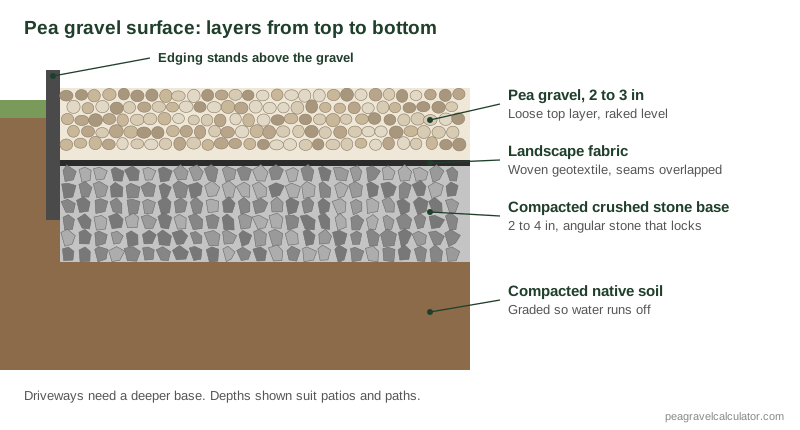
Pea gravel cannot do the structural work on its own. The stones are rounded, so they roll under load instead of locking. The base underneath is what stops footprints, furniture legs, and tires from pushing the surface into the soil.
What You Need Under Pea Gravel, by Project
| Project | Fabric | Compacted base | Pea gravel on top |
|---|---|---|---|
| Decorative bed, no foot traffic | Yes | None needed | 1 to 2 in |
| Garden path on sandy or firm soil | Yes | Optional, 2 in recommended | 2 to 3 in |
| Garden path on clay or soft soil | Yes | 2 to 3 in | 2 to 3 in |
| Patio or seating area | Yes | 2 to 4 in | 2 to 3 in |
| Dog run | Yes | 2 to 4 in | 3 to 4 in |
| Driveway | Yes | 4 in minimum, more on soft ground | 4 to 6 in |
Total excavation depth is base plus pea gravel, less any amount you want the finished surface to sit above the surrounding grade. A patio with 3 inches of base and 3 inches of gravel needs about 6 inches dug out. The depth guide covers the pea gravel layer in detail.
Should You Put Sand Under Pea Gravel?
No, not as the base. Sand is the right bedding for pavers because the pavers lock it in place. Under loose gravel nothing confines it, and four problems follow.
- It shifts. Sand moves under point loads, so chair legs and heels sink and leave hollows.
- It mixes. Without fabric, sand works up into the gravel and the surface turns gritty and dull.
- It holds water. Fine sand drains far more slowly than open gravel, which keeps the surface damp and encourages weeds and moss.
- It washes. Runoff carries sand out from under the edges, leaving voids.
There is one sensible use for sand: a thin leveling layer, about 1/2 inch, raked over a compacted stone base to fill small surface gaps before the fabric goes down. It is optional, and stone dust does the same job with less movement.
Best Base Materials Compared
| Material | Also sold as | Compacts firmly | Drains | Use it for |
|---|---|---|---|---|
| Dense-graded crushed stone | Crusher run, 3/4-inch minus, road base, quarry process | Yes, very hard | Moderately | Patios, paths, driveways. The default choice. |
| Clean crushed stone | #57 stone, 3/4-inch clean | Partly, stays open | Very well | Wet sites and clay soil where drainage matters most |
| Recycled concrete aggregate | RCA, crushed concrete | Yes | Moderately | Budget base where available |
| Stone dust or screenings | Quarry dust, fines | Yes, in thin layers | Poorly | Leveling skim only, not a full base |
| Sand | Concrete sand, masonry sand | No | Slowly | Not recommended as a base |
| Pea gravel | No | Very well | Never as its own base. It does not lock. |
The key property is particle shape. Angular, fractured stone with a mix of sizes down to fines packs into a tight mass. Rounded stone of one size never will. That is also why a deeper layer of pea gravel is not a substitute for a base: more depth just means more loose material to sink into.
Landscape Fabric: Type and Placement
Fabric is a separator. It stops the layers from mixing while letting water through. Use a woven or heavy non-woven geotextile sold for landscaping or driveways. Thin plastic sheeting is not a substitute, because it traps water on top and the gravel slides on it.
Where it goes. The standard position is between the base and the pea gravel, where it keeps the small rounded stones from working down into the base. On clay or soft soil, a second layer under the base is worth adding to stop the base stone from being pressed into the mud over time.
How to lay it. Overlap seams by 6 to 12 inches, pin with landscape staples every few feet, and run the fabric an inch up the inside face of the edging. Cut it cleanly around posts and drains. Fabric reduces weeds from below but does not stop seeds that land on top, as the weed control guide explains.
How Much Base Material to Order
Base is calculated the same way as the gravel: area × depth, converted to cubic yards and then tons. Dense-graded crushed stone weighs about 1.4 tons per cubic yard, slightly more than pea gravel.
Worked example. A 12 × 16 ft patio with a 3-inch compacted base:
- Area: 12 × 16 = 192 sq ft
- Volume: 192 × 0.25 ft = 48 cubic feet = 1.78 cubic yards
- Compaction allowance of 15 percent: 1.78 × 1.15 = 2.04 cubic yards
- Weight: 2.04 × 1.4 = about 2.9 tons of crushed stone
The same patio with 3 inches of pea gravel on top needs 1.78 cubic yards, or about 2.4 tons, before any waste allowance. So the base is a slightly bigger order than the surface. Loose dense-graded stone loses roughly 10 to 20 percent of its depth when compacted, which is why the allowance is larger than the 10 percent used for pea gravel.
The patio calculator and driveway calculator work out base and surface quantities together.
How to Build the Base
- Excavate to the total depth, removing all sod and roots.
- Grade for drainage. Slope the soil about 1 to 2 percent away from buildings. The finished surface will follow whatever shape the subgrade has.
- Compact the soil with a hand tamper or plate compactor. Fill and re-compact any soft spots.
- Install edging so the base is contained. See the edging guide.
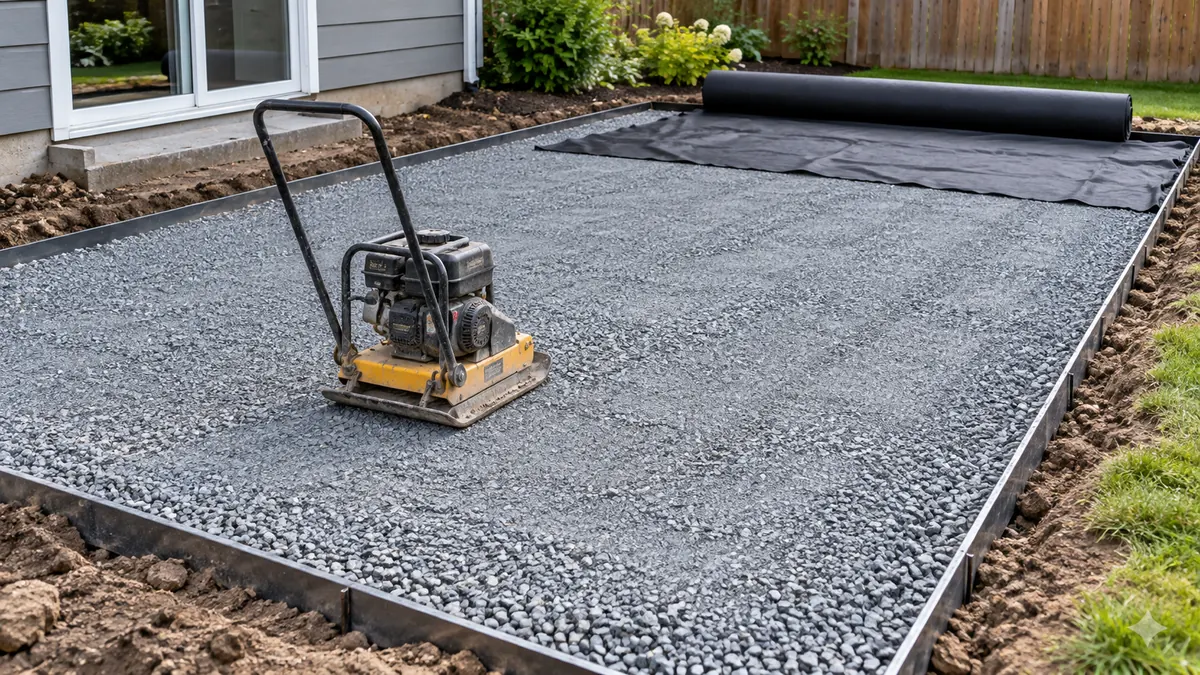
- Spread base stone in lifts of about 2 inches. Dampen each lift lightly and compact it before adding the next. One thick layer compacts only at the top.
- Check level and slope with a straight board. Fix low spots now.
- Lay fabric, then spread the pea gravel and rake it level.
A hand tamper is enough for a small path. For a patio or driveway, renting a plate compactor for half a day gives a noticeably firmer result. The full sequence is in the installation guide.
Special Cases: Over Concrete, Dirt, Grass or Clay
Over concrete. Pea gravel can go over an old slab if water has somewhere to go. The slab is already a base, so add only edging and 2 inches of gravel. If the slab is flat with no fall, water will pond in the gravel, so drill or cut drainage points or keep the layer thin.
Directly over dirt. Acceptable for decorative beds with fabric. For anything walked on, bare soil under pea gravel leads to sinking and mud working up, especially after wet weather.
Over grass. Remove it. Buried sod decomposes unevenly and leaves a soft, lumpy layer, and vigorous grasses grow through.
Clay soil. Clay holds water and swells and shrinks with the seasons. Use fabric under the base as well as over it, choose a base with good drainage, and make sure the subgrade slopes so water is not trapped. The drainage guide covers clay sites.
Driveways. This is where the base matters most and where pea gravel is weakest. Rounded stone ruts under tires even on a good base, so many driveway builders use angular gravel for the surface and keep pea gravel for low-traffic areas. If you want pea gravel on a driveway, read the driveway guide first.
Mistakes to Avoid
- Skipping the base and adding more pea gravel instead. Depth does not create stability.
- Using sand because it is cheap and easy to level. It moves and mixes.
- Not compacting in lifts. A 4-inch layer compacted once stays loose underneath.
- Using plastic sheeting instead of fabric. Water sits on top.
- Leaving the subgrade flat. Without slope, water collects under the surface.
Frequently Asked Questions
What do you put under pea gravel?
Should I put sand under pea gravel?
What is the best base for pea gravel?
How thick should the base be under pea gravel?
Do I need landscape fabric under pea gravel?
Can you put pea gravel directly on dirt?
Can I use pea gravel as its own base?
Do I need to compact the base under pea gravel?
How much base stone do I need under pea gravel?
Can you put pea gravel over concrete?
What kind of landscape fabric goes under pea gravel?
Should I put plastic under pea gravel?
How deep do I dig for a pea gravel patio?
Related Calculators and Guides
How to Install Pea Gravel
The full build sequence from excavation to final raking.
CalculatorPatio Calculator
Base stone and pea gravel quantities together.
CalculatorDriveway Calculator
Separate base and surface layers with compaction.
GuideDepth Guide
How deep the pea gravel layer should be for each project.
GuideDrainage Guide
How pea gravel drains and what changes on clay.
GuidePea Gravel Edging
Containing the base and the gravel.
Sources & Methodology
- USGS: Aggregates Statistics and Information: reference data for construction sand and gravel
Densities used here are 1.35 tons per cubic yard for pea gravel and about 1.4 tons per cubic yard for dense-graded crushed stone, both typical dry values that vary by quarry. Base depths, lift thickness, and compaction allowance reflect common residential hardscape practice and are not a formal standard. Local soil and frost conditions can justify a deeper base, so check with a local supplier or contractor for driveways and large patios.
Last reviewed: October 6, 2026 · Full methodology