
Pea Gravel Delivery: Cost, Truck Sizes and Site Preparation
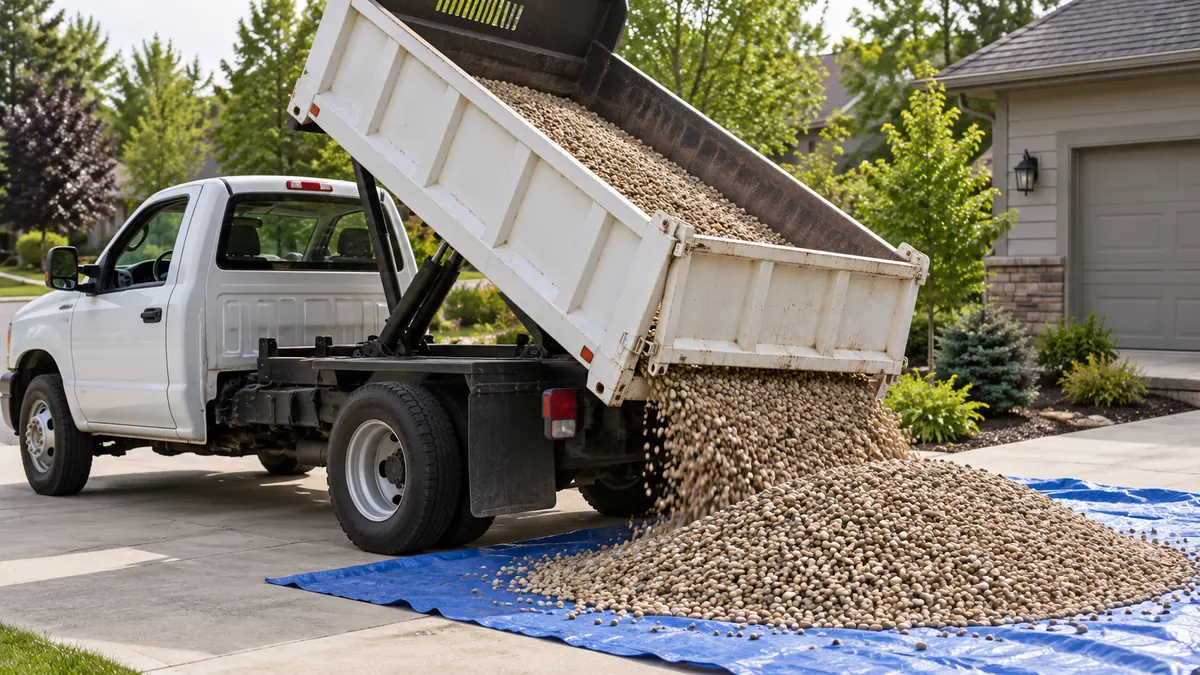
Delivery, Pickup or Bags: Which Fits Your Project?
| Amount needed | Best option | Reason |
|---|---|---|
| Under 0.5 cubic yard (about 27 bags) | Bags from a home improvement store | No delivery fee, easy to carry to the spot |
| 0.5 to 1 cubic yard | Pickup truck load from a landscape yard, or delivery | Depends on your truck payload and the delivery fee |
| 1 to 5 cubic yards | Small dump truck delivery | Too heavy for one pickup trip, well within a single-axle truck |
| 5 cubic yards and up | Tandem dump truck delivery | Lowest cost per ton, one trip |
One cubic yard of pea gravel weighs about 2,700 lb, or 1.35 tons. That number decides most delivery questions. It equals 54 bags of 50 lb each, which is why bagged gravel stops making sense quickly. The bag calculator and cost calculator let you compare both routes for your own quantity.
What Pea Gravel Delivery Costs
Suppliers price delivery separately from the material. The common structures are:
- Flat local fee: $75 to $250 within roughly 15 miles of the yard.
- Mileage beyond the local zone: $4 to $8 per additional mile.
- Fuel surcharge: often 10 to 18 percent of the delivery charge in 2026.
- Minimum load: many yards bill a minimum of 2 or 3 tons even if you order less.
- Free delivery threshold: some suppliers waive the fee above about 5 tons.
Worked example. A 12 × 16 ft patio at 3 inches deep needs 192 × 0.25 = 48 cubic feet, or 1.78 cubic yards. With a 10 percent allowance that is 1.96 cubic yards, or 2.64 tons. At $45 per ton the gravel is about $119. Add a $120 delivery fee and the total is about $239, so delivery roughly doubles the bill. The same quantity in bags would be 106 bags. At $5.98 each that is about $634, plus the trips to carry 5,300 lb home.
Because the delivery fee is fixed, order everything in one drop. Base stone and pea gravel can often share a truck if the yard has a split-bed or will make two piles from two loads on one visit. Ask. The cost guide has per-ton prices by region.
Truck Sizes and What They Carry
| Vehicle | Typical payload | Pea gravel volume | Notes |
|---|---|---|---|
| Half-ton pickup | 1,500 to 2,000 lb | About 0.5 to 0.7 cubic yard | Check the payload sticker on the door jamb |
| Three-quarter or one-ton pickup | 3,000 to 4,000 lb | About 1 to 1.5 cubic yards | Bed space is not the limit, weight is |
| Small dump trailer | Varies with trailer and tow rating | 1 to 3 cubic yards | Rental option for repeat trips |
| Single-axle dump truck | 5 to 7 tons | About 4 to 5 cubic yards | Fits most residential driveways |
| Tandem-axle dump truck | 14 to 18 tons | About 10 to 13 cubic yards | Needs more room to turn and dump |
Payloads vary by truck and by state road limits, so treat these as planning ranges and confirm with the supplier. The practical point for pickups: a level bed full of pea gravel is well over the legal payload of a half-ton truck. Load by weight, not by how full it looks. Use the cubic yards to tons converter to check a load before you drive to the yard.
What to Tell the Supplier
- Material and size. "Washed 3/8-inch pea gravel" is the usual request. Ask what color the current stock is, since it changes with the source.
- Quantity in their unit. Some yards sell by the ton and some by the cubic yard. Have both numbers ready. Multiply cubic yards by 1.35 for tons.
- Delivery address and access. Mention gates, slopes, low wires, and soft ground.
- Where to dump. Driveway, street, or a specific spot in the yard. Not every driver will leave the pavement.
- Minimum load and all fees. Ask for the delivered total in writing, including any fuel surcharge.
- Delivery window. Weekday slots are usually easier to get. In spring, order a week or more ahead.
How to Prepare for Delivery Day
- Clear a path at least 10 feet wide. Dump trucks are about 8.5 feet wide before mirrors.
- Look up. A raised dump bed can reach 20 feet or more. Keep the dump spot away from power lines, tree limbs, and roof overhangs.
- Protect what is underground. Keep the truck off septic tanks, drain fields, irrigation lines, and shallow utilities.
- Think about your driveway. A loaded tandem dump truck can weigh more than 50,000 lb. Older asphalt, thin concrete, and paver driveways can crack or rut. If in doubt, have the load dumped at the street end or on the road where local rules allow it.
- Lay a tarp or plywood. A tarp under the pile keeps stones out of the lawn and makes the last few shovelfuls easy to collect. Plywood protects pavement from scraping.
- Mark the spot. Use stakes, cones, or marking paint. Drivers often arrive when nobody is home.
- Finish the groundwork first. Excavation, edging, base, and fabric should be done before the gravel arrives, so the pile can go straight into place.
How Big Will the Pile Be?
Dumped gravel forms a rough cone. Using a slope of about 33 degrees, which is typical for loose rounded stone, the footprint works out as follows.
| Load | Weight | Approximate pile width | Approximate pile height |
|---|---|---|---|
| 1 cubic yard | 1.35 tons | 7 ft | 2.2 ft |
| 2 cubic yards | 2.7 tons | 8.5 ft | 2.8 ft |
| 5 cubic yards | 6.75 tons | 11.5 ft | 3.8 ft |
| 10 cubic yards | 13.5 tons | 14.5 ft | 4.8 ft |
Real piles spread wider and lower than a perfect cone, especially if the driver pulls forward while dumping. Allow a couple of extra feet on each side. A 5-yard load will block a single-car driveway completely.
Moving the Gravel From the Pile
A standard 6-cubic-foot wheelbarrow should carry only 2 to 3 cubic feet of gravel, which is 200 to 300 lb. At that rate one cubic yard takes 9 to 14 trips. Two cubic yards is a comfortable morning for one person over a short, level route. Five yards is a full day or a job for two people.
Use a flat-point or square shovel on a tarp or pavement, where it slides under the pile cleanly. Dump each load in small heaps across the area, then rake level. Spreading from one big heap leaves the far side thin.
Checking What You Received
Gravel sold by the ton comes with a scale ticket showing the loaded and empty truck weights. Keep it. To check a load sold by the yard, level the pile roughly, measure length, width, and average height in feet, and multiply. A result within 10 percent of the order is normal, since gravel settles in transit.
Look at the material before the driver leaves. Washed pea gravel should be mostly clean stone with little sand or clay. If it is the wrong size or visibly dirty, say so before it is dumped if you can.
Frequently Asked Questions
How much does pea gravel delivery cost?
Is it cheaper to have pea gravel delivered or pick it up?
How much pea gravel can a pickup truck carry?
How many yards of pea gravel are in a dump truck?
What is the minimum order for pea gravel delivery?
Can pea gravel be delivered in bags?
How big is a pile of 1 cubic yard of pea gravel?
Will a gravel truck damage my driveway?
Where should I have pea gravel dumped?
How long does it take to move a yard of pea gravel?
Should I order pea gravel by the ton or by the yard?
How far ahead should I order pea gravel?
Related Calculators and Guides
Cost Calculator
Material cost from your dimensions and the supplier price.
CalculatorCubic Yards to Tons
Convert the order into the unit your supplier uses.
CalculatorBag Calculator
Bag count for small jobs and top-ups.
Guide2026 Cost Guide
Per-ton and per-yard prices, bulk versus bags.
GuideCost by State
Regional price ranges across the US.
GuideHow Much Do I Need?
Quantities for common project sizes.
Sources & Methodology
- USGS: Aggregates Statistics and Information: reference data for construction sand and gravel
Weights use 100 lb per cubic foot (1.35 short tons per cubic yard) for dry, loose pea gravel. Delivery fees are typical 2026 US ranges and match the figures in the cost guide on this site. They are not quotes. Truck payloads are planning ranges, and legal limits vary by vehicle and state. Pile dimensions are calculated for a cone with a 33 degree slope: volume = 1/3 × π × radius² × height.
Last reviewed: October 6, 2026 · Full methodology